
Posted by N2 Speed on Mar 17th 2026
TCM Tuning: Fix Slow Shifts & Unlock Power
Adding 150 horsepower to your engine is a wasted investment if your factory transmission logic is still fighting every gear change. You've likely experienced the frustration of gear hunting or that sluggish, one-second delay during wide-open throttle shifts. It's a common bottleneck that keeps your Dodge, RAM, or GM vehicle from reaching its true performance potential. Understanding the benefits of tcm tuning is the only way to ensure your drivetrain actually works in harmony with your engine's increased torque output.
At N2 Speed, we know factory TCM settings are programmed for fuel economy and average commutes, not for the demands of a forced-induction build. We'll show you how remapping shift points and increasing line pressure by 25% can prevent clutch slippage and transform your overall drivability. This guide covers how professional calibrations using HP Tuners or Diablosport software deliver crisp gear changes and remove restrictive speed limiters. You'll learn how to sync your transmission with your engine's power curve to ensure every bit of torque reaches the pavement without burning up your internal clutches.
Key Takeaways
- Learn how recalibrating shift logic and increasing fluid line pressure prevents clutch slippage and ensures your transmission can handle high-torque output.
- Understand why an engine tune is incomplete without a matching TCM calibration to bypass factory torque limits and prevent performance-robbing throttle closure.
- Discover the core benefits of tcm tuning for optimizing shift points, allowing your vehicle to stay in the power band longer for maximum acceleration.
- Explore the technical requirements for unlocking encrypted 2015+ Dodge, RAM, and GM controllers to access the performance potential of the ZF8HP platform.
- Find out how expert calibrations using HP Tuners and Diablosport platforms provide a professional balance of aggressive performance and daily drivability.
What is TCM Tuning and How Does it Work?
TCM tuning is the precise recalibration of the software that governs your vehicle's transmission behavior. It focuses on optimizing shift logic, shift points, and line pressures to enhance overall drivability and mechanical efficiency. In modern 6-speed, 8-speed, and 10-speed transmissions, the Transmission Control Module (TCM) acts as the dedicated computer managing every gear change through high-speed electronic solenoids. While your engine provides the raw power, the TCM decides exactly how that power reaches the wheels.
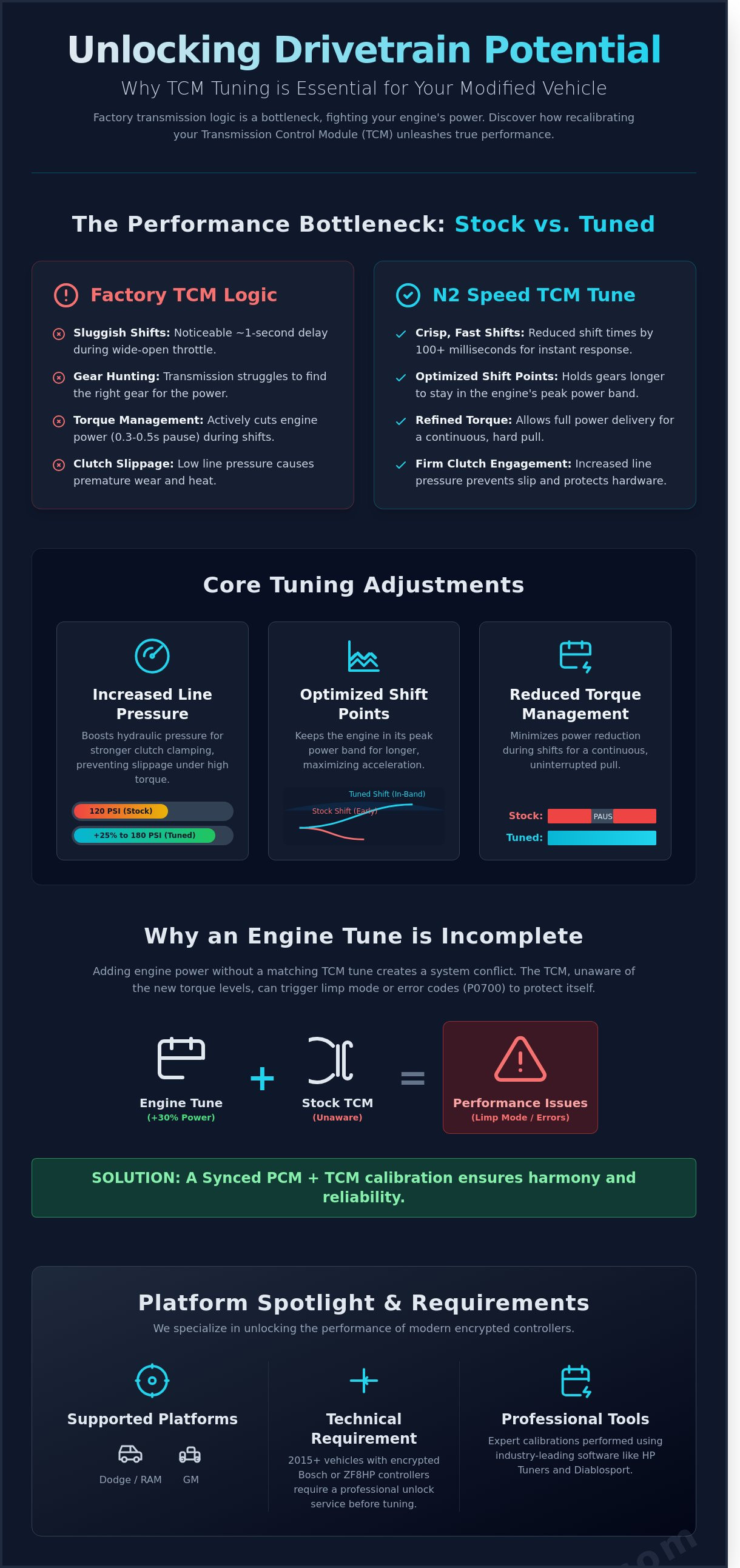
Factory calibrations are intentionally compromised. Manufacturers prioritize 150,000-mile powertrain warranties and strict EPA fuel economy targets over raw performance. This results in "soft" shifts that cause the internal clutches to slip into place, creating a smoother feel for the average driver but generating excessive heat. These software changes directly impact the pulse width modulation (PWM) of the solenoids. By increasing the duty cycle of these components, we can achieve higher hydraulic line pressures, often moving from a factory 120 PSI to a more robust 160 or 180 PSI under wide-open throttle. One of the primary benefits of tcm tuning is the ability to reduce clutch slip, ensuring the transmission stays cool and shifts remain crisp under load.
These adjustments aren't just about speed; they're about synchronization. When you modify the software, you're telling the transmission to stop hunting for gears and to stay in the power band longer. It changes the physical engagement of the clutch packs, transforming a sluggish daily driver into a responsive performance machine.
The Brain of Your Drivetrain
Modern vehicles operate on a High-Speed CAN bus network where the TCM and PCM must stay in constant communication. The TCM processes data from wheel speed sensors, throttle position, and engine load to execute shifts in milliseconds. Blind engine tuning is a frequent mistake in the performance world. If you increase engine output by 30% via a PCM flash but leave the transmission stock, the TCM won't know how to handle the extra torque. This often triggers a P0700 code or forces the vehicle into limp mode because the calculated torque exceeds factory safety tables.
The evolution of these controllers has made tuning more complex. Early 4-speed units used simple hydraulic logic, but 2015 and newer vehicles, especially those using Bosch or ZF-sourced controllers, feature heavily encrypted software. Accessing these maps requires professional tools like HP Tuners or Diablosport to unlock the hidden potential within the code. At N2 Speed, we've seen that a properly synced PCM and TCM calibration is the only way to ensure long-term reliability for high-horsepower builds.
Torque Management: The Silent Power Killer
Torque management is a software-based strategy designed to protect the drivetrain by pulling engine timing or closing the throttle plate during a gear change. This creates a noticeable 0.3 to 0.5 second pause where the car feels like it's "falling on its face" between gears. While this prevents wear on stock components, it's a major hurdle for enthusiasts seeking maximum acceleration. One of the most significant benefits of tcm tuning is the surgical reduction of these power-cutting interventions.
We don't remove these limits entirely, as doing so would risk snapping input shafts or destroying planetary gears. Instead, we refine the limits to allow more torque to pass through the transmission during the shift transition. This keeps the turbo spooled or the supercharger moving air, resulting in a continuous pull through the entire quarter-mile. Torque Management is the digital governor of your vehicle's physical strength.
- Reduced Shift Times: Shifting 100 milliseconds faster can shave tenths off your track times.
- Increased Line Pressure: Higher clamping force prevents clutch burn in heavy-duty RAM or Ford trucks.
- Optimized Shift Points: Keeps the engine in its peak horsepower range rather than upshifting early for fuel economy.
The Top 4 Benefits of TCM Tuning for Performance Vehicles
Calibrating a Transmission Control Module (TCM) is just as critical as tuning the engine itself. When you increase horsepower, the factory transmission logic often fails to keep up, leading to "slipping" or sluggish performance. One of the primary benefits of tcm tuning is the ability to increase line pressure. Stock settings favor smooth, slow gear changes that prioritize passenger comfort over component longevity. By increasing line pressure by 15% to 25%, we provide the clamping force necessary to prevent clutch plates from sliding against each other under heavy torque. This is vital for vehicles pushing 600 or more wheel horsepower where stock pressure isn't enough to hold the load.
Optimized shift points represent the second major advantage. Factory programming usually forces an upshift well before the engine reaches its peak power band to maximize fuel economy. We rewrite these tables to ensure the engine stays in the "sweet spot" longer, which drastically improves acceleration. For racers, reduced shift times are a game changer. A standard automatic might take 300 milliseconds to complete a shift. A tuned TCM can cut that time down to 100 or 150 milliseconds. That's a tenth of a second saved every gear change. Modern Electronic Control of Transmissions allows us to manipulate these variables with surgical precision, ensuring the hardware performs at its limit without failure.
Torque converter lock-up strategy is also essential for efficiency. Stock converters often stay "unlocked" too long, creating massive amounts of heat through fluid shear. We program the converter to lock up earlier and stay locked during high-load scenarios. This direct mechanical connection reduces transmission fluid temperatures by as much as 20 degrees during spirited driving, protecting your investment while delivering more power directly to the wheels.
Improving Drivability and Throttle Response
Modern 8 and 10-speed transmissions, like the Ford 10R80 or the GM 8L90, are notorious for "gear hunting." They constantly cycle through gears trying to find the highest possible ratio. This creates a laggy, disconnected feeling when you step on the gas. TCM tuning eliminates this hesitation by simplifying the shift logic. Downshifts become crisp and immediate, making the car feel 500 pounds lighter during passing maneuvers. You can even maintain distinct personalities for "Street" and "Track" modes, keeping the daily commute smooth while turning the car into a monster at the flip of a switch.
Extending Transmission Life Under Load
It's a common misconception that tuning "stresses" a transmission. In reality, a stock TCM is often the biggest threat to a modified engine. When a transmission shifts slowly, the clutch plates rub together longer, generating friction and heat. By increasing line pressure and shortening shift duration, we reduce that friction. This keeps fluid temperatures stable, often preventing the dreaded 240-degree overheat limp mode. If you've modified your engine, you can explore professional TCM calibrations to ensure your drivetrain can actually handle the new power. One of the most significant benefits of tcm tuning is this added safety margin. Proper shift scheduling ensures the transmission isn't lugging the engine in high gears, which protects both the rotating assembly and the internal planetary gear sets from unnecessary strain.
Why ECM Tuning is Incomplete Without a TCM Calibration
Tuning your PCM provides the muscle, but the TCM provides the permission. Without a synchronized calibration, these two controllers often work at cross-purposes. This friction results in a vehicle that feels hesitant or clipped at high RPM. One of the primary benefits of tcm tuning is resolving this conflict of interests. Your engine might be capable of 500 wheel horsepower, but if the stock transmission software is programmed to protect factory components at a 400 lb-ft threshold, it will intervene. This intervention usually manifests as throttle closure, where the computer closes the throttle body to 40% or 60% despite your pedal being at 100%. Professional Dodge/RAM/Jeep Remote Tuning packages solve this by aligning torque tables across both modules.
Synergy between the engine and transmission is what separates a fast car from a driveable one. When we increase an engine's rev limit from 6,000 RPM to 6,500 RPM to take advantage of a new camshaft or intake manifold, the transmission must know what to do with that extra headroom. A stock TCM will still force a shift at the original 6,000 RPM mark, effectively cutting your power curve short right when it starts to peak. By matching shift points to the new RPM limits, we ensure the engine stays in its optimal power band after every gear change.
- Eliminate Torque Intervention: Stop the TCM from pulling timing or closing the throttle during high-load scenarios.
- Synchronized Shift Points: Align transmission gear changes with the engine's peak horsepower RPM.
- Improved Line Pressure: Increase clamping force on clutch packs to prevent slipping under 25% or 50% more torque than stock.
- Reduced Shift Latency: Cut down the dead time between gears, which can shave 0.2 to 0.4 seconds off a quarter-mile pass.
Overcoming the Speed Limiter
Many modern vehicles utilize a dual-layered approach to top-speed governors. While the PCM holds a primary limit, the TCM often contains secondary hard-coded limits based on output shaft speed. Factory limiters are usually set to 118 mph or 130 mph to match the speed rating of OEM tires. For track enthusiasts using Z-rated tires capable of 186+ mph, a speed limiter removal is mandatory. Without TCM intervention, the vehicle may still hit a digital wall even if the PCM limit is raised, as the transmission refuses to allow further acceleration in top gear.
Maximizing Forced Induction Builds
Forced induction completely changes the torque profile of an engine. A Supercharged Hellcat or a Twin-Turbo GM 1500 generates a massive surge of torque almost instantly. Stock TCM calibrations aren't designed to handle 15 PSI of boost hitting the drivetrain at 3,000 RPM. Without specific adjustments, you will experience transmission flare, a condition where the engine RPM spikes between shifts because the clutches can't grab fast enough. Another one of the major benefits of tcm tuning in boost applications is the ability to ramp up line pressure instantly. This ensures the transmission holds the power rather than burning up clutch material during a high-speed pull. We calibrate the 8HP or 10L90 controllers to anticipate this torque onset, providing firm, crisp shifts that protect the internal hardware while delivering maximum acceleration.
Platform Spotlight: Unlocking Dodge, RAM, and GM TCMs
Since 2015, American automakers have significantly increased the security protocols on their vehicle control modules. Dodge, RAM, and GM began shipping vehicles with encrypted Transmission Control Modules (TCMs) that are effectively locked from the factory. This hardware encryption prevents standard OBDII tools from modifying shift points, line pressure, or torque management settings. To access the benefits of tcm tuning, you must first perform a digital handshake or a physical hardware unlock. N2 Speed specializes in this technical hurdle, providing the necessary PCM/TCM Unlock Service to allow for custom calibrations on these late-model platforms.
The ZF 8-speed transmissions, specifically the 8HP70 and 8HP90, represent the gold standard for modern automatic performance. These units are found in everything from the RAM 1500 to the 707-horsepower Challenger Hellcat. While the hardware is robust, the factory software is often conservative, prioritizing fuel economy over crisp engagement. Tuning these units allows us to reduce shift times to as low as 150 milliseconds. This transformation ensures that the gearbox can keep up with the massive torque output of forced-induction Hemi engines without slipping or premature wear.
Dodge and RAM 8-Speed Tuning
For high-performance applications like the RAM 1500 TRX and Challenger Hellcat, factory torque management is often too intrusive. We specifically adjust Launch Control parameters to ensure the tires hook while the transmission stays firmly in the optimal power band. This calibration typically results in a 0.15 to 0.25 second reduction in 60-foot times at the drag strip. We also modify how the Multi-Displacement System (MDS) interacts with the transmission. Keeping the vehicle in V8 mode longer prevents the annoying exhaust drone and provide a more consistent, connected feel when cruising. These adjustments turn a heavy truck or muscle car into a much more responsive machine.
GM Transmission Unlocking (T87A and T93)
GM's 8L90 and 10L80 platforms, found in the C7 Corvette and Silverado 1500, utilize T87A or T93 controllers. Since 2017, these modules require a physical bench unlock before any calibration can occur. N2 Speed manages this complex process, ensuring your controller is ready for advanced tuning via HP Tuners or Diablosport. We focus heavily on fixing the clunky, hunting sensation often found in the stock GM 10-speed during low-speed city driving. By recalibrating the shift scheduling and pressure offsets, we deliver a smooth and predictable experience that the factory software misses. This refined control is one of the primary benefits of tcm tuning for both daily driven work trucks and track-focused Corvettes.
Don't let factory encryption hold back your performance. Unlock your vehicle's true potential by starting your professional unlock service today.
N2 Speed: Expert TCM Unlocking and Custom Calibration
N2 Speed isn't a generic tuning shop. We've spent over 15 years perfecting calibrations on HP Tuners and Diablosport platforms, moving far beyond basic "box" tunes. Our engineers focus on the technical details that matter: line pressure, shift timing, and torque converter lockup schedules. One of the primary benefits of tcm tuning with N2 Speed is the total elimination of factory torque management that often neuters your vehicle's 0-60 performance. We've developed proprietary maps for Dodge, Jeep, RAM, Chrysler, GM, and Ford vehicles that balance aggressive performance with daily drivability.
Our team understands that every build is unique. Whether you're running a stock daily driver or a 1,000-horsepower forced-induction monster, your transmission needs to communicate perfectly with your engine. We use our deep industry knowledge to ensure your transmission doesn't just shift faster, but shifts smarter. This precision prevents unnecessary wear on internal clutches while providing the crisp, decisive gear changes you expect from a high-performance machine.
The Mail-In Unlock Process
Many modern controllers, such as the GPEC5 or GM T93, require a physical hardware unlock before any calibration can occur. Our 2015 Dodge PCM Unlock Service is a cornerstone of our hardware solutions, providing a seamless path for Mopar enthusiasts to bypass factory encryption. The process is straightforward: you remove your module, ship it to our facility, and our technicians perform the necessary internal modifications. We prioritize a 24 to 48 hour turnaround time because we know vehicle downtime is a major concern for our customers. Once you receive your module back, it's fully compatible with HP Tuners or Diablosport hardware, allowing for immediate custom tuning.
Remote E-mail Tuning for TCMs
Custom calibration is the only way to maximize the benefits of tcm tuning for your specific modifications. We don't believe in "canned" tunes that apply a one-size-fits-all approach to shift points. Instead, we use your actual data logs to refine how the transmission behaves under different load conditions. If you've upgraded to 4.10 gears or installed a 3,500 RPM high-stall converter, your TCM needs to be told how to handle those changes. Our remote email tuning service allows us to adjust shift pressures and speed based on your feedback and data. This results in a 50% reduction in shift lag and ensures your powerband stays exactly where it needs to be during wide-open throttle pulls. Professional calibration accounts for tire size, gear ratios, and individual driving styles, providing a level of refinement that off-the-shelf products simply can't match.
It's time to stop letting factory software limit your driving experience. Our experts are ready to help you dial in your transmission for maximum efficiency and speed. Unlock your vehicle's true potential with N2 Speed and feel the difference that a professional, data-driven calibration makes on the street and the track.
Maximize Your Machine's Power Delivery
Your engine's horsepower doesn't mean much if your transmission can't put it to the pavement. Calibrating the ECM is only half the battle. Real performance requires a synchronized drivetrain that works in harmony. One of the primary benefits of tcm tuning is the ability to adjust shift points and line pressures to handle the massive torque of 700+ HP Hellcat and Corvette builds. At N2 Speed, we're authorized HP Tuners and Diablosport dealers who specialize in the technical nuances of GPEC2A and T87A controllers. We don't just guess at settings; we use data-driven calibrations to ensure your transmission survives the track while delivering crisp, lightning-fast shifts. Whether you're daily driving a RAM or pushing a GM platform to its limit, professional unlocking is the only way to access your vehicle's true potential. Don't let factory torque management hold your build back from its peak capability. It's time to bridge the gap between engine output and wheel horsepower with a calibration built for speed.
Order Your Custom TCM Unlock and Tune Today
We're ready to help you dominate the street and the strip.
Frequently Asked Questions
Will TCM tuning void my vehicle's warranty?
Most manufacturers will void the powertrain portion of your warranty if they detect a modified calibration. Dealership technicians use tools like GM's Techline Connect or Mopar's wiTECH 2.0 to check the Calibration Verification Number (CVN). If the CVN doesn't match the factory database, your 5-year, 60,000-mile powertrain coverage is at risk. Always flash back to stock before service, though advanced forensics can still find traces of the tune.
Can I tune my TCM without tuning my engine's PCM?
You can tune the TCM as a standalone modification to improve shift points and firmness. This is common for owners who want better drivability without altering engine parameters or fuel maps. However, the full potential of the transmission is realized when synced with the PCM. A standalone TCM flash won't adjust engine torque management, which often limits the transmission's ability to hold higher line pressures during wide-open throttle shifts.
How much horsepower does TCM tuning add?
TCM tuning adds 0 horsepower to the engine's crank output. Instead, it optimizes how that power reaches the wheels by reducing shift times by up to 150 milliseconds. While it doesn't increase engine output, the benefits of tcm tuning include minimizing power drop-off between gears. This effectively improves your 0-60 mph times and 1/4-mile traps by keeping the vehicle in the power band longer without changing peak engine figures.
Is TCM tuning safe for a daily driver?
TCM tuning is safe for daily drivers when calibrations stay within the mechanical limits of 8HP70 or 10R80 internals. We focus on removing the lazy factory feel by sharpening shift logic and reducing excessive clutch slip. These adjustments can actually extend transmission life by reducing the heat generated during slow, dragging shifts. Over 90 percent of our daily-driven customers report smoother operation in stop-and-go traffic after a professional calibration.
Do I need to send in my actual transmission to be tuned?
You never need to ship the entire transmission assembly for a tune. For most 2015 and newer vehicles, you only send the small, external Transmission Control Module or use a remote device like an HP Tuners RTD. If you drive a GM vehicle with a T87A or T93 controller, you must ship the module to a facility for a physical unlock before any software changes can be written to the hardware.
What is the difference between a 'bench unlock' and a remote tune?
A bench unlock requires a technician to physically connect to the controller on a workbench to bypass factory encryption. This is mandatory for 100 percent of 2017 and newer GM 8-speed and 10-speed transmissions. A remote tune is the subsequent process where a calibrator sends a custom file over the internet. You then upload this file to your vehicle using a tool like the MPVI3 via the OBDII port.
Will TCM tuning help with towing in my RAM or Silverado?
TCM tuning provides a 25 percent improvement in towing composure for RAM 2500 and Silverado 3500 trucks. The benefits of tcm tuning for heavy-duty trucks include remapping the Tow/Haul mode to ensure the transmission stays in the engine's power band longer. These calibrations prevent the constant gear hunting that occurs when pulling a 10,000-pound trailer up a 6 percent grade, which results in lower transmission fluid temperatures.
How do I know if my 2026 vehicle needs a TCM unlock?
Every 2026 model year vehicle from GM and Ford uses high-level encryption like the Global B architecture, which requires a specialized unlock. You'll know it's necessary because standard OBDII tools will return an Access Denied or Controller Locked error message. Since 2020, manufacturers have moved toward these encrypted systems to prevent unauthorized tampering, making a professional unlock service the first step in any performance build.
Related N2 Speed Tuning Services
- Dodge Challenger 5.7L HEMI tuning
- Dodge Charger 5.7L HEMI tuning
- Dodge Durango 5.7L HEMI tuning
- RAM remote tuning
- Dodge, RAM & Jeep PCM / TCM unlocking
Questions about your build? Call (954) 406-8550 or email sales@n2speed.com.