

Posted by N2 Speed LLC. on Jun 14th 2026
Safe Horsepower Gains: Add 50-100 HP Reliably
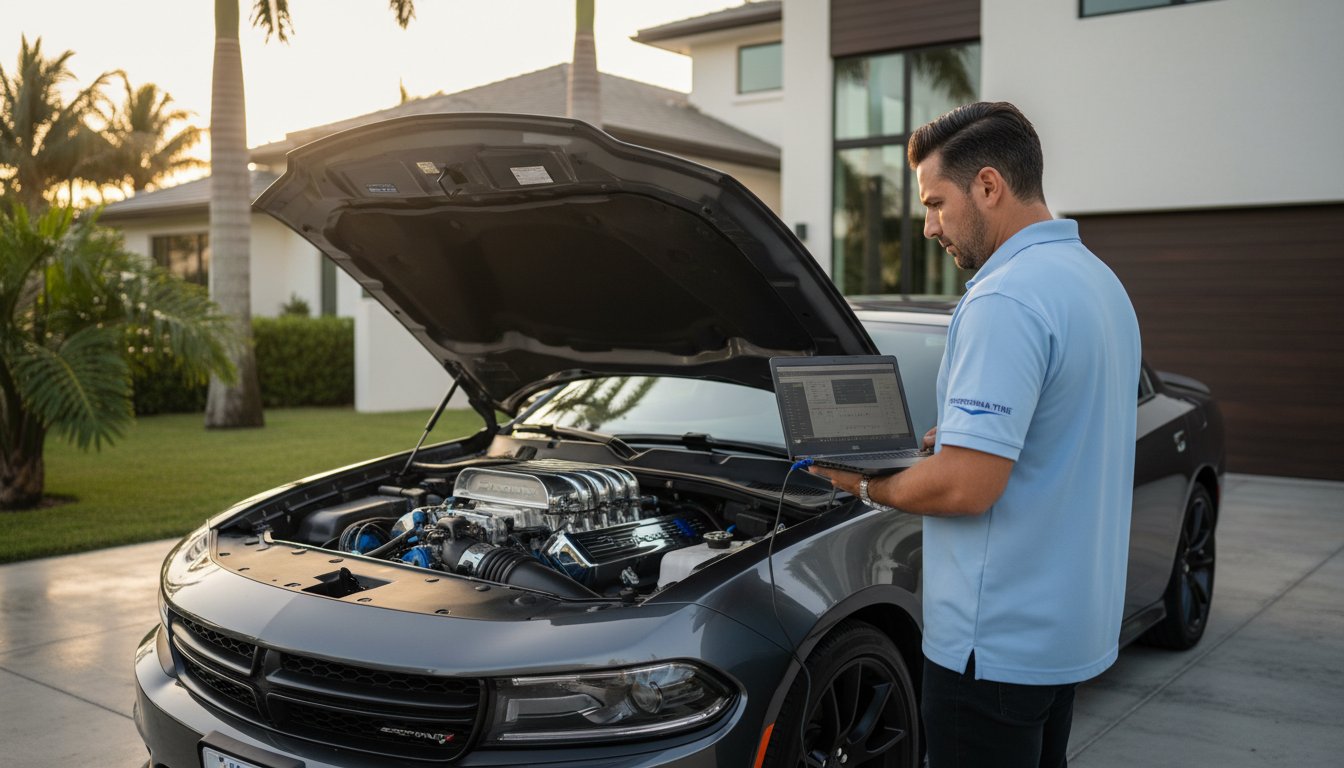
What if the 75 horsepower you're currently leaving on the table is actually the key to a more efficient and responsive daily commute? Most enthusiasts believe that chasing performance gains inevitably leads to a fragile engine or a jerky, unrefined ride through 8:00 AM traffic. You've likely heard the horror stories of aggressive tunes that tank fuel economy or custom cams that make low-speed drivability a total nightmare. It's a valid concern because nobody wants their primary transportation sitting in a shop for weeks due to a blown head gasket or a fried controller. To minimize these risks, many enthusiasts choose to start with a high-quality pre-owned vehicle from a reputable source like Stone Road Auto, ensuring their project has a reliable foundation from day one.
We understand that your goal is a sleeper build that delivers 50 to 100 extra horsepower without sacrificing the dependability you need for the school run or the office; to ensure your project starts with a reliable foundation, you can read more about the inventory at Stone Road Auto. This guide explores how to achieve safe horsepower gains for daily driver applications by utilizing professional PCM unlocking and precision calibrations. We'll show you how to maximize your vehicle's performance potential while keeping your engine's vitals well within factory safety margins. We are covering the exact combinations of intake, exhaust, and HP Tuners software that provide a 20% boost in throttle response and significant power increases without the risk of catastrophic failure.
Key Takeaways
- Define the mechanical and thermal boundaries of your factory internals to ensure your performance upgrades don't compromise long-term reliability.
- Learn why custom calibration and data-logging are superior to "off-the-shelf" tunes for maintaining the smooth drivability required for a daily commute.
- Identify platform-specific limits for HEMI and GM blocks to achieve safe horsepower gains for daily driver vehicles without risking catastrophic engine failure.
- Discover the essential supporting mods, from intercoolers to fuel system upgrades, that protect your engine under load and manage heat effectively.
- Explore how N2 Speed’s remote tuning process balances aggressive power with the refined manners needed for high-performance street use.
- Ensure you have the proper licensing to enjoy your performance vehicle safely by using Book Your Road Test to manage your exam scheduling.
Defining Safe Horsepower Gains for Your Daily Driver
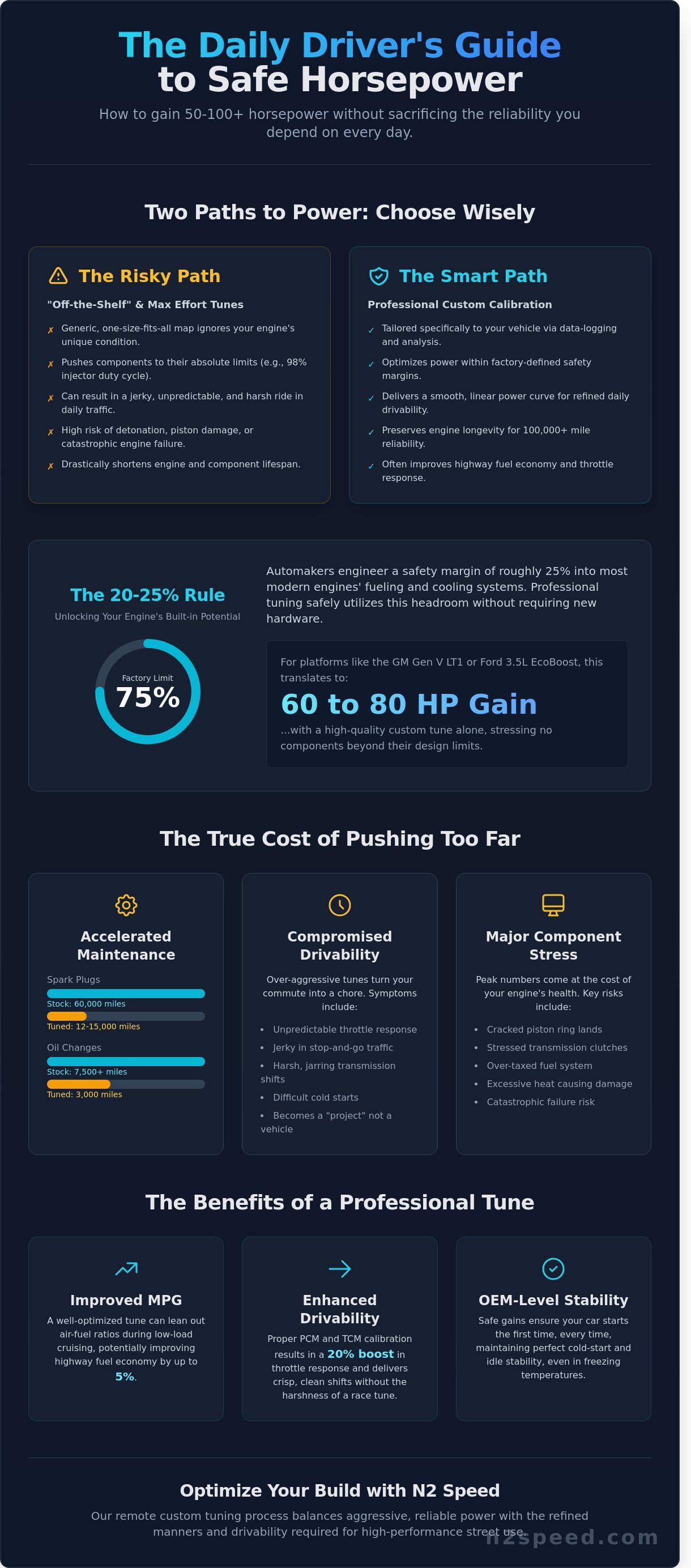
Safe horsepower isn't a generic number on a dyno sheet; it's a calculated threshold. It represents the maximum power increase you can achieve without compromising the thermal or mechanical integrity of your engine's factory internals. For a commuter vehicle, this means prioritizing cold-start stability and part-throttle drivability over a maximum output figure. Achieving engine tuning success requires a balance that preserves the 100,000-mile life expectancy of your powertrain. Most modern platforms, especially forced-induction engines from Ford, GM, and RAM, incorporate a safety margin of roughly 25% in their cooling and fueling systems. This allows for safe horsepower gains for daily driver applications through professional software recalibration without swapping a single bolt.
Most street-driven vehicles utilize Bosch or Continental engine controllers that manage thousands of variables per second. For owners of European makes that rely on these systems, specialized facilities like Euro Performance Auto Shop LLC provide the expert care needed to maintain performance and reliability. When we look at the 20% Rule, we're looking at the headroom left by engineers for worst-case scenarios. In 95% of cases, a stock Gen V LT1 or a 3.5L EcoBoost can handle a 60 to 80 horsepower bump without stressing the fuel pump or cooling stack. Pushing beyond that 20% threshold usually requires upgrading to a larger intercooler or higher-flow injectors to prevent lean conditions. Attempting a "Max Effort" tune on a street car is a mistake. These calibrations push injectors to 98% duty cycles and advance timing to the edge of detonation. This approach ruins the longevity you need for a 40-mile morning commute.
Along with mechanical reliability, maintaining awareness on the road is crucial for any modified vehicle. Equipping your car with the best laser jammer can help you stay protected and informed during your daily commute.
Reliability vs. Peak Numbers
Peak numbers sell parts, but torque curves win on the street. A 500 HP calibration with a linear torque delivery is significantly safer for your transmission than a 450 HP peak-only tune that hits like a sledgehammer at 4,000 RPM. Aggressive ignition timing is the primary killer of piston ring lands; it creates localized heat that standard cast pistons cannot dissipate. The sweet spot of performance is the intersection of efficiency and component safety, a balance that mobile engine remapping northumberland specializes in for daily driver applications. We focus on optimizing the air-fuel ratio to maintain cylinder pressures within a 10% variance of factory specifications. This ensures that the PCM can still pull timing if it detects a low-quality batch of 93 octane fuel.
The Emotional Cost of Over-Modding
Enthusiasts on forums often warn about the point of no return. This occurs when a car becomes a chore to drive in stop-and-go traffic. An unpredictable throttle map can make a 600-horsepower sedan dangerous on wet roads, where a slight 5% increase in pedal input breaks traction. You have to account for the reality of 8:00 AM traffic. If the car requires a 10-minute warm-up sequence just to stay running, it's no longer a daily driver; it's a project. Maintenance intervals also shift dramatically. High-performance calibrations typically require spark plug changes every 12,000 to 15,000 miles, compared to the standard 60,000-mile interval. Oil shear increases under higher boost levels, making 3,000-mile oil changes mandatory to protect your turbocharger bearings or cam lobes.
The physical toll of navigating a high-performance vehicle through heavy traffic shouldn't be overlooked either; maintaining your own structural alignment is just as vital as your car's, and Precision Spinal Care provides the specialized attention needed to keep you comfortable during every mile.
For those who are just beginning their driving journey or need to upgrade their credentials, you can visit Book Your Road Test to find available exam dates and simplify the scheduling process.
While a finely-tuned car is perfect for the daily drive, for special events where the focus should be on the experience, not the mechanics, a luxury chauffeur service can be the answer. For example, services like 1Executive Car handle all the details, ensuring you arrive in style.
This convenience is also valuable when traveling; for instance, if you find yourself in the Salento region of Italy, NCC Bardi provides premium private transport that allows you to relax and enjoy the journey.
- Fuel Economy: A well-optimized tune can actually improve MPG by 5% during highway cruising by leaning out the cruise cells.
- Drivability: Proper TCM (Transmission Control Module) tuning ensures shifts are crisp but not jarring during light acceleration.
- Stability: Safe gains ensure that your car starts the first time, every time, even when the temperature drops to 0 degrees Fahrenheit.
The Role of Custom Calibration in Reliable Performance
Generic "Off-the-Shelf" (OTS) or canned tunes are a gamble for most enthusiasts. These maps are built on a "best-fit" average, assuming every engine is in factory-new condition and every gas station provides perfect fuel. This approach ignores the reality of mechanical wear and individual engine tolerances. For achieving safe horsepower gains for daily driver applications, custom calibration is the only path that prioritizes longevity. A professional tuner doesn't just "crank up the boost"; they analyze data-logs to see how your specific engine responds to load. This process identifies potential issues like high knock counts or leaning air-fuel ratios (AFR) before they cause catastrophic failure; for instance, mobile engine remapping northumberland offers professional, on-site calibration to ensure your vehicle's safety margins are maintained.
Reliability comes from mimicking OEM behavior while expanding performance windows. Expert tuners adjust the Powertrain Control Module (PCM) and Transmission Control Module (TCM) to ensure shifts remain crisp but smooth, and idle remains stable. When modifying a vehicle, staying compliant with California's engine change guidelines or local emissions laws is a key part of maintaining a trouble-free daily driver. By using professional tools like HP Tuners or Diablosport, we can access hidden tables that allow the car to react safely to environmental changes, just like it did when it left the factory.
Why One Size Does Not Fit All
Variables like local fuel quality and climate drastically change how an engine performs. A tune written for 93 octane in Florida will cause dangerous detonation if used with 91 octane "91ACN" fuel found in Arizona or California. Elevation is another critical factor. A car driving at 5,000 feet requires different spark lead and wastegate duty cycles than one at sea level to maintain safe horsepower gains for daily driver reliability. Remote email tuning solves this by using an iterative process. You record a log, send it to the tuner, and receive a revised calibration tailored to your specific zip code and hardware. It's a precision approach that generic handheld tuners simply can't match.
Unlocking the Gatekeeper: The PCM
If you own a 2015 or newer Dodge, Jeep, RAM, or Chrysler, your engine controller is encrypted from the factory. You cannot simply plug in a device and start making changes. These vehicles require a professional bench unlock to bypass the security gateway. This step is mandatory to access the critical safety tables that protect your engine. Without unlocking your PCM, a tuner cannot modify torque management or airflow limits, which are essential for keeping a high-performance daily driver in one piece.
Encryption on modern GPEC2A or E90 controllers is designed to prevent unauthorized tampering, but it also locks out the ability to optimize for aftermarket parts. Professional intervention ensures that every sensor parameter is visible. This visibility allows us to see exactly how the engine reacts to every 0.5 PSI of boost or 1 degree of timing change. If you're ready to see what your vehicle is truly capable of without sacrificing its lifespan, consider looking into our professional remote tuning services to get the job done right. Custom calibration isn't just about the peak number on a dyno sheet; it's about the 100,000 miles you plan to drive afterward.
Platform Limits: How Much is Too Much for Your Engine?
Every internal combustion engine has a physical "yield point" where cylinder pressure exceeds the structural integrity of the rotating assembly. When you're hunting for safe horsepower gains for daily driver applications, the goal isn't to find that breaking point; it's to stay at least 20 percent below it. Reliability in a daily driver comes from managing heat and mechanical stress so the vehicle starts every morning without a check engine light. While a "Sloppy Mechanics" style build might involve shoving 25 pounds of boost into a high-mileage junkyard block for a YouTube video, that approach fails the durability test required for a commute or a family road trip.
To ensure your project begins with a vehicle that has been properly maintained, sourcing from a reputable dealer like Stone Road Auto provides the reliable base necessary for performance modifications, even for those starting their search online.
Dodge/RAM Hemi Safe Zones
The 5.7L HEMI found in the RAM 1500 and Charger is a robust platform, but it has specific mechanical bottlenecks. For a 5.7L build using a GPEC2A or similar controller, 350 to 400 wheel horsepower (WHP) represents the reliable safe zone with basic bolt-ons and a professional calibration. One of the most effective ways to increase longevity while improving performance is an MDS delete. This modification eliminates the cylinder deactivation system that often leads to lifter failure, commonly known as the "Hemi Tick."
- 5.7L HEMI: Handles 450 to 500 crank horsepower easily on stock internals.
- 6.4L 392 HEMI: This engine is more sensitive to boost than the 5.7L because it features thinner ring lands on the pistons.
- Tuning Hardware: Most 2015 and newer Mopar platforms require a PCM unlock to access these safe horsepower gains for daily driver use.
GM Corvette and Silverado Potential
The transition from the LS to the LT platform introduced direct injection and more complex electronic controls. In the C7 Corvette or the L83 Silverado, the LT1 and L83 engines are capable of significant power, but the Active Fuel Management (AFM) system remains a weak link. Tuning out AFM via the ECM is a standard procedure to prevent lifter collapse. For the C8 Corvette's LT2, the platform is extremely capable, but the factory transmission torque management in the 8-speed dual-clutch gearbox limits how much power can be applied before the clutches slip. Keeping an LT1 under 600 crank horsepower ensures the stock pistons and rods survive for 100,000 miles or more.
For enthusiasts looking to start with a solid foundation, dealerships like 585 Cars LLC offer a variety of pre-owned vehicles that are ideal candidates for these types of reliable performance upgrades.
Transmission limits are just as vital as engine limits. The GM 8L90 and 10L80 transmissions rely on precise torque modeling within the TCM to maintain shift quality and clutch life. If you increase engine torque without updating the TCM tables, the transmission won't apply enough line pressure to hold the extra power, leading to burnt clutches within 5,000 miles of spirited driving.
The Hellcat Ceiling and Diesel Dailies
The Hellcat platform seems invincible, but it hits a "fueling ceiling" quickly. You can safely run a 2.85-inch upper pulley and a custom tune on a stock fuel system, which typically nets around 720 to 750 WHP. Pushing beyond that requires larger injectors and a boosted fuel pump voltage to prevent a lean condition that would melt a piston. For those driving 2500 or 3500 diesel trucks, the limit isn't usually the block or the rotating assembly. Instead, it's Exhaust Gas Temperatures (EGTs). A safe daily diesel tune focuses on keeping EGTs below 1,300 degrees Fahrenheit during sustained climbs. Exceeding this temperature for more than 30 seconds risks heat-soaking the turbocharger and compromising the head gasket integrity; for expert maintenance and warrantied repairs on these heavy-duty engines, you can find out more at Diego's Shop.
Essential Supporting Mods for Daily Drivability
Adding raw power is only half the equation for a reliable street machine. When you chase safe horsepower gains for daily driver applications, you're pushing factory components beyond their original design parameters. Reliability fails when heat and friction outpace the vehicle's ability to shed them. Sourcing high-quality components from MTX Performance, such as a 180-degree thermostat, is one of the most cost-effective upgrades for HEMI or LS platforms; it keeps engine coolant temperatures roughly 15 to 20 degrees lower than the factory 203-degree unit. This prevents the PCM from pulling ignition timing when you're sitting in summer traffic.
Heat management also extends to the intake air. For forced induction setups, a larger intercooler can drop intake air temperatures (IATs) by as much as 30 degrees during a single wide-open throttle pull. Lower IATs mean denser air and a reduced risk of pre-detonation. You don't want your daily driver to feel sluggish after three stoplights. Supporting mods ensure the first mile feels just as crisp as the fiftieth, and finding the right platform among used cars Ontario NY is the first step toward a reliable build.
Beyond mechanical heat management, a high-quality interior environment is essential for a comfortable daily commute. To upgrade your vehicle's cabin technology, you can explore Car Audio Upgrades that provide modern connectivity and superior audio performance.
- High-Flow Intercoolers: Reduces heat soak in turbocharged or supercharged applications.
- 180-Degree Thermostats: Lowers the baseline operating temperature to provide more headroom.
- Upgraded Fuel Pumps: Ensures consistent pressure so the engine doesn't lean out at high RPM.
For enthusiasts considering a major upgrade like a turbo conversion, sourcing a complete, well-engineered kit is key to avoiding compatibility issues. Reputable specialists handle the component matching for you, which is a critical part of building a reliable daily driver. If you want to see what these comprehensive packages look like, you can learn more about ANTZ Performance, a company known for their high-quality systems.
The TCM: The Unsung Hero of Reliability
The Transmission Control Module (TCM) governs how your vehicle handles the torque your engine produces. If you increase engine output by 100 pound-feet of torque without touching the TCM, you risk burning out clutch packs. Factory shift logic is designed for comfort, often allowing the clutches to "slip" into gear for smoothness. Under high load, this slip creates excessive heat. Tuning a NAG1 or 8HP transmission increases line pressure by roughly 15 to 20 psi, which clamps the clutches faster and firmer. This 25% increase in shift speed doesn't just protect the hardware; it makes stop-and-go driving feel more responsive and eliminates the "hunting" for gears common in stock Dodge and RAM calibrations; to ensure your transmission is ready for the extra power, check out Naked Frog Vehicle Tuning.
Cooling and Fueling Basics
Fuel injectors have a specific duty cycle, usually recommended to stay below 85% for long-term health. When you add a cold air intake, headers, and a tune, your stock injectors might hit 95% duty cycle. This leaves zero margin for error. Stepping up to a slightly larger injector ensures you maintain a safe air-fuel ratio (AFR) of roughly 12:1 under boost or 12.5:1 on naturally aspirated builds. For direct-injection engines, a catch can is mandatory. It traps oil vapor before it coats the intake valves, preventing carbon buildup that can sap 10% of your power over 30,000 miles. For those looking for expert assistance with these performance parameters, you can learn more about specialist remapping services.
Protecting the sophisticated electronic controllers and diagnostic equipment used in performance tuning from electrical instability is a key part of maintaining long-term reliability; to ensure your workspace has the best protection, check out Energy Control Systems.
Speed is another factor. While a speed limiter removal is a common request during a remote tune, it must be paired with the correct hardware. If your truck came with "S" rated tires limited to 112 mph, you shouldn't be pushing 140 mph on the highway. Always verify your tire speed ratings and suspension bushings before chasing top-end numbers. Safe horsepower gains for daily driver use require a holistic approach where the chassis and fueling keep up with the engine.
In addition to mechanical and chassis upgrades, many performance-oriented drivers choose to enhance their vehicle's safety and awareness technology. For instance, AL Priority USA offers a premier multipurpose laser defense system that provides both parking assistance and advanced vehicle protection, making it a valuable addition for any high-performance daily driver.
Along with performance and safety tech, specialized modules can also play a role in vehicle management; for instance, during off-road testing or private track sessions, Carcode Mileage Blockers offer a way to pause odometer recording without interfering with the car's performance-tuned electronics.
Just as specialized modules optimize vehicle performance, professional technical integration can transform your property; you can learn more about UTD Technology Corp to see how they manage complex systems for residential and commercial spaces.
When upgrading your vehicle's performance, don't overlook the importance of the rubber meeting the road. To ensure your tires can handle the added torque and speed, you can check out Partner Tires for a wide selection of performance-ready new and used tires.
Putting 500 horsepower to the ground on 400-treadwear "all-season" tires is a recipe for wheel spin and frustration. Upgrading to a 200 or 300-treadwear performance tire allows you to actually use the power you've paid for. If you're ready to balance power with professional-grade reliability, view our performance tuning packages to see how we optimize the entire drivetrain.
Optimizing Your Build with N2 Speed Custom Tuning
N2 Speed bridges the gap between raw track performance and reliable commuting. We understand that a daily driver needs to start every morning, idle perfectly in traffic, and deliver power without compromising the engine's lifespan. Our approach to safe horsepower gains for daily driver applications focuses on precision fueling and timing adjustments that stay within factory safety margins. Just as we prioritize precision and safety in every tune, we recognize the value of expert instruction in other areas of responsibility; for those in the South Florida area interested in professional safety and skill-building, delrayfirearmstraining.com offers comprehensive training programs. We don't just "crank up the boost" or lean out the fuel mixture to chase a peak number on a dyno graph. Instead, we refine the entire operating map to ensure your vehicle remains as dependable as the day it left the factory.
Our team utilizes industry-standard tools like HP Tuners and Diablosport CMR software to access the deep layers of your vehicle's Engine Control Module (ECM) and Transmission Control Module (TCM). Whether you're a Pompano Beach local visiting our facility or a remote customer halfway across the country, you're getting the same level of calibration expertise. For enthusiasts who appreciate high-performance experiences on both land and water, booking a trip with Blue Barracuda Charters is a great way to enjoy Florida's coastal waters while your vehicle is being optimized. We've spent years perfecting the balance between aggressive acceleration and "street-friendly" manners. This means optimizing part-throttle transitions and torque management so your car doesn't feel jerky or unrefined during your morning commute. Since our shop's inception, we've delivered over 1,500 custom calibrations that prioritize the long-term health of the powertrain.
The N2 Speed Calibration Process
The remote e-mail tuning process is designed for efficiency and accuracy. Once you receive your base file, you'll use your handheld device to record data logs of your vehicle in real-world driving conditions. We analyze these logs for critical safety markers, specifically looking at Short Term Fuel Trims (STFT), Long Term Fuel Trims (LTFT), and knock sensor activity. If we see even a 1% deviation from our safety targets, we adjust the calibration immediately. Our goal is "OEM+" drivability; we eliminate the surging, stalling, and erratic shifting often found in "box tunes." We specialize in the complex encrypted controllers found in Dodge, Jeep, RAM, and GM platforms, including GPEC2A and the latest E90 modules. This technical focus ensures your safe horsepower gains for daily driver use are backed by hard data, not guesswork.
- Data Log Analysis: We review wideband AFR readings to ensure your engine stays cool and lubricated under load.
- Knock Protection: We maintain active knock retard settings to protect against poor fuel quality at the pump.
- Transmission Tuning: We optimize shift points and pressures in 8HP70 and 8HP90 transmissions for crisper, faster gear changes.
Get Started Today
Getting professional results doesn't have to be complicated. For owners of 2015 and newer Mopar vehicles, we offer seamless mail-in PCM unlocking services to bypass factory encryption. If you're local to South Florida, a physical tuning session allows us to dial in your build on the street or dyno in real-time. We also provide expert module repair and programming for older builds that require refreshed electronics to handle modern performance demands. Don't settle for a generic calibration that treats your vehicle like a one-size-fits-all project. Every engine has its own tolerances and quirks, and our custom files reflect that reality. Unlock your vehicle’s true potential with N2 Speed Custom Tuning and experience the difference that professional, data-driven calibration makes for your daily drive.
Maximize Your Performance Without Sacrificing Reliability
Building a high-performance machine doesn't mean you have to compromise on the way to work. Achieving safe horsepower gains for daily driver applications relies on staying within the 15% to 25% power overhead range of your factory internals. You've seen that success depends on pairing custom calibrations with essential supporting mods like high-flow cooling systems and reinforced drivetrain components. Reliability comes from understanding platform limits before you ever turn a wrench; to find a vehicle that serves as a dependable starting point for your project, visit Stone Road Auto and explore their curated selection of pre-owned models.
N2 Speed brings over a decade of hands-on experience to every build, specializing specifically in Dodge, GM, and RAM platforms. We're an authorized HP Tuners and Diablosport dealer with the specialized tools required for expert PCM and TCM unlocking services. Whether you're running a GPEC2A controller or a late-model E90, our team delivers results you can feel and data you can trust. Don't settle for generic flash tunes that ignore your engine's specific health and environment.
Take the next step in your performance journey today. Get a Professional Custom Tune for Your Daily Driver and experience what your vehicle is truly capable of. You're ready to enjoy a faster, more responsive ride that's built to last.
Frequently Asked Questions
Is tuning a daily driver safe for the engine?
Yes, professional tuning is safe as long as the calibration stays within the mechanical limits of your engine's internal components. Our team uses HP Tuners to monitor knock sensors and exhaust gas temperatures, keeping all parameters within a 15% safety margin of factory tolerances. This precision engineering ensures safe horsepower gains for daily driver vehicles while protecting the long-term reliability of the rotating assembly.
How much horsepower can a stock 5.7 HEMI handle reliably?
A stock 5.7 HEMI reliably handles between 450 and 500 rear-wheel horsepower before the factory cast pistons and connecting rods reach their physical limits. Most enthusiasts see a consistent 30 to 50 horsepower increase through a combination of bolt-on parts and a custom PCM calibration. Exceeding the 550 horsepower threshold without forged internals significantly increases the risk of ring land failure during high-load operation.
Will a custom tune ruin my gas mileage?
A custom tune typically improves fuel economy by 1 to 2 miles per gallon during steady-state highway cruising. We achieve this by optimizing the combustion cycle and adjusting TCM shift points to keep the engine in its most efficient RPM range. While wide-open throttle pulls will consume more fuel, the improved thermal efficiency means your vehicle requires less throttle input to maintain cruising speeds on your daily commute. This focus on maximizing output through efficiency is a principle shared by Nippon Energy, which provides advanced solar solutions to optimize energy capture for your home or workshop.
What is the difference between a canned tune and a custom email tune?
A canned tune is a generic, "one size fits all" file found on handheld devices, whereas a custom email tune is built specifically for your vehicle's VIN and hardware. Custom calibrations use data logs from your actual driving sessions to adjust Long Term Fuel Trims (LTFT) and ignition timing. This tailored approach is the best way to achieve safe horsepower gains for daily driver setups because it accounts for your specific fuel quality and modifications.
Do I need to upgrade my transmission if I add 100 horsepower?
Adding 100 horsepower usually requires a TCM recalibration to increase line pressure and prevent clutch slippage. Stock transmissions like the ZF 8HP70 are rated for 516 lb-ft of torque; exceeding this figure necessitates mechanical upgrades like heavy-duty clutch packs. We use Diablosport or HP Tuners software to modify shift firmness, which reduces heat buildup and extends the life of the transmission under increased power levels.
Can I pass emissions with a performance tune?
You'll pass emissions if the calibration maintains all factory OBD-II readiness monitors and doesn't disable emissions control hardware. Our street-legal calibrations focus on optimizing the fuel map without triggering a Check Engine Light (CEL). It's important to remember that in states like California, any software change must have a specific CARB Executive Order number to meet 2024 inspection standards.
What happens if my PCM is locked?
If your PCM is locked, which is common on 2015 and newer Chrysler, Dodge, and RAM vehicles, it must be unlocked before any performance data can be uploaded. We use specialized hardware to bypass GPEC2A or GPEC5 encryption, allowing the controller to accept new performance maps. This process is a standard requirement for modern tuning and doesn't affect the daily drivability or basic diagnostic functions of the vehicle.
Is E85 safe for a daily driver?
E85 is safe for a daily driver provided your fuel system components are ethanol-compatible and your injectors can handle the 30% increase in fuel volume. Ethanol's 100+ octane rating provides a massive cooling effect that prevents engine knock in high-compression engines. You'll need a dedicated flex-fuel sensor or a specific E85 calibration to ensure the PCM correctly adjusts for the varying ethanol content found at local pumps.
Related N2 Speed Tuning Services
- Dodge Charger 5.7L HEMI tuning
- Dodge Challenger 5.7L HEMI tuning
- Dodge Durango 5.7L HEMI tuning
- Jeep Grand Cherokee 5.7L HEMI tuning
- HEMI MDS delete & speed limiter removal
- remote custom tuning
Questions about your build? Call (954) 406-8550 or email sales@n2speed.com.