
Posted by CMB on Feb 6th 2026
Dodge Hellcat Guide: Redeye vs Demon vs Jailbreak
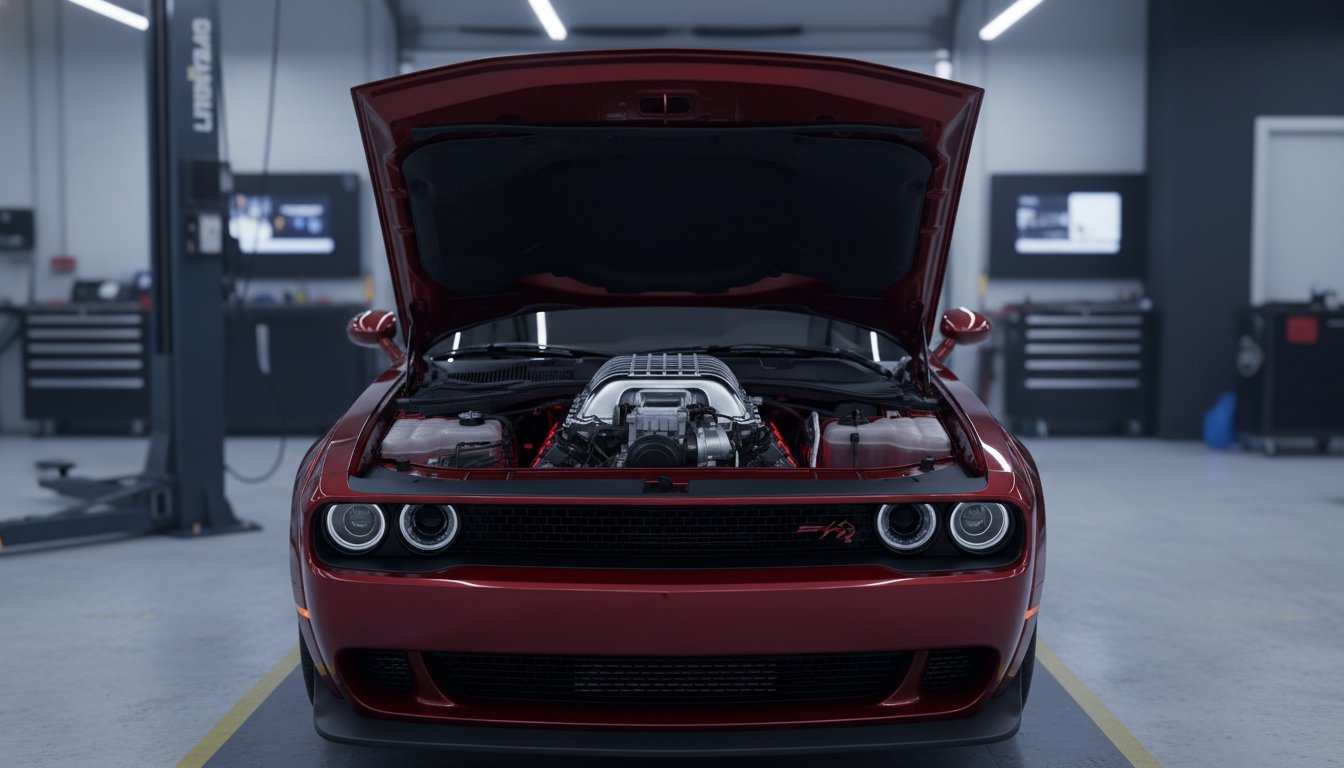
The Dodge Hellcat: An In-Depth Guide to America's Supercharged Icon
Navigating the world of modern Mopar performance presents a unique challenge: distinguishing between the standard Hellcat, the formidable Redeye, and the legendary Demon. For the serious enthusiast, understanding the precise engineering that separates these supercharged monsters is critical, yet reliable, consolidated information is notoriously hard to find. The questions are always the same: What truly makes the engine so powerful, and where does the real performance potential lie?
This in-depth guide is the definitive resource you've been searching for. We are breaking down the entire Hellcat platform, from the groundbreaking 6.2L supercharged HEMI to the specific factory calibrations that define each model. You will gain a clear understanding of the advanced forced-induction technology, learn the key differences between each variant, and discover the true modification pathway. Consider this your complete technical brief on America's supercharged icon-the knowledge you need to unlock its ultimate performance potential.
Key Takeaways
- Discover how the supercharged HEMI V8 is engineered from the factory with robust components built to handle immense power.
- Learn to distinguish between the key Hellcat-powered models and their specific performance outputs, from the original to the Redeye and Demon.
- Understand why the Powertrain Control Module (PCM) is the critical first step to unlocking your hellcat's true performance potential.
- Identify the core principles behind modifying these platforms for reliable, high-horsepower gains beyond factory specifications.
What is a Hellcat? The Birth of a Modern Muscle Car Legend
In the world of modern performance, few names command as much respect and raw intimidation as the Hellcat. This isn't just a trim level; it's Dodge's halo brand, a declaration of dominance in the automotive horsepower wars. When it first erupted onto the scene in 2015, it fundamentally reset the benchmark for American muscle, delivering a level of factory-backed power that was previously reserved for highly modified vehicles or exotic supercars. The Hellcat became an instant legend, solidifying Dodge's image as the premier purveyor of unapologetic, high-octane performance.
The Supercharged 6.2L HEMI Engine: An Overview
The heart of this monster is the supercharged 6.2L HEMI V8. Its initial output of 707 horsepower was a seismic event in the industry. Built upon the proven architecture of the existing HEMI V8, engineers added a 2.4L IHI twin-screw supercharger, a key component of its forced-induction design. This supercharger is not only responsible for the immense power output but also for the iconic, high-pitched whine that has become the engine's signature auditory cue-a sound that instantly signals its performance potential to enthusiasts.
The Mission: Dominating the Streets and the Strip
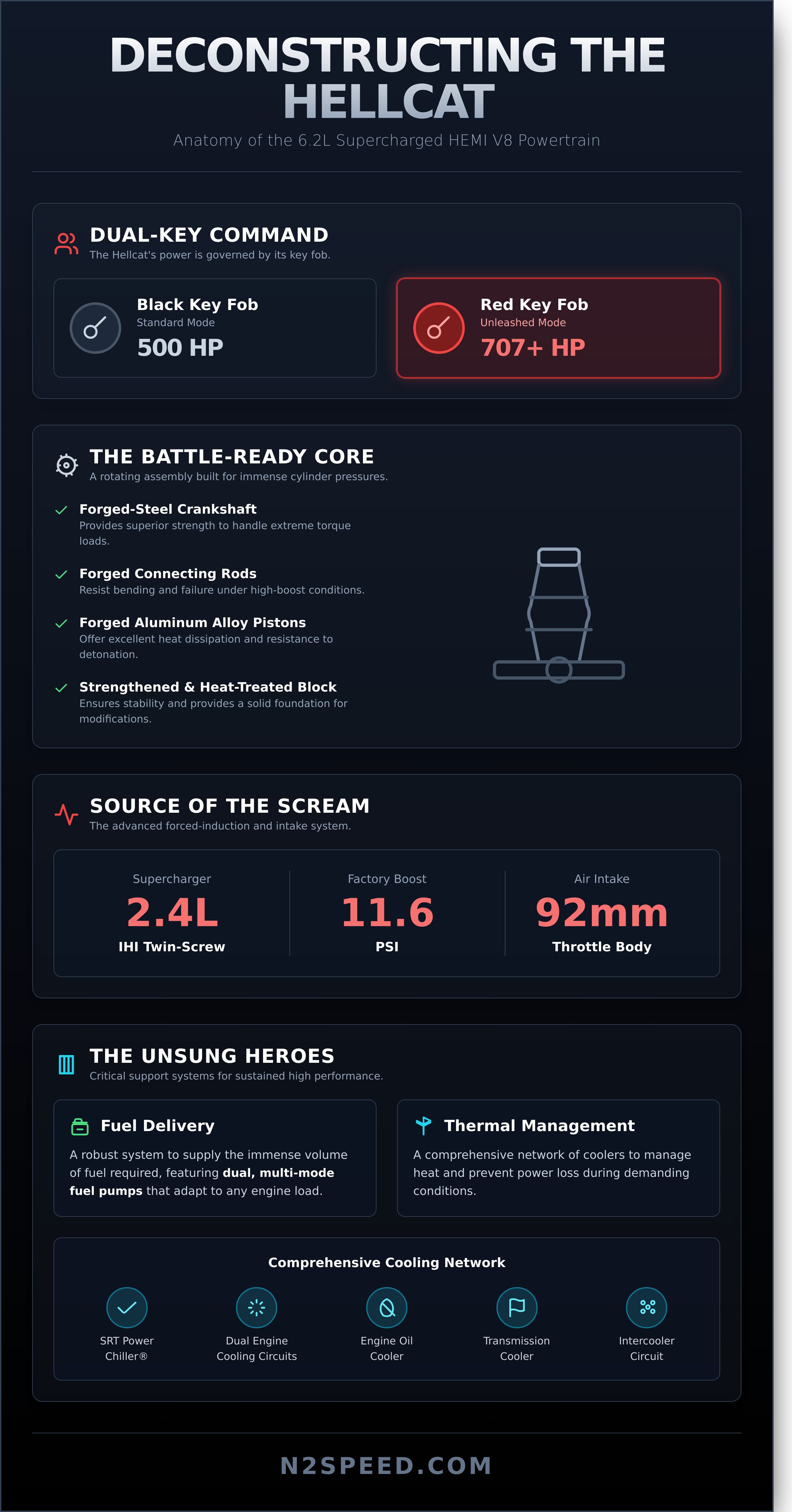
Dodge's objective was clear and direct: create the most powerful American production car. The Hellcat's philosophy prioritized brute force and immense torque over the lightweight, high-revving precision of its European counterparts. This was masterfully controlled by a dual-key system: a black key fob limited output to a more manageable 500 horsepower, while the red key fob unlocked the engine's complete, unrestricted power. This wasn't a tuner special; it was a factory-engineered, warranty-backed vehicle built for total domination.
The cultural impact was immediate and profound. The platform that launched the legend, the Dodge Challenger SRT Hellcat, became a symbol of extreme power accessible to the masses. The success of this powertrain led Dodge to install it across its most capable platforms, creating a family of high-performance monsters:
- Dodge Challenger
- Dodge Charger
- Dodge Durango SRT Hellcat
- Ram 1500 TRX
Anatomy of a Monster: Deconstructing the Hellcat Powertrain
The headline-grabbing horsepower and torque figures of the 6.2L supercharged HEMI V8 are just the beginning of the story. Dodge engineers didn't simply add a supercharger to a standard engine; they built a powertrain engineered from the ground up for extreme, reliable performance. This robust architecture is not only crucial for handling the immense factory output but also provides a solid foundation for serious modifications. Paired with either the stout ZF 8HP90 8-speed automatic or the Tremec TR-6060 6-speed manual, every component is designed to manage the monster's torque.
Forged Internals and a Strengthened Block
At the core of the hellcat engine lies a rotating assembly built for battle. It features a forged-steel crankshaft, forged connecting rods, and high-strength forged aluminum alloy pistons. Unlike cast components, forged parts offer superior strength and resistance to detonation under the immense cylinder pressures of a high-boost engine. The entire block and its induction-hardened components are heat-treated to ensure stability, making this powertrain exceptionally receptive to advanced tuning and increased boost levels.
The Advanced Supercharger and Induction System
The source of the iconic whine and relentless power is a 2.4L IHI twin-screw supercharger. Internally geared for high RPM, it crams air into the cylinders at a factory setting of 11.6 psi. To combat the heat generated by this compression, the system uses two integrated charge air coolers (intercoolers) that reduce intake air temperature, creating a denser, more powerful charge. A massive 92mm throttle body serves as the gateway, ensuring the engine is never starved for the air it needs to generate its legendary output.
Fueling and Cooling: The Unsung Heroes
Managing the fuel and heat required for over 700 horsepower is a monumental task. The powertrain relies on dual, multi-mode fuel pumps to supply the necessary volume of fuel under any load. To manage intake temperatures, Dodge implemented the innovative SRT Power Chiller®, which diverts refrigerant from the air conditioning system to further cool the air entering the supercharger. This is supported by a comprehensive network of coolers:
- High-temperature and low-temperature cooling circuits for the engine
- Dedicated engine oil cooler
- Transmission fluid cooler (for automatic models)
- Coolant circuit for the supercharger's intercoolers
These supporting systems are critical for sustained performance and are often the first components that require upgrades when pushing power well beyond factory specificationsDownload

A Guide to the Hellcat Family: From 707 HP to the 840 HP Demon
Since its explosive debut, the Hellcat platform has evolved into a diverse family of high-performance vehicles, often leading to confusion about their specific capabilities. What began as a single engine calibration has spawned multiple iterations, each with a distinct purpose. The core of the platform is the supercharged 6.2L HEMI V8, but power output, hardware, and target application vary significantly across the lineup. Understanding this evolution is key to appreciating the engineering behind each model.
| Model | Horsepower | Torque (lb-ft) | Key Feature |
|---|---|---|---|
| SRT Hellcat | 707-717 | 650-656 | The original 2.4L supercharger |
| Hellcat Redeye | 797 | 707 | Demon-derived 2.7L supercharger |
| Demon | 808 / 840 (race fuel) | 717 / 770 | Transbrake, drag radials, limited run |
| Super Stock | 807 | 707 | Drag-focused suspension & tires |
| Durango Hellcat | 710 | 645 | AWD Drivetrain, 8,700 lb tow |
| Ram 1500 TRX | 702 | 650 | Off-road suspension, detuned for durability |
The Original: SRT Hellcat (707-717 HP)
Launched in 2015, the original Challenger and Charger SRT Hellcat models redefined the modern muscle car with an unprecedented 707 horsepower. This monster was capable of sub-4-second 0-60 times and low 11-second quarter-mile passes from the factory. To manage the power, Dodge later introduced the Widebody option, providing wider tires and improved mechanical grip-a critical upgrade for putting power to the pavement effectively.
The Upgrade: Hellcat Redeye (797 HP)
The Redeye is the direct beneficiary of the Demon's development program. It inherited the Demon’s larger 2.7L IHI supercharger, strengthened connecting rods and pistons, and a high-flow fuel injection system. This hardware allows the Redeye to produce a staggering 797 horsepower, positioning it as the top-tier production hellcat model for those seeking Demon-level straight-line performance without the drag-strip-specific compromises.
The Drag Strip Kings: Demon and Super Stock (808-840 HP)
The 2018 Demon was a limited-production, street-legal drag car engineered for one purpose: quarter-mile dominance. With features like a transbrake, drag radial tires, and the ability to run on 100-octane race fuel for a peak output of 840 HP, it was a factory-built weapon. The later Super Stock model served as a "Demon-lite," combining the Redeye's 807 HP engine with drag-tuned suspension and standard drag radials for a more accessible but still formidable drag strip machine.
The SUVs and Trucks: Durango Hellcat & Ram 1500 TRX
Proving the engine's versatility, Dodge and Ram integrated the supercharged V8 into all-wheel-drive platforms. The Durango Hellcat became the world's most powerful production SUV, while the Ram 1500 TRX dominated the performance truck segment. Both required unique engineering for their drivetrains and specific engine calibrations to handle different loads and use cases, creating the ultimate high-performance utility vehicles. Regardless of which model you drive, unlocking its full performance potential requires expert calibration. At N2 Speed, we specialize in tuning every iteration of this legendary platform.
Unlocking True Potential: The World of Hellcat Tuning and Mods
The 700+ horsepower figure from the factory is impressive, but for a true enthusiast, it's merely the starting point. The key to unlocking the monster within your hellcat lies within its Powertrain Control Module (PCM)-the vehicle's central computer. Manufacturers implement sophisticated encryption on these units to limit modifications. To truly customize performance, this digital gatekeeper must be professionally unlocked, paving the way for advanced calibrations and hardware upgrades that transform your car from powerful to dominant.
Why Custom Tuning is Essential for Performance
A custom tune is not just about adding horsepower; it's about optimizing the entire powertrain. Unlike generic, off-the-shelf tunes, a professional calibration adjusts fuel delivery, spark timing, and supercharger boost parameters specifically for your vehicle and its modifications. Through precise data logging, every change is validated to ensure maximum power is achieved safely and reliably. See how N2 Speed's expert Hellcat tuning delivers real results you can feel.
The First Step: PCM & TCM Unlocking
Modern Dodge vehicles are equipped with encrypted PCMs (like the GPEC2A, GPEC4, and newer variants) that cannot be flashed with custom software. This makes unlocking a mandatory first step. The process involves physically sending your module to a specialist who can bypass the factory security. While the PCM is being serviced, it's the perfect time to also tune the Transmission Control Module (TCM) for faster, firmer shifts that can handle the increased power.
Popular 'Bolt-On' Modifications for Hellcats
Once your vehicle’s computer is unlocked, you can begin installing performance hardware. These "bolt-on" parts are the foundation for building a high-horsepower machine:
- Supercharger Pulleys: Swapping the factory pulley for a smaller one is the quickest way to increase boost pressure and make a significant jump in horsepower and torque.
- Cold Air Intakes: An upgraded intake system allows the supercharger to breathe more efficiently, feeding it cooler, denser air for improved combustion.
- Exhaust Systems: A high-flow cat-back or full exhaust system reduces backpressure, improves throttle response, and unleashes the signature HEMI V8 sound.
- Fuel System Upgrades: To support higher power levels, larger fuel injectors and high-flow fuel pumps are essential to prevent a lean condition and protect your engine.
Commanding the Apex Predator: Your Hellcat's True Potential
From its groundbreaking debut to the tire-shredding Demon, the Dodge Hellcat has cemented its legacy as America's supercharged icon. We've explored its revolutionary powertrain, the diverse family of high-horsepower models, and the incredible engineering that sets it apart. But as every owner knows, the factory floor is just the starting line for what this monster is truly capable of achieving.
Unlocking that next level of performance requires precision and expertise. As specialists in Dodge, Jeep, and Ram performance calibration, N2 Speed provides the advanced solutions your vehicle deserves. With proven results on the street and the drag strip, our expert PCM & TCM unlocking services for all modern HEMI platforms are the key to unleashing its full capabilities. Ready to unleash the monster? Explore our expert Hellcat PCM unlocking and custom tuning services.
Take control of the power you were meant to command.
Frequently Asked Questions
What is the difference between a Scat Pack and a Hellcat?
The primary distinction lies in the engine and power delivery. The Scat Pack is equipped with a naturally aspirated 6.4L 392 HEMI V8, producing 485 horsepower. The Hellcat features a 6.2L HEMI V8 with a factory supercharger, a form of forced induction that elevates its output to 707 horsepower or more. This power increase is supported by upgraded drivetrain components, brakes, and adaptive suspension systems engineered to handle the massive performance differential.
How much horsepower does a stock Dodge Hellcat actually have?
A standard stock Dodge Hellcat produces 707 horsepower and 650 lb-ft of torque. However, Dodge has released several higher-output variants. The Hellcat Redeye models increase this figure to 797 horsepower, while limited-production models like the SRT Demon were factory-rated at 808 horsepower on pump gas and a monstrous 840 horsepower on 100-octane race fuel. Each model delivers class-defining power straight from the factory floor.
Can you drive a Hellcat every day?
Yes, a Hellcat can be used as a daily driver. Despite its immense power potential, its advanced engine management and ZF 8-speed automatic transmission provide surprisingly docile road manners in standard driving modes. The primary considerations for daily use are its significant fuel consumption, which is well below average, and accelerated rear tire wear. However, for those who can accommodate these factors, it is a perfectly capable and comfortable daily vehicle.
What is the fastest Hellcat model ever made?
The fastest production model is the limited-edition 2018 Dodge Challenger SRT Demon. Engineered specifically for drag racing, the Demon achieves a 0-60 mph time of just 2.3 seconds and conquered the quarter-mile in a record-setting 9.65 seconds at 140 mph. Its specialized equipment, including a transbrake and drag-radial tires, made it the quickest and most powerful production muscle car ever built, solidifying its legendary status among performance enthusiasts.
Why are there two different key fobs for a Hellcat?
The dual key fob system provides control over the vehicle's performance output. The black key fob acts as a limiter, restricting the engine to approximately 500 horsepower for daily driving or valet situations. The red key fob is the key to full performance, unlocking the supercharged engine's entire 707+ horsepower potential. This feature allows the driver to choose the appropriate power level for the conditions, ensuring both safety and maximum capability.
Is the Hellcat engine reliable?
The 6.2L supercharged HEMI is a robust and well-engineered powertrain. Built with a cast-iron block and forged internals, the Hellcat engine was designed from the ground up to withstand extreme cylinder pressures and stress. When maintained with proper fluid changes and care, the core engine is exceptionally durable. Reliability issues typically arise from aftermarket modifications that push the platform beyond its factory-engineered limits, not from inherent design flaws in a stock configuration.
Related N2 Speed Tuning Services
- Dodge Challenger Hellcat & Redeye tuning
- Dodge Charger Hellcat & Redeye tuning
- Dodge Durango SRT Hellcat tuning
- Jeep Grand Cherokee Trackhawk tuning
- remote custom tuning
Questions about your build? Call (954) 406-8550 or email sales@n2speed.com.