
Posted by N2 Speed LLC. on Aug 23rd 2026
Hellcat Fuel Injector Upgrade: The Definitive Guide to Unlocking HEMI Performance
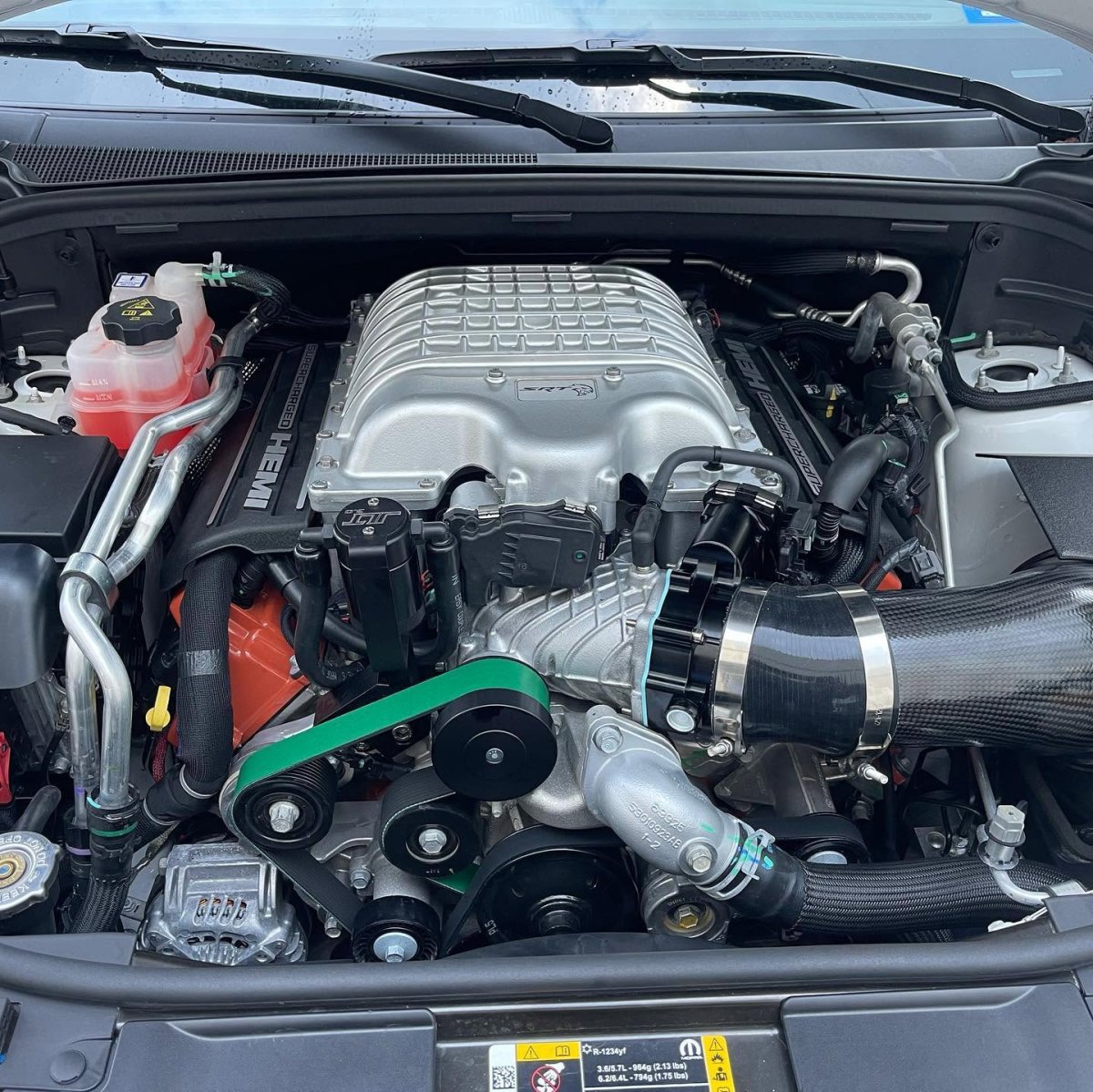
Your Hellcat’s factory fuel injectors are the primary bottleneck standing between your current setup and a reliable four-digit horsepower figure. It's a common frustration for HEMI enthusiasts when the supercharger has plenty of overhead but the fuel system reaches its limit at a dangerous duty cycle. Executing a hellcat fuel injector upgrade is the only way to safely support high-boost 93 octane builds or full E85 conversions, which currently offer a 37.2% price advantage over E0 gasoline. We understand the hesitation many owners feel regarding 2015+ PCM security and the fear that larger injectors will ruin that refined factory idle.
This guide provides a clear roadmap to bypass those hurdles. You'll learn how to handle the mandatory PCM bench unlock process and implement custom calibrations using industry-standard platforms like HP Tuners. We will detail the hardware requirements for various power levels and show you how to achieve a setup that delivers massive gains without compromising crisp throttle response or stock-like drivability. By the end of this article, you will have the technical foundation to maximize the latent capability of your supercharged HEMI.
Key Takeaways
- Understand why a physical PCM bench unlock is the required first step for any 2015+ Hellcat before the factory security gateway allows for fuel system modifications.
- Identify the 750 whp threshold where factory fueling fails and learn how a hellcat fuel injector upgrade supports the increased volume required for high-boost pulleys.
- Master the process of injector characterization to maintain refined drivability and a stable idle after installing high-flow hardware.
- Discover why E85 requires 30% more fuel volume than gasoline and how to calculate the correct injector size to prevent dangerous lean conditions.
- Learn how to leverage remote e-mail tuning and specialized unlocking services to achieve professional performance results without visiting a physical shop.
Understanding the Hellcat PCM: The Gateway to Fuel Upgrades
The Powertrain Control Module (PCM) acts as the central intelligence for your HEMI engine. It is responsible for calculating the precise fuel pulse width required for every combustion cycle. While modern fuel injection systems have become incredibly sophisticated, the underlying logic remains consistent. The computer must know the exact flow rate and offset data of an injector to maintain a safe air-fuel ratio. Without this synchronization, a hellcat fuel injector upgrade cannot function correctly.
For Hellcat owners, the PCM is more than just a controller; it is a gatekeeper. The factory software contains hard-coded limits designed to protect the engine within stock power levels. When you move beyond these parameters, the PCM requires a fundamental change in its permissions. You cannot simply plug in a handheld tuner and expect to scale 1000cc or 1300cc injectors if the module is still in its factory-shipped state.
The 2015+ Security Challenge
Starting with the 2015 model year, Dodge introduced a robust encryption layer on their PCMs. This security gateway functions as a digital firewall that blocks any unauthorized modifications to the internal calibration tables. If you try to scale new injectors using a standard OBD-II tool on a locked unit, the system will reject the write command immediately. This often results in a "failed to write" error or, worse, a vehicle that enters a permanent limp mode.
There is a significant difference between a temporary software bypass and a physical modification of the unit. The PCM bench unlock is the hardware modification required to allow custom injector data to be written to the module. This process involves specialized equipment that resets the security flags at the board level. Once this is completed, the PCM becomes receptive to the custom fuel maps necessary for your hellcat fuel injector upgrade.
Why Factory Fuel Maps Limit Your Power
The stock calibration is optimized for reliability on 91 or 93 octane at standard boost levels. When you install a smaller supercharger pulley, the engine pulls in a much larger volume of air. The factory PCM is programmed to "clip" fuel delivery when it detects airflow values that exceed these pre-set safety limits. It doesn't matter how much potential your new injectors have; if the PCM can't be told to utilize that capacity, the engine will run dangerously lean under load.
Unlocking the PCM is the essential first step, but high-performance builds also require coordination with the drivetrain. Utilizing a 2015+ Dodge PCM Unlock Service ensures that your fueling adjustments work in harmony with the rest of the vehicle. This allows for a complete calibration where torque management and fuel delivery are perfectly aligned. This synergy is what transforms a collection of high-end parts into a reliable, high-horsepower machine.
Choosing the Right Hellcat Fuel Injector Upgrade
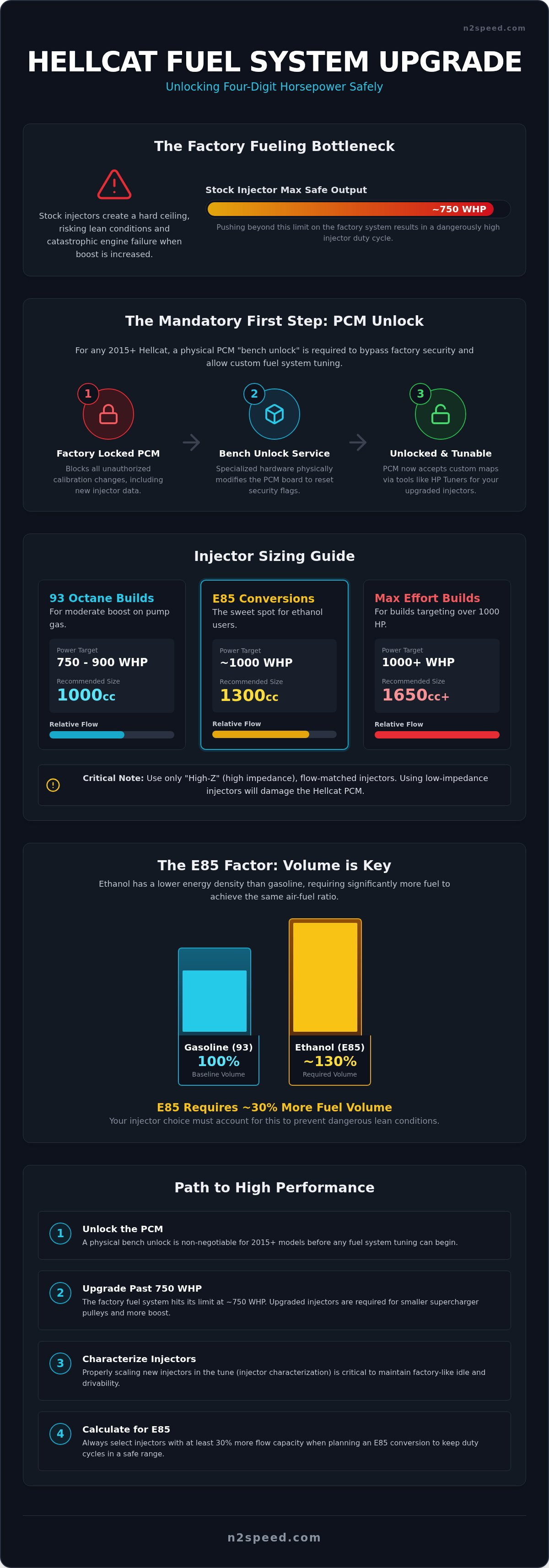
Stock Hellcat injectors are efficient for factory power, but they reach a hard ceiling at approximately 750 wheel horsepower (whp). Pushing past this limit on the factory fuel system risks a lean condition that can lead to catastrophic engine failure. A hellcat fuel injector upgrade becomes necessary the moment you swap to a smaller supercharger pulley. More boost directly increases the oxygen volume in the combustion chamber. This requires a proportional increase in fuel mass to maintain safe lambda targets.
Every performance build relies on the precision of its components. You must use "High-Z" (high impedance) injectors because the Hellcat PCM is specifically designed for high-impedance drivers. Attempting to run low-impedance injectors will likely fry the module's internal drivers. Additionally, investing in flow-matched sets is non-negotiable. Flow-matching ensures cylinder-to-cylinder consistency, which prevents "hot" cylinders from causing knock or pre-ignition during high-load pulls.
Sizing Your Injectors for Your Horsepower Goals
Selecting the correct flow rate depends on your fuel type and target output. For owners staying on 93 octane with moderate boost, 1000cc (95lb/hr) injectors are the sweet spot. They provide enough headroom for growth without overwhelming the stock fuel pump. If you're planning an E85 conversion, you'll need to step up to 1200cc or 1300cc injectors. Since E85 requires roughly 30% more volume than gasoline, this size ensures your duty cycles remain within a safe 80% range. For max-effort builds exceeding 1,000 HP, 1650cc+ injectors are required to support the massive fuel demands of high-boost supercharger setups.
Physical Fitment and Installation Tips
Precision is paramount when selecting hardware for the HEMI platform. Hellcat-specific injectors must match the factory height and EV6/USCAR connector types to ensure a true plug-and-play installation. Using adapters or spacers can introduce potential leak points in high-pressure fuel rails, which is a risk you don't want to take. It is also a good time to consider a Dodge PCM Bench Tune & Speed Limiter Removal to ensure your software is ready for the increased fuel volume. If you're ready to scale your fuel system, you can browse our performance fuel systems and tuning packages to find the right match for your build. Managing fuel rail pressure is equally important, as larger injectors can sometimes tax the stock fuel pump if you don't account for the increased volume requirements at the top of the RPM range.
The Tuning Process: Scaling Injectors for Drivability
Installing high-flow hardware is only half the battle. Scaling a hellcat fuel injector upgrade requires a systematic approach to calibration to ensure the engine remains reliable under heavy load. The process begins with the PCM Bench Unlock, which serves as the hardware-level security clearance needed to write new data. Once the module is accessible, the focus shifts to Injector Characterization. This involves inputting specific flow data, offset tables, and short-pulse adders into the tuning software. Without this precise data, the PCM cannot accurately calculate fuel mass, which leads to erratic engine behavior and poor fuel economy.
After the characterization data is flashed, we move to the initial start-up and idle calibration. This stage is critical for identifying any immediate rich or lean conditions that could foul spark plugs or cause stalling. Once the idle is stabilized, the final step involves wideband data logging. This allows us to verify the Air-Fuel Ratio (AFR) across the entire RPM range. Monitoring the AFR under full boost is the only way to confirm that the new injectors are delivering the volume required to keep combustion temperatures within safe limits.
Custom E-mail Tuning vs. Canned Tunes
Generic or "canned" tunes often fall short because they use generalized assumptions for injector latency. These one-size-fits-all solutions frequently result in poor idle quality and stumbling during low-speed cruising. N2 Speed provides custom e-mail tunes that rely on actual vehicle logs to refine throttle tip-in and part-throttle drivability. This tailored approach ensures that your specific hardware configuration performs with factory-like refinement. You can find more information on the necessary hardware in our HP Tuners MPVI2: The Complete Guide.
The Importance of Data Logging
Data logging serves as the diagnostic backbone of the tuning process. We utilize the HP Tuners VCM Scanner to monitor Short Term Fuel Trims (STFT) and Injector Duty Cycle (IDC) in real-time. If the IDC exceeds 85%, it indicates that the fuel system is approaching its physical limit and may require further hardware upgrades. Professional Dodge/Ram/Jeep Remote Tuning allows us to analyze these logs and make incremental adjustments to the fuel maps. This iterative process is what separates a basic parts installation from a fully optimized, high-performance build.
Fueling for Power: E85 vs. 93 Octane Requirements
E85 is the definitive "cheat code" for the HEMI platform. Its high ethanol content provides superior knock resistance and a significant cooling effect on the intake charge. This allows for more aggressive ignition timing and higher boost levels without the risk of detonation. However, transitioning from 93 octane to E85 requires a fundamental shift in fuel volume. You cannot simply switch fuels without first verifying that your fuel system can handle the increased demand.
This is where the "30% Rule" becomes critical. E85 contains less energy per gallon than gasoline. To achieve the same power output, the engine requires roughly 30% more fuel by mass. If you choose a 1000cc hellcat fuel injector upgrade for a 93 octane build, you'll likely find those same injectors maxed out at a 100% duty cycle on E85. For this reason, we recommend sizing up to at least 1200cc or 1300cc injectors if ethanol is in your future plans. Injectors aren't the only potential bottleneck; high-boost E85 builds often require upgraded fuel pumps to maintain stable rail pressure at the top of the RPM range.
The PCM handles these fuels differently depending on your tuning strategy. A dedicated E85 tune is optimized for a specific ethanol content, usually E85 or higher. A flex fuel tune is more versatile. It utilizes an ethanol content sensor to allow the PCM to adjust timing and fuel maps in real time based on the actual blend in the tank. This provides the convenience of filling up with 93 octane when ethanol isn't available while still reaping the performance benefits of E85 when it is.
E85 Conversion Checklist
Switching to ethanol requires more than just a new map. You must ensure your hardware is up to the task to avoid leaning out under boost. Use this checklist to verify your setup:
- 1200cc+ Injectors: Essential for maintaining a safe duty cycle on ethanol.
- Ethanol-Compatible Lines: Ensure your fuel system seals and lines won't degrade.
- Custom Calibration: A tune that specifically manages the increased volume and timing requirements.
E85 requires a higher volume of fuel delivery to achieve the same stoichiometric balance as gasoline. If you're ready to make the switch, you can order your performance fuel system components directly from our site to ensure your hardware matches your horsepower goals.
Heat Management for Supercharged HEMIs
Fuel choice significantly impacts Intake Air Temperatures (IATs). The evaporation of ethanol in the intake tract pulls heat out of the air, which is a major benefit for the top-heavy 6.2L supercharger. To complement a high-performance fuel tune, many owners install a 180-degree thermostat. This helps maintain lower overall engine temperatures, which reduces the likelihood of the PCM pulling timing due to heat soak. Always monitor your wideband gauge for lean conditions during back-to-back track runs, as high heat can occasionally tax the fuel system's ability to maintain consistent pressure.
Getting Your Custom Hellcat Setup with N2 Speed
N2 Speed operates on a simple philosophy: professional-grade calibration shouldn't be limited by your geographic location. While local dyno shops have their place, our remote e-mail tuning services provide a level of specialized expertise that generalist shops often lack. We focus exclusively on high-performance American muscle platforms. This deep immersion in the Dodge and GM ecosystems allows us to deliver a hellcat fuel injector upgrade that integrates seamlessly with your existing modifications. Whether you utilize HP Tuners or Diablosport hardware, our team provides the technical support needed to ensure your build reaches its latent potential.
Our approach bridges the gap between hardware sales and software optimization. We don't just sell components; we provide the logic that makes them work. By combining our PCM unlocking services with custom-tailored fuel maps, we eliminate the guesswork often associated with high-horsepower builds. This synergy ensures that your fuel system, supercharger, and transmission work as a single, cohesive unit.
Why Choose N2 Speed for Your Upgrade?
Our experience with the 6.2L Supercharged HEMI platform is extensive. We understand that a 1000+ HP build is useless if it stalls at every stoplight or has a surging idle. We prioritize refined drivability alongside peak power metrics. This no-nonsense approach ensures your vehicle remains as reliable on the street as it is capable on the track. For enthusiasts with multi-car households, we also offer specialized Chevrolet Corvette Tuning to ensure every vehicle in your garage performs at its peak. We don't just chase numbers; we optimize the entire operating range of the engine.
Next Steps to 800+ Horsepower
Achieving a reliable 800+ horsepower setup requires a coordinated effort between hardware and software. The first step is securing a PCM bench unlock, which is mandatory for all 2015 and newer Hellcat models. You can order our PCM unlock and custom tune bundle online to streamline the process. Once your order is placed, you'll need to package and ship your factory PCM to our facility. Our team performs the physical unlock and ships the unit back to you with a quick turnaround, allowing you to begin the tuning process without extended downtime.
When you're ready to start the calibration, you'll provide our tuners with a complete list of modifications. This includes your specific hellcat fuel injector upgrade size, pulley diameters, fuel type, and desired boost levels. This data allows us to build a base file that is safe for your initial start-up and data logging sessions. We then work through iterative log reviews to sharpen throttle response and finalize your high-boost maps. Unlock your Hellcat’s potential today by choosing a tuning partner that understands the intricacies of the HEMI platform.
Optimizing Your HEMI for Maximum Output
A successful hellcat fuel injector upgrade requires more than just high-flow hardware. It demands a coordinated approach that begins with a physical PCM unlock and ends with precise software calibration. We've established that factory fuel limits act as a hard ceiling for performance. Bypassing that ceiling is the only way to support high-boost pulleys or E85 conversions. By prioritizing injector characterization and data logging, you ensure your build maintains refined drivability without sacrificing peak power metrics.
N2 Speed specializes in Dodge performance and offers remote e-mail tuning for nationwide convenience. Our expert PCM/TCM unlocking services for 2015+ models provide the security clearance your build needs to function correctly. Don't let factory software restrictions hold back your supercharger's latent capability. Order Your Hellcat PCM Unlock and Custom Tune Today. Your path to reliable, high-output performance starts with the right calibration partner. We look forward to helping you reach your horsepower goals.
Frequently Asked Questions
Do I really need to ship my PCM to get a Hellcat tune?
Yes, for all 2015 and newer models, the factory PCM is encrypted and requires a physical bench unlock before any calibration changes can be made. You must ship the unit to a specialized facility like N2 Speed to have the security gateway bypassed. While some handheld devices claim to bypass security, a true custom hellcat fuel injector upgrade requires the hardware-level access that only a bench unlock provides.
Will a custom tune and larger injectors void my factory warranty?
Modification of the factory calibration and fuel system components will almost certainly void your powertrain warranty. Dealers can detect if the PCM has been flashed or unlocked, even if returned to stock. You should weigh the performance benefits against the loss of factory coverage. Most enthusiasts who perform a hellcat fuel injector upgrade accept this trade-off to reach the higher power levels that stock hardware cannot support.
What is the difference between a PCM unlock and a TCM unlock?
The PCM (Powertrain Control Module) controls engine functions like fuel pulse width and ignition timing, while the TCM (Transmission Control Module) manages shift points and torque management. Unlocking the PCM is mandatory for engine tuning. Unlocking the TCM is recommended for high-horsepower builds to ensure the transmission can handle the increased torque and shift appropriately without hitting factory limiters or causing premature clutch wear.
Can I pass emissions with a custom Hellcat engine tune and upgraded injectors?
Emissions compliance depends on your local regulations and the specific tune parameters. In 17 states following CARB standards, such as California and New York, certain high-performance HEMI models and modifications are restricted. A properly scaled injector tune should maintain factory-like readiness monitors, but any modification that alters the exhaust system will fail inspection. You should verify your state's specific 2026 targets before modifying your fuel system.
How much horsepower can I expect from just a tune, pulley, and injector upgrade?
A standard package including a smaller pulley, larger injectors, and a professional tune yields measurable results. On a standard Hellcat, a simple PCM swap and tune can yield an additional 30 rear-wheel horsepower (RWHP). Redeye models see even higher gains, often reaching up to 54 RWHP. These metrics assume a safe calibration that prioritizes engine longevity while maximizing the increased airflow provided by the upgraded supercharger pulley.
Can I switch back to the stock tune and injectors if I sell the car?
You can revert the vehicle to stock, but you must reinstall the original factory injectors and flash the stock calibration back to the PCM. Running factory injectors on a high-flow tune, or vice versa, will cause the engine to run dangerously rich or lean. Keep in mind that the PCM will remain physically unlocked; this may be detectable by a dealership service department during a deep scan.
Do I need to upgrade my fuel pump when I upgrade my Hellcat injectors?
For moderate 93 octane builds, the stock Hellcat fuel pump is usually sufficient. However, if you are planning an E85 conversion or aiming for high-horsepower builds exceeding 1,200 HP, the fuel pump becomes a critical bottleneck. E85 requires 30% more volume than gasoline, which can tax the stock pump's ability to maintain rail pressure. Monitoring your fuel pressure during data logging will reveal if a pump upgrade is necessary.
What is a Dodge PCM SKIM reset and do I need it for tuning?
The SKIM (Security Key Immobilizer Module) reset is required if you are installing a replacement PCM that was not originally paired with your vehicle's VIN and ignition key. If you are sending in your original PCM for a bench unlock, you don't need a SKIM reset. This service is only necessary for module replacements or swaps to ensure the vehicle's anti-theft system recognizes the hardware and allows the engine to start.