
Posted by N2 Speed LLC. on Jun 23rd 2026
Dodge Challenger Tuning: HEMI & Hellcat HP Guide

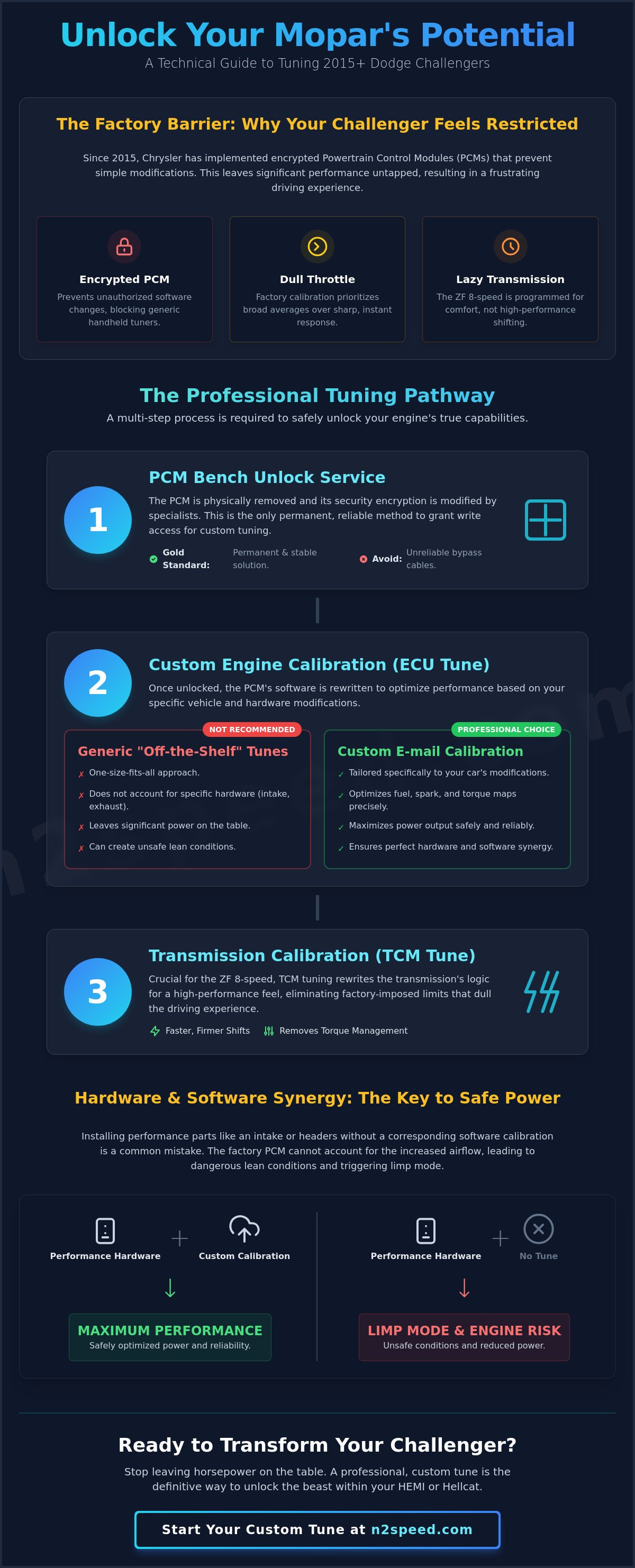
Plunking down cash for a generic handheld device won't unlock the true potential of a modern Mopar engine. Since 2015, Chrysler has utilized locked PCMs that prevent simple plug-and-play modifications. If you want real results, Dodge Challenger tuning requires a sophisticated, multi-step approach that addresses the electronic gatekeepers standing between you and peak performance.
You likely recognize that the factory calibration leaves significant horsepower and torque on the table to satisfy broad consumer averages. It's common to feel disappointed by sluggish throttle response or a ZF 8-speed transmission that shifts like a family sedan rather than a high-performance muscle car. This guide provides the technical roadmap to fix those issues. You'll discover how to manage PCM unlocking and implement custom remote calibrations that optimize your HEMI or Hellcat safely. We'll examine the essential hardware requirements, the importance of TCM tuning for transmission logic, and how to achieve a professional-grade setup that transforms your driving experience.
Key Takeaways
- Identify the specific PCM unlocking requirements for 2015 and newer models to bypass factory encryption.
- Compare the reliability of custom email calibrations against generic off-the-shelf options for effective Dodge Challenger tuning.
- Recognize the necessity of TCM tuning to eliminate factory torque management and improve ZF 8-speed shifting performance.
- Understand how professional software adjustments synchronize with performance hardware to prevent lean conditions and maximize output.
- Determine the optimal calibration path for 5.7L and 6.4L HEMI engines to balance increased power with long-term engine safety.
The 2015+ Dodge Challenger Tuning Barrier: Understanding Locked PCMs
Starting in the 2015 model year, Chrysler introduced a security firewall that changed the landscape of Engine tuning for the Challenger platform. This wasn't a simple software patch; it was a hardware-level encryption designed to prevent unauthorized modifications to the Powertrain Control Module (PCM). Owners of earlier models could simply plug in a handheld tuner and upload a file, but modern HEMI and Hellcat platforms require a physical intervention to grant write access to the calibration tables.
A factory-locked unit is essentially a read-only device for aftermarket software. While you might be able to read diagnostic codes, you cannot modify ignition timing, fuel maps, or rev limits. A performance-ready module has had its security sector modified, allowing specialized software to overwrite factory parameters. Attempting to force a tune onto a locked unit with a generic handheld device will result in a failed write or, in some cases, a bricked module that renders the vehicle inoperable.
To better understand the specific steps involved in this process, watch this breakdown of the tuning workflow:
Some market solutions suggest using bypass cables or temporary hardware bridges. These are often unreliable workarounds that don't address the root security encryption within the PCM itself. They can lead to communication errors during high-speed data logging or, worse, trigger limp mode during wide-open throttle. Professional bench unlocking remains the gold standard for Dodge Challenger tuning because it provides a permanent, stable solution that doesn't rely on external hardware tricks to maintain access.
What is a Dodge PCM Bench Unlock?
A bench unlock is a precision procedure where the PCM is removed from the vehicle and connected to a specialized interface in a controlled environment. Technicians access the module's internal bootloader to modify the security RSA keys. This physical modification is the only way to ensure the module accepts new calibration data without triggering anti-tamper protocols. Mail-in services have become the preferred method for enthusiasts because they offer a secure, verified path to performance. You can utilize a professional Dodge PCM unlock service to prepare your hardware for custom calibration without the risk of local errors.
GPEC2A and GPEC2 PCM Security Locks
Modern Challengers utilize specific hardware families, primarily the GPEC2 and GPEC2A controllers. The GPEC2A, found in later 6.4L Scat Packs and Hellcats, features even more stringent encryption than its predecessors. Identifying your specific hardware identifier is the first step in any Dodge Challenger tuning project. These alphanumeric codes dictate which protocols are required for a successful unlock and subsequent tune. N2 Speed maintains deep expertise in these specific Mopar architectures, ensuring that whether you're driving an R/T or a Redeye, the underlying hardware is handled with engineering precision.
Performance Hardware vs. Software Calibration: What Does Your Challenger Need?
Installing high-flow hardware without a corresponding software update is a common error. It leaves significant power on the table. When you add a cold air intake or long-tube headers, you're physically increasing the engine's volumetric efficiency. However, the factory PCM is programmed with narrow volumetric efficiency (VE) tables designed specifically for stock components. Without Dodge Challenger tuning, the engine's computer cannot accurately calculate the new airflow. This often results in lean conditions that trigger "limp mode." It's a frustrating experience for any enthusiast.
This safety protocol occurs when sensors detect values outside factory-defined parameters. To protect the engine, the PCM will aggressively pull ignition timing or limit throttle plate opening. Professional calibration ensures your software recognizes the hardware improvements. This allows you to maximize the return on investment for every performance part installed. Precision matters. A properly calibrated car doesn't just make more power; it operates with the reliability of a factory-engineered machine while delivering the aggressive output you expect.
The Limits of Bolt-On Performance
The factory ECU utilizes complex torque management strategies to prioritize drivetrain longevity over raw output. Even if your hardware allows for 500 horsepower, the software may cap torque at a lower threshold. This effectively negates your mechanical upgrades. Exhaust modifications also require software oversight because changing backpressure affects fuel trims and scavenging. Effective Dodge Challenger tuning removes these artificial ceilings, including factory speed limiters, to align the car's electronic logic with its mechanical capabilities.
Essential Tuning Devices: HP Tuners vs. The Rest
Precision calibration requires high-fidelity data. N2 Speed relies on the HP Tuners platform for this reason. The MPVI3 interface serves as the bridge between your vehicle's OBDII port and the calibration software. It captures high-resolution data logs, recording critical parameters like knock retard and fuel ratios. These logs provide the empirical evidence needed to refine a tune. You can find more detail in this HP Tuners guide. If you're ready to synchronize your modifications, consider exploring custom remote tuning options to unlock your car's latent capability.
Off-the-Shelf (OTS) vs. Custom E-mail Tuning: Which Delivers Real Power?
Many owners begin their journey by purchasing a handheld device pre-loaded with "canned" or Off-the-Shelf (OTS) tunes. These are generic calibrations designed for a stock vehicle using a specific octane rating. While they provide a marginal improvement over factory settings, professional Dodge Challenger tuning requires a more granular approach. Generic files cannot account for the unique wear of your engine, local atmospheric pressure, or variations in fuel quality. They are built for the average car, not your car.
Custom E-mail Tuning is a data-driven alternative that prioritizes both safety and output. Instead of a one-size-fits-all file, a professional tuner creates a calibration based on your vehicle's actual performance data. This precision is vital for preventing dangerous lean conditions. If your air-fuel ratio (AFR) becomes too thin under high load, you risk catastrophic engine failure. Custom tuning monitors these parameters through data logs, ensuring your HEMI or Hellcat runs at peak efficiency without compromising longevity.
Remote tuning offers the same results as a local dyno session without the high hourly rental costs. It uses the real world as your laboratory. By recording data during actual driving conditions, your tuner can optimize part-throttle transitions and wide-open throttle (WOT) pulls with extreme accuracy. This modern workflow delivers professional-grade results directly to your driveway.
The Custom Calibration Process
The workflow is efficient and systematic. Step 1 involves using your interface to read the factory PCM file and sending it to your tuner to establish a baseline. In Step 2, you receive a base performance file. You load this file and record a data log during specific driving scenarios. Step 3 is the iterative refinement phase. The tuner analyzes your logs and adjusts ignition timing and fueling until the calibration is optimized for your specific modifications and environment.
Why Remote Tuning is the Modern Solution
Remote tuning eliminates geographical barriers. You gain access to the specialized expertise at N2 Speed regardless of your location. This is essential for complex builds. If you have upgraded to larger fuel injectors or are performing an E85 conversion, a canned tune is not a viable option. You need a Dodge remote tuning service that can scale with your modifications. High-level Dodge Challenger tuning ensures that every hardware change is backed by a corresponding software adjustment, resulting in a cohesive and powerful performance package.
Beyond the Engine: The Critical Role of TCM Tuning for the ZF 8-Speed
Engine power is essentially useless if the transmission cannot efficiently deliver it to the pavement. Most Dodge Challenger tuning strategies focus exclusively on the PCM, but the Transmission Control Module (TCM) is the critical link in a high-performance build. The TCM and PCM must work in perfect synchronization to manage the massive torque produced by HEMI and Hellcat engines. The ZF 8HP transmission is an engineering masterpiece, yet its factory programming often prioritizes fuel economy and passenger comfort over maximum acceleration. It employs aggressive torque management strategies that momentarily pull ignition timing or close the throttle during gear changes. This creates a noticeable dip in power delivery that enthusiasts often describe as a lazy or clunky sensation during spirited driving. Don't settle for factory bottlenecks when your hardware is capable of so much more.
Recalibrating the TCM allows us to rewrite these rules. We can adjust shift points to ensure the engine stays within its optimal power band longer. We also increase shift firmness by modifying the speed at which the internal clutches engage. This results in gear changes that are crisp, immediate, and consistent. Raising factory torque limits is another essential step. It prevents the transmission from prematurely intervening when the engine's output exceeds stock specifications. Reducing shift lag in manual mode is especially rewarding. It transforms the paddle shifters from a delayed electronic suggestion into a direct mechanical command.
Unlocking the ZF 8-Speed Potential
Challengers from 2015 and newer require a specialized TCM unlock to gain access to these hidden parameters. This process is about more than just speed; it is a vital safety measure for high-horsepower cars. A tuned TCM increases internal line pressure, providing the clamping force necessary to prevent clutch slippage during aggressive launches. This protection is essential for long-term drivetrain health. If you are ready to eliminate the lag and maximize your 8-speed's performance, secure your TCM unlocking service today.
Legacy Support: NAG1 Transmission Tuning
Owners of 2008 to 2014 Challengers equipped with the NAG1 5-speed automatic can also see significant gains. While the older 5-speed lacks the gear count of the ZF, its responsiveness can be greatly improved through software. We can optimize the shift logic to keep the engine in its sweet spot during spirited driving. This modernization of the drivetrain behavior transforms the character of older HEMI platforms. To complement these transmission upgrades, you can order a bench tune for MDS delete and speed limiter removal to fully optimize your vehicle's electronic architecture.
Choosing Your Tuning Path: From Scat Pack to Hellcat Redeye
Every trim level in the Mopar lineup requires a specific calibration strategy to reach its mechanical ceiling. For the 5.7L R/T, the primary goal of Dodge Challenger tuning is often improving throttle response and mid-range torque. The factory "Eagle" HEMI utilizes a conservative drive-by-wire map that can feel sluggish. By remapping the pedal-to-throttle relationship and optimizing ignition timing for 93 octane fuel, we transform the R/T into a much more aggressive street machine. These adjustments provide the "seat-of-the-pants" improvement that owners expect without overstressing stock internals.
Optimizing the 6.4L Scat Pack involves a more technical approach to heat management and airflow. The 392 Apache engine is notoriously sensitive to heat soak, especially in high-temperature environments like Florida. We focus on adjusting cooling fan engagement temperatures and maximizing the active intake manifold's switching points. This ensures the engine breathes efficiently across the entire RPM range. Florida performance enthusiasts prefer N2 Speed because our calibrations account for high humidity and ambient heat, preventing the PCM from pulling timing during heat-heavy summer runs.
Hellcat and Redeye platforms demand the most sophisticated software oversight. When you increase boost via a smaller supercharger pulley, you must address the fuel system immediately. The factory injectors and pump assembly have finite limits. Successful Dodge Challenger tuning for these supercharged monsters requires integrating larger fuel injectors and fuel pump boosters into the software logic. This prevents lean conditions at high RPM that could otherwise lead to catastrophic piston failure.
The Hellcat Performance Blueprint
Calibrating a supercharged 6.2L engine involves managing complex air-charge temperature models and bypass valve logic. We precisely integrate high-flow fuel injectors and voltage boosters to ensure the stoichiometric ratio remains stable under heavy load. Hellcat custom tuning is the definitive method for extracting maximum horsepower while maintaining the mechanical integrity of the supercharged 6.2L platform.
Getting Started with N2 Speed
The path to a faster Challenger is straightforward when you follow a professional workflow. You can schedule a PCM unlock or order your custom remote tune file through our secure portal. Before your first data logging session, ensure your vehicle is in good mechanical standing with fresh spark plugs and high-quality fuel. You will need your tuning interface ready to capture the real-world data our team uses to refine your calibration. Precision engineering is just a few clicks away. Contact N2 Speed for a professional Dodge Challenger tune today and experience the full potential of your HEMI or Hellcat.
Maximize Your Mopar’s Latent Capability
Achieving peak performance from your HEMI or Hellcat requires a systematic approach to electronic optimization. True power comes from synchronizing your mechanical modifications with precise software calibration. By addressing the security hurdles of 2015+ PCMs and implementing specialized TCM tuning for the ZF 8-speed, you eliminate factory bottlenecks that stifle acceleration. Professional Dodge Challenger tuning ensures that every pound of boost and every degree of timing is optimized through empirical data logging and real-world testing.
N2 Speed provides the technical expertise required for this level of integration. We specialize in HEMI and Hellcat platforms, offering expert PCM/TCM unlocking services and remote e-mail tuning via the HP Tuners interface. This professional workflow delivers a safe, high-output calibration tailored specifically to your vehicle's hardware configuration. Your car is capable of significantly more than the factory allows. Take the next step toward professional-grade performance and Unlock Your Challenger's Potential with N2 Speed Custom Tuning. It's time to experience what your build can really do on the street and the track.
Frequently Asked Questions
Will tuning my Dodge Challenger void my factory warranty?
Modifying the factory PCM parameters will likely lead to a warranty denial for drivetrain-related claims. While federal laws protect consumers from arbitrary denials, dealers often identify aftermarket software as the primary cause of mechanical failures. If a technician discovers a modified calibration during a diagnostic scan, the vehicle's powertrain warranty is typically flagged or voided.
Do I need to send in my physical PCM for an unlock service?
Yes, all 2015 and newer models require the physical module to be mailed in for a bench unlock procedure. This process involves accessing the internal circuit board to modify the security sector, which is a hardware-level requirement. This cannot be performed through the OBDII port and is a necessary prerequisite for any Dodge Challenger tuning project on modern platforms.
What is the difference between a canned tune and a custom email tune?
A canned tune is a generic, one-size-fits-all file designed for a completely stock vehicle using standard octane. In contrast, a custom email tune is a bespoke calibration built from your car's specific data logs. Custom tuning accounts for your unique modifications, engine health, and local fuel quality to maximize both safety and performance output.
Can I return my Challenger to the stock tune before visiting the dealer?
You can re-flash the factory calibration file, but modern Chrysler PCMs utilize a non-resettable flash counter. Even if the current software is stock, a dealer can see that the module has been accessed and overwritten multiple times. This transparency means that returning to stock does not guarantee that your previous modifications will remain undetected during a deep scan.
How much horsepower can I expect from a custom tune on a Scat Pack?
Enthusiasts typically see gains of 15 to 25 rear-wheel horsepower on a 6.4L Scat Pack with a custom calibration. However, the primary benefit of Dodge Challenger tuning on this platform is the significant improvement in throttle response and mid-range torque. These adjustments eliminate factory lag and optimize the active intake manifold for a much more aggressive power delivery.
Is TCM tuning necessary for a manual transmission Challenger?
No, TCM tuning is exclusive to automatic vehicles because manual cars do not have a Transmission Control Module. Manual owners focus their performance efforts entirely on the PCM to optimize engine parameters like ignition timing and fuel ratios. The driver maintains full control over shift points and firmness, making electronic transmission intervention unnecessary for these builds.
What hardware do I need to perform a remote email tune at home?
You need a specialized interface like the HP Tuners MPVI3 and a Windows-based laptop running the VCM Suite software. This hardware acts as the communication bridge between your car's OBDII port and the tuner. It allows you to read the factory file, upload your custom calibration, and record the high-resolution data logs required for the refinement process.
How long does the mail-in PCM unlock service typically take?
The bench unlock procedure is usually completed within one business day of the module arriving at the service facility. Most owners receive their unlocked PCM back within three to five business days depending on the shipping speed selected. It's a highly efficient process designed to minimize vehicle downtime while ensuring the security sector is properly modified for tuning access.
Related N2 Speed Tuning Services
- Dodge Challenger 5.7L HEMI tuning
- Dodge Challenger 6.4L 392 tuning
- Dodge Challenger Hellcat & Redeye tuning
- Dodge Challenger SRT8 6.1L tuning
- HEMI MDS delete & speed limiter removal
- Dodge, RAM & Jeep PCM / TCM unlocking
Questions about your build? Call (954) 406-8550 or email sales@n2speed.com.
Browse every option on our Dodge Challenger remote tuning page.