

Posted by N2 Speed on Aug 12th 2026
C7 Corvette Custom Tune: The Ultimate Guide to Unlocking LT1 & LT4 Power

Your C7 Corvette left the factory with its LT1 or LT4 engine intentionally throttled by conservative software and aggressive torque management. While the hardware is capable of elite performance, the stock calibration often prioritizes emissions and fuel economy over raw output and throttle response. You've likely noticed the frustrating lag when you mash the pedal or the sluggish behavior of the transmission under load. It's a common pain point for enthusiasts who want their car to react with the urgency it was designed for.
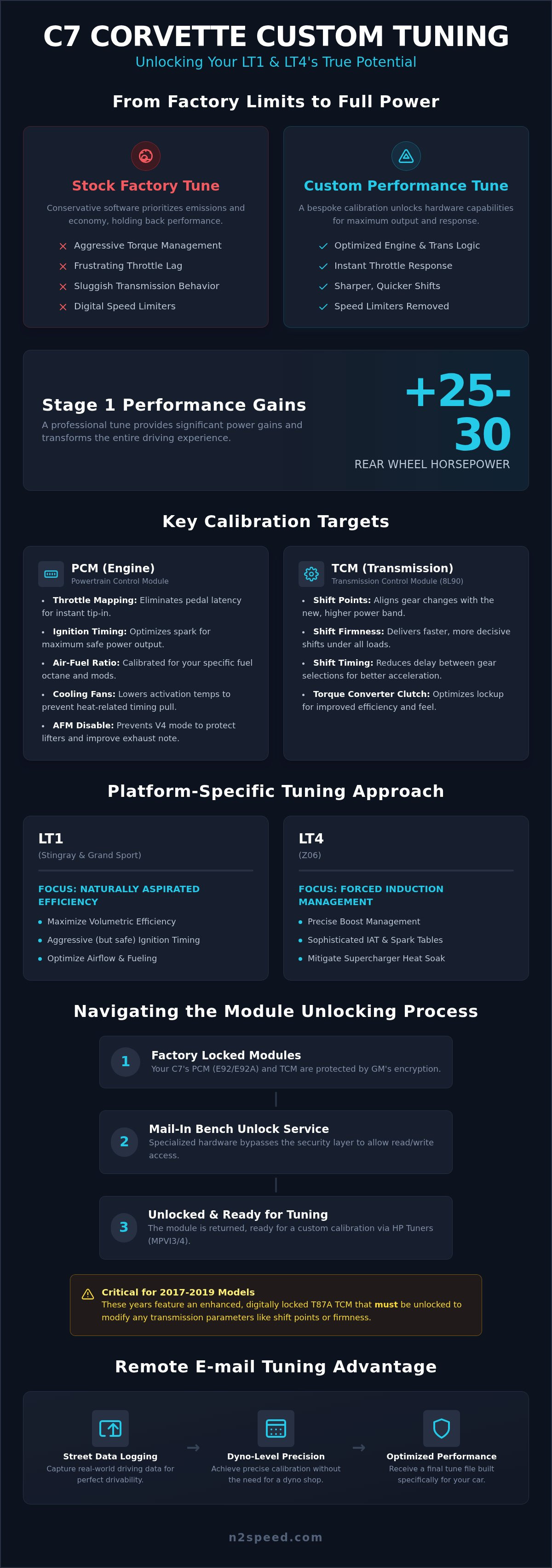
A professional C7 Corvette custom tune is the digital blueprint required to synchronize your engine output with transmission logic. By optimizing the PCM and TCM, you can unlock up to 25 to 30 rear-wheel horsepower on a Stage 1 setup while completely removing speed limiters and AFM/MDS interference. This guide breaks down the essential technical requirements for a successful calibration. We'll explore the hardware needs for HP Tuners MPVI3 and MPVI4 platforms, the specific unlocking procedures for 2017 to 2019 T87A controllers, and how remote e-mail tuning delivers dyno-quality results without the logistical headaches of a local shop.
Key Takeaways
- Custom tuning replaces conservative factory logic with bespoke calibrations that eliminate throttle lag and maximize LT1 and LT4 engine output.
- Modern C7 platforms, particularly 2017 through 2019 models, require specialized PCM and TCM unlocking services to access and modify transmission parameters.
- A C7 Corvette custom tune delivered via remote e-mail tuning provides dyno-level precision by using real-world street data logging for optimal drivability.
- Utilizing industry-standard hardware like the HP Tuners MPVI3 ensures seamless communication between your laptop and the vehicle's electronic modules.
- Beyond peak horsepower, professional calibration transforms the 8L90 transmission's behavior, delivering sharper shifts and more intuitive gear selection.
What is a C7 Corvette Custom Tune and Why Do You Need It?
A C7 Corvette custom tune is a bespoke recalibration of the factory Powertrain Control Module (PCM). Unlike generic "canned" tunes found on entry-level handheld devices, a custom calibration is built specifically for your vehicle's unique hardware profile. While a canned tune uses broad parameters to cover thousands of cars, a vehicle-specific tune adjusts for your exact modifications, local fuel octane, and environmental conditions. This level of precision is critical for the Chevrolet Corvette (C7), as it allows for the optimization of air-fuel ratios and ignition timing across the entire RPM range.
Factory calibrations are riddled with digital constraints designed for emissions compliance and drivetrain longevity at the expense of performance. Key bottlenecks include aggressive torque management and power enrichment delays. Torque management artificially limits engine output during shifts or sudden acceleration to protect components, while enrichment delays prevent the engine from receiving the extra fuel it needs for high-load situations. A professional C7 Corvette custom tune removes these digital handcuffs, delivering the immediate power delivery that factory software intentionally suppresses.
Beyond Horsepower: Improving C7 Drivability
Mechanical output is only one part of the equation. Modern tuning significantly enhances the daily driving experience by addressing factory software shortcomings that affect how the car feels on the street. By targeting specific logic tables, we can refine the operation of both the LT1 and LT4 platforms:
- Throttle Mapping: We eliminate the accelerator pedal latency that makes the car feel heavy or sluggish during initial tip-in.
- Cooling Fan Triggers: Adjusting fan activation temperatures helps maintain optimal operating ranges, preventing the PCM from pulling timing due to excessive heat.
- AFM Disable: Disabling Active Fuel Management prevents the engine from switching to V4 mode, which protects lifters and maintains a consistent V8 exhaust note.
The LT1 vs. LT4: Tuning for Stingray vs. Z06
The naturally aspirated LT1 in the Stingray and Grand Sport relies on optimized volumetric efficiency and aggressive ignition timing to find hidden power. We focus on maximizing the airflow through the intake manifold and ensuring the spark curve is as close to the knock limit as safe fuel allows. The supercharged LT4 platform requires a different approach focused on boost management and intake air temperature (IAT) tables. Because the LT4 generates significant heat, the calibration must be more sophisticated to prevent power loss during extended pulls. The LT4 in the C7 Z06 requires specialized spark retard and fueling strategies to mitigate the heat soak inherent to its factory 1.7L supercharger system.
Navigating the C7 PCM and TCM Unlocking Process
The C7 platform utilizes the E92 or E92A Powertrain Control Module (PCM) to govern engine operations. While these modules are accessible for a C7 Corvette custom tune, the transmission logic is handled by a separate Transmission Control Module (TCM). For owners of the 8L90 8-speed automatic, the TCM is just as vital as the PCM. It dictates shift firmness, timing, and torque converter clutch (TCC) apply rates. If you've read a technical deep-dive on the LT1 engine, you know that managing the physical hardware is only half the battle. The electronic interface must be fully accessible to synchronize these mechanical components effectively.
GM utilizes sophisticated encryption to protect these modules from unauthorized changes. To perform a comprehensive calibration, the module must first be "unlocked" on a bench. This involves bypassing the factory security layer so that tuning software like HP Tuners can read and write new calibration data. N2 Speed provides specialized mail-in services to handle this technical hurdle, ensuring your vehicle's brain is ready for performance optimization without compromising the underlying factory security credentials.
Why the 2017-2019 TCM Lock Matters
Starting in the 2017 model year, GM implemented enhanced security protocols that digitally locked the TCM. This encryption prevents standard tuning hardware from writing new files to the module through the OBD-II port. If your TCM remains locked, you can't adjust shift points, increase line pressure for crisper gear changes, or modify downshift patterns. This creates a significant bottleneck for high-performance builds where the transmission needs to keep pace with increased engine output. Understanding this requirement is essential for anyone pursuing a N2 Speed PCM Unlock Service or similar GM module modifications. Without an unlocked TCM, your transmission will continue to operate under factory safety logic, which often limits the car's true potential.
N2 Speed's Specialized Module Services
N2 Speed offers professional bench unlocking services to bypass these factory security layers. The process is straightforward but requires precision. You'll remove the module from your vehicle and ship it to our facility for a professional unlock. We utilize specialized hardware to open the module's communication gates while ensuring all VIN-matching and security credentials remain intact. This ensures that your Corvette's electronics continue to communicate seamlessly with other onboard systems like the Body Control Module (BCM) and ABS.
Once the module is unlocked and returned, your car is ready for a comprehensive C7 Corvette custom tune. This step is non-negotiable for 2017-2019 owners who want total control over their drivetrain. If you're ready to clear these electronic hurdles, our team can guide you through the proper module preparation steps to ensure your car is ready for its first data logging session.
Remote E-mail Tuning vs. Dyno Tuning: Which is Better for Your C7?
Choosing between remote e-mail tuning and a physical dyno session often comes down to accessibility and the specific goals of your build. Remote e-mail tuning has become the industry standard for most street and track applications. This workflow involves an iterative process where the tuner sends a base calibration file, the owner records vehicle data during actual driving, and the tuner provides revised files based on that data. This cycle continues until the air-fuel ratios, timing, and transmission logic are optimized. For many owners, a C7 Corvette custom tune delivered remotely is the most logical choice because it doesn't require proximity to a specialized performance shop.
High-quality data logs are the only source of truth in performance calibration. While a dyno is an excellent tool for measuring peak numbers, it's a controlled, static environment. Street data logging captures real-world variables like actual aerodynamic load, varying ambient temperatures, and genuine airflow that shop fans cannot replicate. By analyzing how your LT1 or LT4 reacts to these conditions, a tuner can refine the drivability and safety of the calibration with extreme precision. Data doesn't lie. If the sensors detect a lean condition or knock retard on the highway, the remote tuning process allows us to address it immediately.
The Power of Data Logging
Modern tuning relies on sophisticated hardware like the HP Tuners MPVI3 to bridge the gap between your car's PCM and the tuner's software. This device records hundreds of parameters per second, including manifold absolute pressure (MAP), ignition timing, and injector pulse width. Capturing wideband O2 data and monitoring knock sensors under actual load is critical for a safe C7 Corvette custom tune. According to Holley's guide to C7 Corvette tuning, adjusting these parameters for track-like conditions ensures the car remains reliable while pushing its performance limits. N2 Speed uses these logs to verify that every adjustment results in a tangible improvement in mechanical efficiency.
When to Choose a Dyno vs. Remote
Remote tuning is the ideal solution for bolt-on configurations, including cold air intakes, long-tube headers, and supercharger pulley upgrades. These modifications are well-understood, and street logging provides more than enough data to dial them in perfectly. It's a common myth that remote tuning is generic or "lesser" than dyno tuning. In reality, a remote tune is fully bespoke to your specific engine's health and sensor feedback. You should only prioritize a dyno for extreme builds involving custom port-injection fuel systems, massive aftermarket blowers, or highly experimental cam profiles where initial start-up and safety monitoring require a controlled environment. For the typical enthusiast, N2 Speed's remote services offer a superior balance of convenience and real-world accuracy.
The Step-by-Step Roadmap to a Perfect C7 Custom Tune
Executing a successful C7 Corvette custom tune requires a structured technical approach. It's an engineering exercise that moves from hardware setup to final optimization through a series of precise steps. This roadmap ensures that your LT1 or LT4 engine receives a calibration that's both powerful and safe. The process is designed to eliminate guesswork by relying on empirical data from your specific vehicle. Following this sequence is the only way to guarantee that your modifications work in harmony with the factory electronics.
- Step 1: Hardware Selection. You'll need a reliable interface like the HP Tuners MPVI3 to bridge the gap between your laptop and the vehicle's OBD-II port.
- Step 2: Module Unlocking. As established in previous sections, 2017 to 2019 models require a bench unlock of the TCM to enable transmission adjustments.
- Step 3: Reading the Factory File. You'll use the VCM Scanner software to pull the existing calibration from your PCM and TCM, then e-mail that file to N2 Speed.
- Step 4: Initial Flash and Logging. We'll provide a base map for you to flash onto the car. You'll then perform a data logging session to record how the engine reacts to the new parameters.
- Step 5: Iterative Revisions. We analyze your logs and send revised files. This cycle repeats until every table is dialed in for maximum performance and drivability.
Essential Hardware: HP Tuners and Widebands
The MPVI3 is the preferred interface for the C7 platform due to its high-speed data logging capabilities and seamless integration with GM's E92A controllers. If you're still using older hardware, you can review our HP Tuners MPVI2 Guide to understand the evolution of these tools. For accurate Wide Open Throttle (WOT) tuning, a wideband O2 sensor is mandatory. While the factory narrowband sensors are excellent for part-throttle cruising, they aren't precise enough to monitor air-fuel ratios during high-load pulls. A wideband provides the granular data needed to finalize your C7 Corvette custom tune with absolute precision.
Preparing Your C7 for the First Log
Mechanical integrity is the foundation of a good tune. Before you record your first log, check for vacuum leaks or unmetered air entering the system, as these will skew the fuel trims. It's equally important to have fresh, high-octane fuel in the tank. We recommend at least 93 octane or a verified E85 blend if your fuel system supports it. When you're ready to perform WOT logs, always use a closed course or a safe, private testing area. Safety is paramount when pushing your Corvette to its mechanical limits. If you're ready to begin the process, you can start your C7 Corvette tuning project by selecting the appropriate module services for your year and model.
Maximizing the C7 Experience with N2 Speed Calibration
N2 Speed's calibration philosophy focuses on extracting latent capability while maintaining a strict margin for engine safety. Our approach to the LT1 and LT4 platforms prioritizes mechanical efficiency over reckless aggression. We understand that a C7 Corvette custom tune must deliver repeatable performance whether you are on a technical road course or a daily commute. By balancing ignition timing advance with real-world fuel quality, we ensure your engine produces maximum torque without triggering the knock sensors or compromising internal components. This professional oversight is what separates a high-performance calibration from a generic file that simply ignores factory safety limits.
Our tuning services extend far beyond basic engine adjustments. We provide comprehensive support for a wide array of hardware modifications, including long-tube headers, high-flow intakes, and sophisticated flex-fuel conversions. Integrating a flex-fuel sensor allows the PCM to adjust timing and fueling parameters in real-time based on ethanol content, providing a significant power boost when E85 is available. The N2 Speed difference lies in our direct communication and performance-driven results. We don't just send a file; we partner with you to ensure your Corvette performs exactly as intended for your specific build goals.
Transmission Tuning Secrets
The 8L90 8-speed automatic is often the weak link in the factory driving experience. Owners frequently complain about low-speed clunkiness and a general lack of urgency during spirited driving. Our transmission calibrations transform this gearbox to feel more like a modern dual-clutch system. We achieve this by reducing shift times and optimizing torque converter clutch (TCC) lockup schedules for track use. By adjusting shift points to stay within the meat of the LT4's torque curve, we ensure the car is always in the optimal gear for immediate acceleration. These refinements eliminate the "hunting" behavior of the factory software and provide a much more connected feel between the driver and the pavement.
Ready to Transform Your Corvette?
Starting your performance journey is a straightforward process. You can begin by selecting an N2 Speed Chevrolet Corvette custom tune that matches your vehicle's model year and current modifications. Our support doesn't end once the initial calibration is loaded. We offer ongoing assistance as you continue to modify your car, ensuring your tune evolves alongside your hardware. Whether you are adding a smaller supercharger pulley or a full exhaust system, our team is ready to provide the necessary revisions to keep your car at peak performance. Unlock the latent power of your C7 today and experience the true potential of the LT platform.
Take Command of Your C7's Performance
Digital constraints shouldn't dictate your driving experience. By addressing factory torque management and optimizing transmission shift logic, you transform the LT platform from a restricted cruiser into a precision instrument. A professional C7 Corvette custom tune ensures that your hardware modifications and fuel choices are reflected in tangible horsepower gains and sharpened drivability. You've invested in the hardware; it's time to ensure the software is operating at the same elite level.
N2 Speed provides the specialized PCM and TCM unlocking services required for modern Corvettes alongside expert LT1 and LT4 calibration. We offer comprehensive remote support for nationwide owners, utilizing real-world data logs to refine every table in your calibration. Unlock Your C7s Potential with N2 Speed Custom Tuning and stop settling for factory compromises. Your Corvette was engineered for world-class performance, and we're here to help you finally experience it on the street and the track.
Frequently Asked Questions
Will a custom tune void my C7 Corvette's factory warranty?
Modifying your software will likely void the powertrain portion of your warranty. GM dealers utilize tools to check for non-factory Calibration Verification Numbers (CVN) and flash counters. If a mechanical failure occurs, the manufacturer can use this data to deny your claim. You should consider the factory warranty effectively void for the engine and transmission once the PCM is flashed.
How much horsepower can I expect from a C7 Corvette custom tune?
You can expect gains of 20 to 25 rear-wheel horsepower (RWHP) on a Stage 1 LT1 setup. Some 2017 to 2019 models report gains reaching 30 HP with optimized timing and fueling. Supercharged LT4 engines often see even higher increases by managing boost levels and heat soak. These figures depend on fuel quality and the specific hardware installed on your vehicle.
Do I need to unlock my TCM for a manual transmission C7?
Manual transmission vehicles don't require a TCM unlock. The security restrictions that necessitate a bench unlock are specific to the T87A Transmission Control Module found in 2017 to 2019 automatic models. If you're rowing your own gears, you only need to focus on the E92 engine controller. This simplifies the hardware requirements for manual C7 owners significantly.
Can I return my Corvette to the stock tune before taking it to the dealer?
You can flash the factory calibration back to the module, but the digital footprint remains. GM's diagnostic equipment can identify that the controller was accessed or that the flash counter doesn't match service records. While returning to stock is possible for emissions testing, it won't reliably hide the tuning history from a deep-dive warranty inspection by a dealer.
What is the difference between HP Tuners and a handheld programmer like Diablosport?
HP Tuners provides a professional interface for accessing thousands of individual calibration tables that handheld units can't reach. A C7 Corvette custom tune requires this level of depth to manage complex direct injection and transmission parameters. Handheld programmers typically offer generic "canned" tunes that lack the precision needed for a high-performance LT1 or LT4 build.
Is remote e-mail tuning safe for my daily driver?
Remote tuning is extremely safe for daily drivers because it relies on actual street data logs. By analyzing how your car reacts to real-world loads and temperatures, a tuner can build a calibration that's safer than the factory's broad assumptions. It's a reliable method for ensuring your car maintains its longevity while delivering improved throttle response and power.
What modifications require a custom tune on the C7 platform?
Modifications like long-tube headers, aftermarket intakes, and supercharger pulley changes all require a C7 Corvette custom tune. These parts alter the engine's volumetric efficiency, which the factory software isn't programmed to handle. Even on a stock car, a custom calibration is necessary to disable Active Fuel Management (AFM) and remove the aggressive torque management that causes throttle lag.
How long does the remote tuning process usually take from start to finish?
Most projects are completed within three to five data logging revisions. The total turnaround time depends on your availability to record logs and return them for analysis. If you provide logs promptly, the process usually takes about one business week. This ensures every table is verified and adjusted for your specific driving environment and hardware configuration.