

Posted by N2 Speed LLC. on Jun 1st 2026
What Is Torque Management & How to Remove It
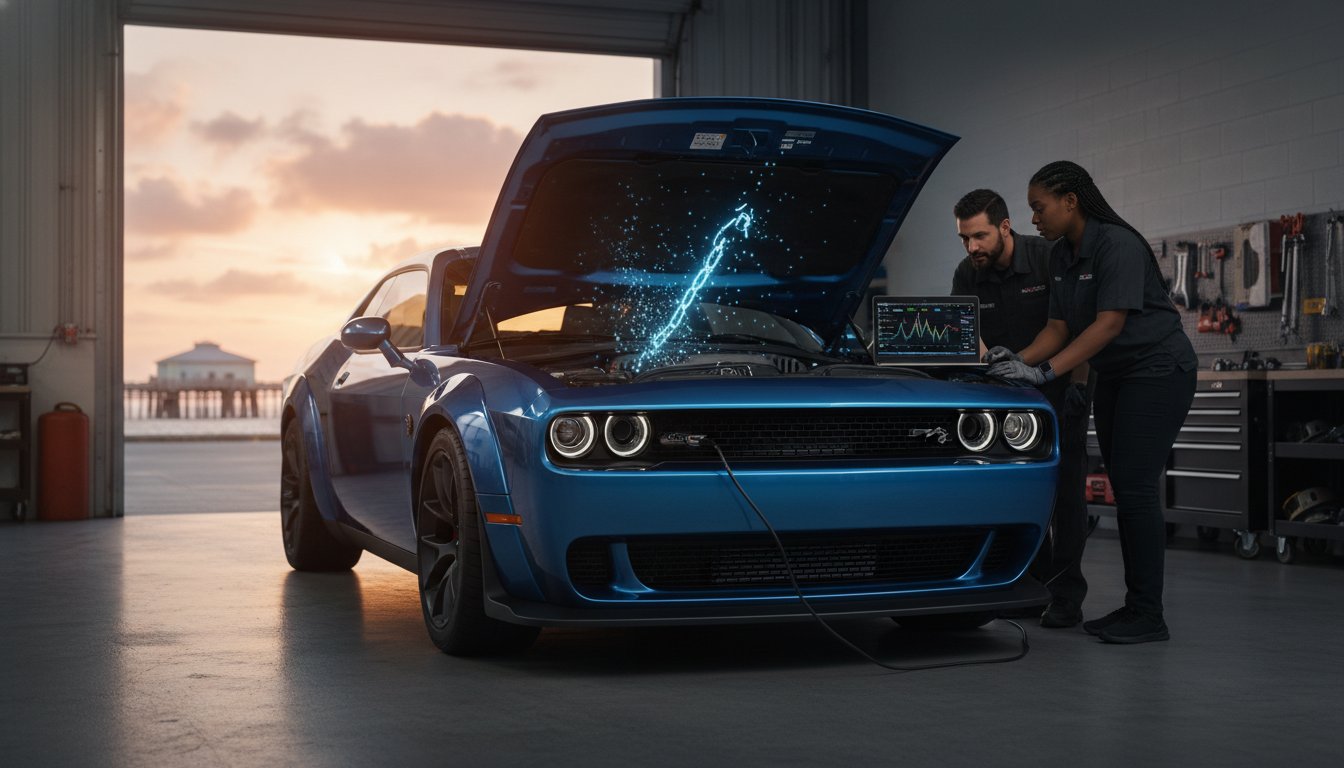
Your high-performance engine is fighting a digital leash that prioritizes component longevity over your desire for speed. You've likely experienced that annoying power dip during wide-open throttle shifts or a throttle pedal that feels disconnected from the engine's actual capability. To fix this, you must understand what is torque management and how to remove it without compromising your drivetrain's structural integrity.
We agree that nothing is more frustrating than a car that refuses to deliver 100% of the torque you've built it to produce. This guide will show you exactly how torque management acts as a multi-layered safety net and provide the professional steps required to safely disable these restrictions for maximum power. We will explore the essential role of PCM and TCM unlocking services, explain how custom e-mail tunes refine transmission logic, and show you how to achieve the crisp, immediate response your build deserves.
Key Takeaways
- Identify how factory torque management acts as a digital handbrake, intentionally limiting engine output to protect mechanical components.
- Recognize the specific performance penalties of aggressive software limits, including sluggish 1/4 mile launches and power dips during gear transitions.
- Discover exactly what is torque management and how to remove it through a structured process of PCM and TCM unlocking and calibration adjustment.
- Understand why strategic torque reduction is often superior to 100% removal for maintaining drivetrain longevity while maximizing power.
- Learn how professional custom e-mail tunes provide the precision required to optimize Dodge, RAM, Jeep, and GM platforms for immediate throttle response.
Understanding Torque Management: The Drivetrain's Digital Handbrake
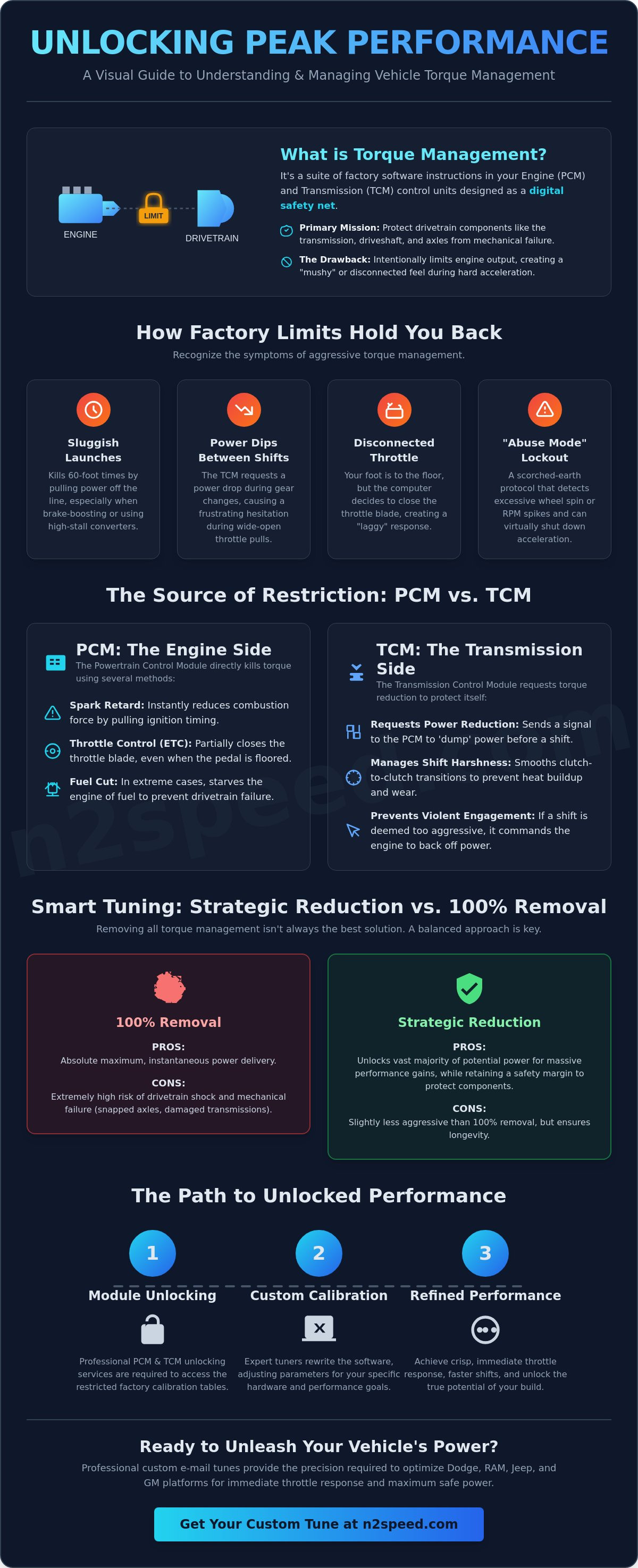
Torque Management (TM) is a complex suite of software instructions embedded within the Engine Control Unit (ECU) and Transmission Control Module (TCM). Its primary mission is to act as a digital safety net, protecting your transmission, driveshaft, and axles from mechanical failure. When the sensors detect high-stress scenarios, the software intervenes to limit the engine's output. While this helps a stock vehicle reach its warranty milestones, it creates a "mushy" feeling during hard acceleration that enthusiasts find restrictive. Understanding what is torque management and how to remove it is the first step toward reclaiming your vehicle's latent performance.
It's vital to distinguish between standard shift-point management and the more aggressive "Abuse Mode." Standard management gently reduces power during gear changes to smooth out the ride. Abuse Mode is a scorched-earth protocol that triggers when the computer detects excessive wheel spin or rapid RPM spikes. This mode can virtually shut down acceleration to prevent parts from snapping. To see these systems in action and understand the impact of their removal, watch this technical breakdown:
The Engine Side: PCM Intervention
The PCM utilizes several methods to kill torque instantly. Spark retard is the most common tool. By pulling ignition timing, the PCM reduces the force of the combustion event, dropping torque in milliseconds. Electronic Throttle Control (ETC) is another layer of restriction. Even if you've pinned the pedal to the floor, the PCM can command the throttle blade to close partially. In extreme Abuse Mode scenarios, the system may even implement a fuel-cut strategy, effectively starving the engine of power until the perceived threat to the drivetrain passes.
The Transmission Side: TCM Logic
The TCM is responsible for requesting torque reduction during gear changes. It manages clutch-to-clutch transitions to prevent internal heat buildup. If the TCM determines a shift will be too violent for the internal clutches, it sends a signal to the PCM to "dump" power until the next gear is fully engaged. This logic is what causes the dreaded power dip between gears. To bypass these factory-set limits, most modern vehicles require professional PCM & TCM unlocking services to access and modify the restricted calibration tables.
How Torque Management Limits Your Vehicle’s Performance
Factory calibrations prioritize mechanical longevity over raw acceleration. This results in a significant performance ceiling that prevents your build from reaching its true potential. When enthusiasts ask what is torque management and how to remove it, they're usually reacting to the sluggish behavior of the vehicle at the drag strip or during spirited driving. The system creates a "dead spot" where the engine should be pulling hardest, effectively neutering your hardware's output to stay within safe factory margins.
Launch Lag and 60-Foot Times
Drag racers often utilize "brake boosting" to build manifold pressure before the green light. Modern automotive torque management software often detects this simultaneous application of brake and throttle as a fault. It responds by pulling timing or closing the throttle plate. This prevents the engine from reaching full torque until the vehicle reaches a specific speed or RPM threshold. For those running high-stall converters, "torque truncation" is a major hurdle. The ECU sees the rapid RPM rise of a high-stall setup and prematurely limits output, killing your 60-foot times before you've even left the tree.
Factory settings are notoriously conservative. Engineers design these maps for the lowest common denominator of driver and fuel quality. When you install aftermarket hardware like a supercharger or an aggressive camshaft, the disparity grows. The stock software isn't programmed to handle the massive torque spikes these mods produce. Instead of rewarding you with power, the computer sees the extra air and fuel as an "over-torque" condition and pulls spark to protect the drivetrain.
Shift Recovery and Power Band Gaps
The "torque hole" is the most noticeable performance killer during wide-open throttle shifts. As the transmission moves from one gear to the next, the TCM and PCM communicate to drop power. This ensures a smooth transition but leaves a gap in the power band. In high-horsepower applications like the Hellcat platform, this feels like the car is "stumbling" into the next gear. This happens because modern ECUs rely on complex torque modeling. They calculate how much torque the engine should be making based on airflow and spark. If the real-world output exceeds the model, the digital handbrake applies. Achieving a seamless power curve requires a recalibration of these internal models. Our custom e-mail tunes address these specific logic gaps to ensure your engine and transmission work in perfect synchronization.
Removing Torque Management: Performance Gains vs. Drivetrain Risk
The most common objection to modifying factory software is the fear of catastrophic mechanical failure. Many enthusiasts worry that disabling these protections will immediately snap a driveshaft or burn up a clutch pack. When researching what is torque management and how to remove it, you must distinguish between total removal and strategic reduction. While factory settings are overly cautious, 100% removal on a stock drivetrain can lead to premature wear. The goal is to find the balance where the vehicle responds instantly without exceeding the physical yield strength of the hard parts.
Built transmissions actually require the removal of torque management to function as intended. High-performance clutch materials and reinforced input shafts are designed to handle rapid, high-pressure engagement. Keeping factory torque reduction active on a built unit causes the transmission to "fight" the engine, leading to inconsistent shift feel and slower ETs. This relationship is documented in the SAE Technical Paper on Torque Management, which highlights how these systems are integrated to manage load during gear transitions.
The Benefits: Crisper Shifts and Instant Response
Reducing torque intervention eliminates the frustrating delay between your right foot and the tires. This modification results in shifts that are fast and decisive rather than "slushy" or drawn out. Paradoxically, reducing torque management can actually improve transmission longevity in high-output applications. By shortening the shift duration, you reduce the time the internal clutches spend slipping. This minimizes heat buildup, which is the primary killer of automatic transmissions. This optimization is a core component of professional Hellcat custom tuning, where every millisecond of power delivery counts toward a faster time slip.
The Risks: Mechanical Limits of Stock Components
Every drivetrain has a finite torque capacity. A stock 8HP70 or 6L80 transmission can only handle so much force before the internal components reach their limit. On street tires, the lack of traction often acts as a "fuse" that protects the drivetrain. However, once you add drag radials or slicks, the full force of a zero-torque-reduction shift is transferred directly to the sun gears and axles. Professional calibration is essential here. An expert tuner doesn't just "turn off" the settings; they recalibrate the torque models to match your specific hardware. This "sweet spot" ensures the shifts are firm enough to prevent slip but controlled enough to keep the hard parts in one piece. For those pushing extreme power, our PCM & TCM unlocking services provide the necessary access to these critical safety tables.
How to Disable or Reduce Torque Management (PCM & TCM Tuning)
Disabling factory restrictions requires a systematic approach to both the Engine Control Module and the Transmission Control Module. For anyone asking what is torque management and how to remove it, the process begins with gaining access to the protected calibration layers of your vehicle's software. This is not a simple "on/off" switch. Instead, it involves a multi-step workflow of unlocking hardware, reading existing data, and precisely modifying torque models to ensure the engine and transmission communicate without digital interference.
The Necessity of PCM & TCM Unlocking
Since 2015, manufacturers like Dodge, Chrysler, Jeep, RAM, and GM have utilized encrypted modules to prevent unauthorized calibration changes. This encryption acts as a firewall. You cannot modify torque tables if the hardware remains locked. Utilizing a professional PCM unlock service is the vital first step for these platforms. TCM unlocking is equally critical. If you only tune the PCM, the transmission will still request torque reduction during shifts, leaving your performance gains on the table. Both modules must be synchronized to achieve a seamless power curve.
Software Tools: HP Tuners and Diablosport
Accessing hidden torque tables requires sophisticated interfaces. Tools like HP Tuners provide the granularity needed to adjust "Peak Torque" and "Torque Model" tables. Many novice tuners make the mistake of simply zeroing out every management table they find. This often triggers limp mode or erratic shifting because the ECU can no longer calculate load accurately. Professional calibration involves adjusting individual constants and shift-time variables rather than using global switches. This ensures the transmission maintains enough pressure to prevent clutch slip while removing the "lag" associated with factory settings.
The final stage of removal is iterative refining through datalogging. By using the VCM Scanner or similar diagnostic tools, you can monitor spark retard and throttle blade position during wide-open throttle (WOT) runs. If the logs show the PCM is still pulling timing during a shift, the torque model requires further adjustment. For enthusiasts who want the highest level of precision without the steep learning curve, our custom e-mail tunes provide a calibrated solution based on thousands of hours of real-world R&D. This mail-in approach is the safest route to ensure your drivetrain remains reliable while delivering maximum output.
Professional Calibration: Why N2 Speed is the Expert Choice
Navigating the intricacies of modern engine and transmission logic requires more than just access to tuning software. The learning curve for complex torque modeling is steep. Miscalculating a single constant in the Virtual Torque tables can lead to erratic engine behavior, limp mode, or transmission failure. This is why professional calibration is essential for those seeking to understand what is torque management and how to remove it safely. Our team specializes in the nuanced requirements of Dodge, RAM, Jeep, and GM platforms, ensuring your software modifications match your hardware capabilities perfectly.
We utilize remote email tuning to provide enthusiasts with world-class calibration without the need for a local dyno shop. This process allows us to review your specific datalogs and refine the torque limits based on real-world driving conditions. We prioritize protecting your drivetrain by maintaining essential safety margins while simultaneously maximizing your horsepower and torque delivery. Our experience across thousands of platforms allows us to identify the exact point where performance gains meet mechanical limits.
Custom Tailored Torque Logic
A generic "delete" of all management tables is a reckless approach to tuning. We don't just remove the digital leash; we optimize the logic for your specific build. For high-output platforms like the Corvette, we focus on linear power delivery that enhances traction rather than overwhelming it. Our calibrations ensure that part-throttle driving remains smooth and predictable for daily use, while wide-open throttle performance becomes aggressive and immediate. This balanced approach provides the best of both worlds: drivability and raw power.
Ready to Unlock Your Power?
The transformation from a "stock lazy" feel to a "tuned responsive" machine is profound. By recalibrating how your PCM and TCM interact, we eliminate the delays that hinder your driving experience. You've invested in the hardware; it's time to ensure the software allows it to perform. If you're ready to experience the full potential of your vehicle, Contact N2 Speed for a Custom Tune today. We invite you to explore our PCM Bench Tune services for specialized modifications, including MDS delete and speed limiter removal, to complete your performance profile.
Reclaim Your Vehicle's Latent Performance
Torque management serves as a software-based restriction that prioritizes conservative factory margins over your vehicle's genuine capability. By addressing the digital handbrake within both the PCM and TCM, you eliminate the shift delays and launch lag that compromise your 1/4 mile times and daily drivability. Understanding what is torque management and how to remove it is the final step in transitioning from a stock cruiser to a track-ready machine that responds instantly to every input.
Achieving this transformation requires precision calibration that balances immediate throttle response with drivetrain structural integrity. We specialize in Dodge Hellcat and GM LT/LS platforms, providing expert PCM/TCM unlocking services and sophisticated remote tuning available nationwide. These professional services ensure your hardware modifications aren't neutered by restrictive factory logic or outdated torque models.
Get Your Custom N2 Speed Performance Tune Today and experience the crisp, immediate power your build was designed to deliver. You've built the engine for performance; it is time the software matches that ambition. We are ready to help you unlock the full potential of your drivetrain.
Frequently Asked Questions
Can I remove torque management with a cheap handheld programmer?
Most entry-level handheld programmers offer limited control over complex torque tables and often lack the granularity needed for modern platforms. While some "canned" tunes claim to reduce management, they frequently fail to address the underlying TCM logic or peak torque models required for a complete solution. Professional calibration using specialized hardware is the only way to achieve a comprehensive result when you are looking at what is torque management and how to remove it effectively.
Will removing torque management void my vehicle's warranty?
Modifying the factory calibration will almost certainly void your powertrain warranty. Dealership service departments can detect that the PCM or TCM has been flashed by checking the internal flash counter or checksum values. If a mechanical failure occurs in the transmission or engine, the manufacturer will likely deny the claim based on the unauthorized software changes found within the modules.
Does torque management affect manual transmission cars?
Manual transmission vehicles utilize torque management to protect the clutch and prevent drivetrain shock during aggressive driving. The PCM may pull ignition timing or limit throttle opening during rapid shifts or high-RPM launches to safeguard the input shaft and rear differential. While less intrusive than automatic setups, manual platforms still benefit from recalibrated torque modeling to ensure linear power delivery across the entire RPM range.
What is the difference between traction control and torque management?
Traction control reacts to wheel speed sensor data to prevent tire slip, while torque management is a proactive software limit designed to protect internal drivetrain components. Traction control often uses the ABS system to apply brakes to a spinning wheel or cut power after slip occurs. Torque management intervenes directly at the engine and transmission level by reducing output before mechanical stress exceeds factory-set limits.
Why did the manufacturer put torque management in my car to begin with?
Manufacturers implement these limits to maximize component longevity and minimize warranty expenses across the vehicle's lifespan. By restricting the peak torque delivered during gear changes or from a standing start, they reduce the likelihood of internal transmission failure or axle breakage. This allows them to use lighter components that meet the needs of the average driver while maintaining a reliable service life under standard conditions.
How do I know if my PCM needs to be unlocked before I can adjust torque settings?
Dodge, Chrysler, Jeep, and RAM vehicles from the 2015 model year and newer require a physical PCM unlock to bypass factory encryption. Many GM platforms from 2017 onwards also feature locked modules that prevent calibration changes. If your tuning device cannot read or write to the vehicle, you likely need a professional unlocking service to gain access to the restricted torque management tables.
Will removing torque management improve my gas mileage?
Removing torque management is a performance-oriented modification and does not typically result in improved fuel economy. In some cases, the more aggressive driving style enabled by faster throttle response and firmer shifts can lead to a slight decrease in MPG. The primary goal of this adjustment is to optimize power delivery and shift firmness rather than enhancing fuel efficiency metrics.
What happens if I remove too much torque management on a stock transmission?
Eliminating too much torque reduction on a stock transmission can lead to rapid mechanical failure or internal clutch slippage. Without sufficient power reduction during shifts, the internal components may experience excessive heat or the input shaft could snap under the sudden load. Finding the balance between performance and reliability requires professional calibration to ensure the transmission survives the increased stress of high-output runs.
Related N2 Speed Tuning Services
- Dodge Challenger 5.7L HEMI tuning
- Dodge Charger 5.7L HEMI tuning
- Dodge Durango 5.7L HEMI tuning
- Jeep Grand Cherokee 5.7L HEMI tuning
- HEMI MDS delete & speed limiter removal
Questions about your build? Call (954) 406-8550 or email sales@n2speed.com.