
Posted by N2 Speed on Jun 29th 2026
Dyno Tune vs Street Tune: Which Is Better?
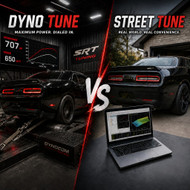
Dyno Tune vs Street Tune: The Complete Comparison
If you're considering getting your car tuned, you've probably heard the terms "dyno tune" and "street tune" (also called remote tune or email tune). Both can unlock serious power from your engine, but they work differently. Here's what you need to know before choosing.
What Is a Dyno Tune?
A dyno tune is performed on a dynamometer - a machine that simulates road load while your car is stationary. The tuner straps your vehicle to the dyno and makes real-time adjustments while watching air/fuel ratios, ignition timing, and power output on screen.
Pros of dyno tuning:
- Real-time data feedback during the tuning process
- Precise horsepower and torque measurements
- Great for forced induction setups (superchargers, turbos) that need careful boost calibration
- You can see before/after dyno pulls immediately
Cons of dyno tuning:
- Must drive to a shop with a dyno - not always nearby
- Typically costs $400-$800+ per session
- Results can vary based on the dyno (Dynojet vs Mustang dyno reads differently)
- Not ideal for daily driver refinements and drivability concerns
What Is a Street Tune (Remote / Email Tune)?
A street tune is calibrated by a professional tuner who works remotely. You send your tune file (via HP Tuners RTD or similar device), the tuner writes a custom calibration based on your mods and driving conditions, and you flash it to your vehicle. After driving, you send a data log back and the tuner refines the tune.
Pros of street/remote tuning:
- No need to drive to a shop - done from home
- Tuner optimizes for real-world driving conditions (temperature, altitude, fuel quality)
- Usually includes multiple revisions until the tune is perfect
- More affordable - typically $150-$350
- Focuses on drivability, not just peak numbers
Cons of street/remote tuning:
- No instant dyno numbers (though you can dyno after to verify)
- Takes a few revision cycles to dial in perfectly
- Requires a tuning device (HP Tuners RTD, MPVI4, or Diablosport)
Which Gets Better Results?
Here's the truth most tuners won't tell you: the tuner matters more than the method. A great remote tuner will outperform a mediocre dyno tuner every time. The calibration knowledge, experience with your specific platform, and attention to drivability are what make the difference.
For most bolt-on and naturally aspirated builds (Stage 1 and Stage 2), a remote/email tune delivers excellent results at a fraction of the cost. For high-boost forced induction setups (Stage 3+), a dyno tune has the edge for dialing in boost curves safely.
N2 Speed Remote Tuning
At N2 Speed, we specialize in remote/email tuning for Dodge Challenger, Charger, RAM, Corvette, and more. Our tuners have calibrated thousands of vehicles using HP Tuners and Diablosport. Every tune includes multiple revisions until you're satisfied with the drivability and power delivery.
View our PCM unlock and tuning services or contact us to get started.
Our rule of thumb
| Your build | What we recommend |
|---|---|
| Stock to bolt-ons (intake, exhaust, headers) | Remote tune. A dyno adds cost, not power. |
| MDS delete, speed limiter, tire/gear correction, shift quality | Remote tune. These are calibration changes, not power hunting. |
| Cam and heads, naturally aspirated | Remote works well with good datalogs; dyno is a nice-to-have. |
| Supercharger or turbo, pulley/injector changes | Remote is very doable with disciplined logging; dyno preferred if you are chasing the last few percent. |
| Race fuel, nitrous, high boost, competition | Dyno or in-shop. Don't develop that on public roads. |
What we need from you to start
- Year, model, engine, and transmission
- Full and honest mod list, including anything a previous owner or shop did
- Fuel you will actually run (91, 93, E85, mixed)
- Your goal — daily drivability, track, towing, max power
- Whether your PCM has been unlocked yet (2015+ Dodge/Jeep/RAM/Chrysler needs it)
Related N2 Speed Tuning Services
- Dodge Charger 5.7L HEMI tuning
- Dodge Challenger 5.7L HEMI tuning
- Corvette remote tuning
- Ford Mustang & F-150 remote tuning
- remote custom tuning
Questions about your build? Call (954) 406-8550 or email sales@n2speed.com.