

Posted by N2 Speed on Mar 20th 2026
7 Signs of a Bad Engine Tune to Watch For
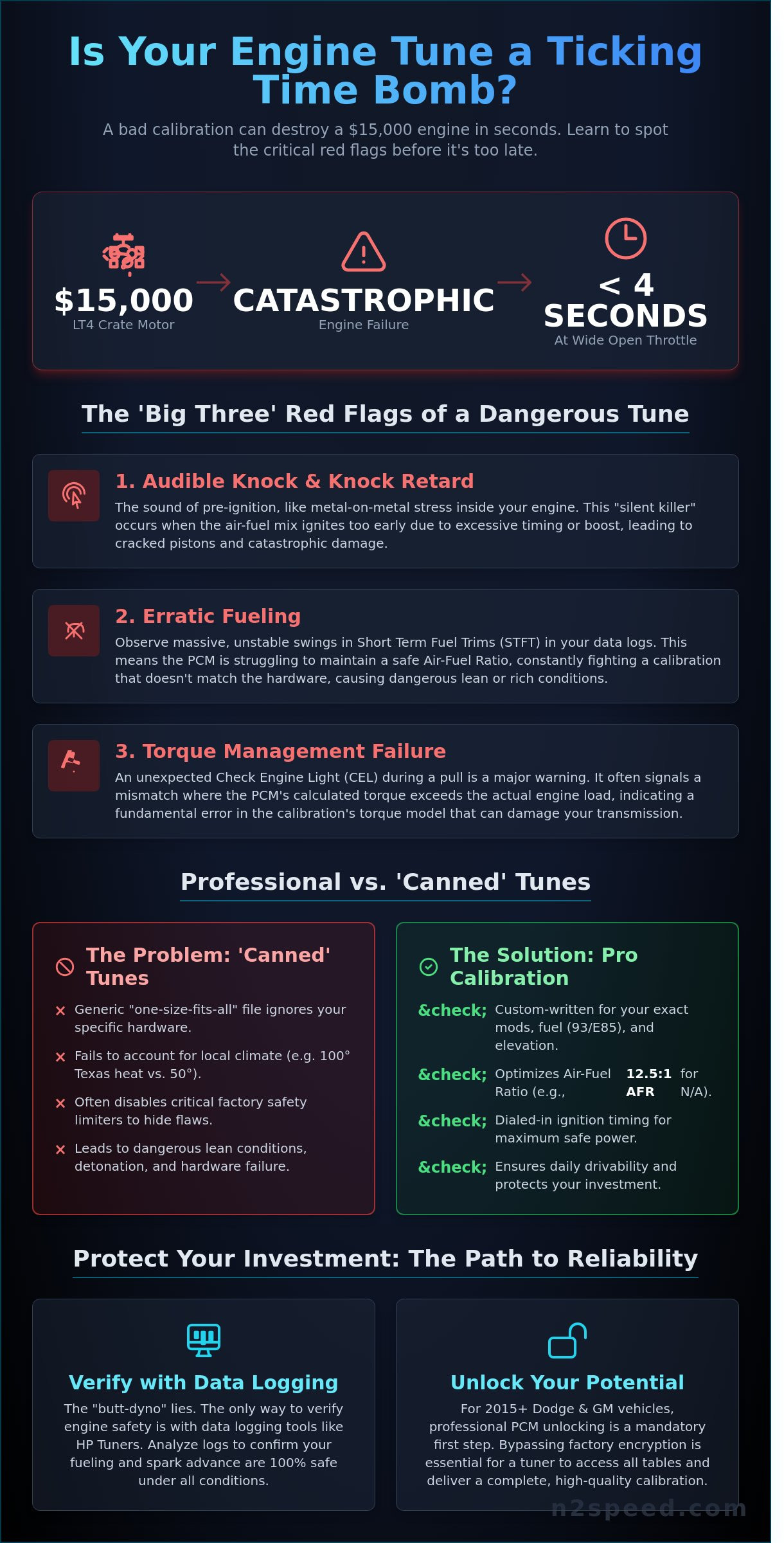
A $15,000 LT4 crate motor can be reduced to a pile of scrap metal in less than 4 seconds of wide-open throttle if your calibration is off. You didn't invest in high-flow injectors and forced-induction upgrades just to have the car stumble at a stoplight or surge during a 60-mph roll. It's a common frustration for HEMI and GM owners who receive a file that delivers peak horsepower on a dyno sheet but fails in real-world drivability. Recognizing the signs of a bad engine tune is the only way to protect your performance investment from a catastrophic lean condition or excessive spark knock.
Reliability is non-negotiable when you're pushing a vehicle's limits. You've likely heard conflicting advice from different shops, but the data doesn't lie. We're going to give you a clear checklist of symptoms that indicate your PCM or TCM programming is dangerous. This guide covers how to use HP Tuners data logs to verify your fueling and spark advance with 100% certainty. You'll learn to spot a failing calibration early and find a professional partner who delivers the 100-plus horsepower results your build deserves without compromising the hardware.
Key Takeaways
- Distinguish between routine maintenance and precision electronic calibration to understand how modern PCM maps control your vehicle's performance potential.
- Identify the critical signs of a bad engine tune, such as audible knock and erratic fueling, to prevent permanent damage to your pistons and internals.
- Learn why data logging with tools like HP Tuners VCM Scanner is the only reliable way to verify engine safety and move beyond "butt-dyno" guesswork.
- Discover why professional PCM unlocking is a mandatory first step for 2015+ Dodge and GM platforms to bypass factory encryption and achieve a high-quality calibration.
- Master the immediate recovery steps and mechanical health checks required to protect your investment and restore your engine's reliability.
Performance Calibration vs. Maintenance: What is a 'Bad Tune'?
Many drivers confuse a standard maintenance interval with a professional performance calibration. A traditional tune-up usually involves replacing NGK spark plugs, swapping a dirty air filter, or cleaning a throttle body every 30,000 miles. When we discuss high-performance vehicles like the HEMI or LT platforms, the definition shifts entirely. What is engine tuning? In a modern context, it's the precise digital manipulation of the Power Control Module (PCM) to optimize how the engine processes air, fuel, and spark. A bad tune isn't just a missed oil change; it's a fundamental error in the software instructions that govern your engine's life.
Modern PCM and ECM maps act as the central nervous system for your performance modifications. Whether you've added a ProCharger or a simple cold air intake, the factory computer doesn't automatically know how to handle the increased airflow. You're relying on a tuner to rewrite the fueling tables and ignition curves. The stakes are incredibly high for modern engines. For example, adding just 1 degree of excessive timing at 6,000 RPM on a 6.4L HEMI can result in immediate detonation. This leads to cracked piston ring lands and a bill for a $10,000 short block. Recognizing the signs of a bad engine tune before this happens is the difference between a fast car and a paperweight.
To better understand the risks involved with poor calibration, watch this breakdown of how incorrect parameters lead to mechanical failure:
A professional tuner's job is to find the sweet spot where power meets reliability. It's a delicate balancing act. They must ensure the engine makes peak torque while maintaining daily drivability and safety. If the calibration is aggressive but lacks smooth transition tables, the car will feel jerky in stop-and-go traffic. Data logging through tools like HP Tuners or Diablosport allows us to see exactly how the engine reacts to different loads. If the data shows high knock retard or erratic fuel trims, those are clear signs of a bad engine tune that needs immediate correction.
The Goal of a Professional Performance Tune
A quality calibration focuses on optimizing Air-Fuel Ratios (AFR) for your specific hardware. For a naturally aspirated build, we target a 12.5:1 AFR at Wide Open Throttle. We also adjust ignition timing based on fuel octane, such as 93 pump gas or E85. Finally, the TCM is synced with engine torque to prevent clutch slippage during high-RPM shifts.
Why Amateur or 'Canned' Tunes Often Fail
Generic "one-size-fits-all" files ignore local variables. A file written for a 50-degree climate can fail in 100-degree Texas heat. These tunes often disable safety limiters that protect against heat soak. Without these protections, the PCM cannot pull timing when intake temperatures skyrocket. This negligence leads to lean conditions and permanent hardware damage that custom calibrations prevent.
The 'Big Three' Red Flags of a Dangerous Engine Tune
A bad calibration isn't just a nuisance; it's a mechanical liability that can lead to catastrophic failure. Identifying the signs of a bad engine tune early can save a $10,000 long block from the scrap heap. The most critical red flags involve combustion instability, fueling errors, and erratic torque management. When a PCM receives conflicting data or forced parameters that exceed physical limits, the vehicle reacts with physical symptoms that indicate severe internal stress.
- Audible Knock: The sound of metal-on-metal stress within the combustion chamber.
- Erratic Fueling: Massive swings in Short Term Fuel Trims (STFT) that the computer cannot stabilize.
- Torque Management Failure: Unexpected Check Engine Lights (CEL) triggered because the calculated torque doesn't match the actual load.
Knock Retard: The Silent Engine Killer
Pre-ignition occurs when the air-fuel mixture ignites before the spark plug fires, often due to excessive ignition timing or high boost levels. You'll hear this as "pinging" or a "marbles in a tin can" sound during wide-open throttle (WOT) pulls. Professional tuners monitor Knock Retard (KR) in real-time to pull timing and protect the engine. A dangerous tune often hides these issues by "desensitizing" or "tuning out" knock sensors to prevent the PCM from pulling power. This is a recipe for cracked ring lands and melted pistons. If your scanner shows 4 to 8 degrees of KR consistently, your timing map is far too aggressive for your fuel octane.
AFR Imbalance: Black Smoke vs. Melting Spark Plugs
Fueling must be precise to maintain engine health. Running "rich" results in heavy soot, a strong raw gas smell, and fuel dilution in your oil. While rich is "safe" in the short term, it kills catalytic converters and fouls plugs. Conversely, running "lean" is lethal. Lean conditions spike Exhaust Gas Temperatures (EGTs), often exceeding 1,600 degrees Fahrenheit, which melts electrode tips and compromises cylinder heads. A quality calibration must account for cold starts and barometric pressure changes at high altitudes. Some low-quality tuners bypass these safety checks, ignoring the dangers of aftermarket defeat devices that sacrifice emissions and engine longevity for marginal gains.
Drivability and Transmission Surging
Power is useless if the car is undrivable in traffic. One of the most common signs of a bad engine tune is "hunting" or surging, where the PCM cannot find a steady idle or cruise RPM. This often stems from improper airflow modeling or torque management errors in the software. In modern Mopar and GM platforms, a poor NAG1 or 8HP transmission tune causes the car to stumble between gears or hesitate during downshifts. You might experience severe throttle lag when stepping on the gas or stalling at stoplights. These issues indicate that the engine and transmission controllers aren't communicating correctly. If your car feels like it's fighting itself during low-speed maneuvers, the calibration logic is flawed. You should review your data logs with a professional before a small drivability glitch becomes a total mechanical failure.
Technical Diagnostics: Using Data Logs to Spot a Bad Tune
Relying on the "butt-dyno" to evaluate a calibration is a dangerous game for any enthusiast. While a car might feel faster due to aggressive throttle mapping, the internal data could tell a story of impending engine failure. Professional diagnostics require high-speed data logging to see exactly what is happening inside the cylinders. Tools like the HP Tuners VCM Scanner allow you to monitor 50+ parameters per second, providing a granular view of engine health. If you don't verify your data, you're just guessing with an expensive piece of machinery.
To diagnose issues effectively, you need to understand how the Engine Control Module (ECM) works as a closed-loop system. The ECM constantly adjusts variables based on sensor feedback to maintain specific targets. One of the most obvious signs of a bad engine tune is a PCM that's constantly fighting the calibration. When the programmed tables don't match the physical reality of the airflow or fuel delivery, the computer has to work overtime to prevent a lean condition or catastrophic knock.
Understanding Fuel Trims (STFT & LTFT)
Fuel trims are the primary indicator of fueling health and calibration accuracy. Short Term Fuel Trims (STFT) represent immediate, real-time adjustments based on O2 sensor readings. If these numbers are constantly swinging wildly by 15% or more, your air-fuel ratio is unstable. Long Term Fuel Trims (LTFT) represent the PCM's 'memory' of fueling corrections over time. In a well-calibrated setup, these trims should stay within a tight +/- 5% range during steady-state driving.
When you see trims exceeding +/- 10%, it's a clear red flag. Positive trims mean the PCM is adding fuel because the engine is running lean, often due to a vacuum leak or an incorrectly scaled Mass Air Flow (MAF) sensor. Negative trims indicate the system is pulling fuel because the mixture is too rich. If your LTFT sits at +22% at idle, your tune is fundamentally flawed or your hardware is failing. High-performance engines require precision, not massive software compensations to stay running.
Monitoring Knock Retard (KR) in Real-Time
Knock Retard is the most critical safety metric to monitor during any data log. It occurs when the PCM detects detonation and pulls ignition timing to protect the pistons. While 0.5 to 1.0 degrees of "burst knock" during a rapid throttle transition is often a predicted safety measure, actual KR during a wide-open throttle pull is unacceptable. Seeing 4.0 or 6.0 degrees of timing pull at 5,500 RPM is a definitive sign of a bad tune or poor fuel quality that cannot support the requested advance.
Distinguishing between mechanical noise and actual detonation is key for high-output builds. Using professional tuning devices to capture data during a 3rd-gear pull provides the evidence needed to fix the spark curve. If the log shows consistent KR in the same load cells, the timing is too aggressive for the setup. Reliable power comes from a clean log with zero knock and stable spark advance, ensuring the engine lives to see the next track day without melting a spark plug or cracking a ring land.
Why Custom Remote Tuning is the Solution for Modern PCM Locks
Modern performance vehicles built after 2015 present a unique challenge that older platforms didn't face. Manufacturers like Dodge and GM moved to encrypted engine control modules to prevent unauthorized software changes. If you're noticing signs of a bad engine tune, such as surging at partial throttle or inconsistent boost levels, it's often because a cut-rate tuner tried to bypass these security layers without the proper hardware. Professional PCM unlocking is the mandatory first step for any 2015+ Mopar or GM build. Without a clean unlock, the controller won't accept the high-resolution maps required for forced induction or aggressive cam profiles.
Remote e-mail tuning has evolved into the gold standard for enthusiasts who don't live near a world-class shop. You get access to elite calibrators who specialize in specific platforms, using tools like the HP Tuners RTD or MPVI3. This isn't a "canned" flash drive tune. It's a bespoke calibration built from the ground up. By analyzing 15 to 20 different data parameters, a remote tuner can identify why your car is pulling 4 degrees of timing or why the air-fuel ratio is dipping into the dangerous 10.5:1 range under load.
The Remote Tuning Process Explained
The process starts with a base file designed to get your engine running safely. You'll perform an initial startup and a low-load driving cycle while recording data. You then send these logs back to the tuner for refinement. This iterative cycle is what separates a professional build from a dangerous one. One-and-done tunes are rarely optimal for modified cars because they don't account for local fuel quality or specific mechanical tolerances. A high-quality remote tune typically requires 3 to 5 revisions to dial in the MAF or Speed Density tables perfectly.
Platform-Specific Tuning Needs (Hellcat & Corvette)
High-output platforms require specialized logic that generic shops often overlook. For Mopar owners, Dodge Hellcat custom tuning involves managing the complex bypass valve logic and ensuring the GPEC2A or GPEC5 controllers aren't fighting the increased airflow from a pulley swap. On the GM side, unlocking the potential of the C7 and C8 Corvette requires deep knowledge of the E90 and E99 ECMs. These vehicles rely heavily on torque-mode modeling; if these tables are wrong, the car will feel sluggish despite making more boost.
- TCM Tuning: Modern 8-speed and 10-speed automatics like the 8HP90 or 10L90 require their own calibrations to handle 700+ lb-ft of torque without slipping.
- Data Accuracy: Using a wideband O2 sensor is non-negotiable for remote tuning to ensure the commanded lambda matches the actual exhaust output.
- Safety Margins: Professional remote tuners leave room for weather changes and varying octane levels to prevent catastrophic engine failure.
Identifying the signs of a bad engine tune early can save you thousands in repair costs. If your vehicle is hesitating or showing erratic fuel trims, it's time to move to a platform-specific solution that utilizes real-world data logging. Don't settle for a generic file when your engine's longevity is on the line.
How to Fix a Bad Tune and Restore Your Vehicle's Potential
Fixing a compromised calibration requires a systematic approach that separates mechanical failure from software errors. Identifying the signs of a bad engine tune is only half the battle; you must act quickly to prevent permanent hardware damage. Follow these five steps to stabilize your engine and recover lost performance.
- Step 1: Cease aggressive driving immediately. If you notice audible pinging or see your Air-Fuel Ratio (AFR) climbing past 12.5:1 under boost, park the vehicle. High cylinder temperatures can destroy ring lands or rod bearings in less than 3 seconds of sustained wide-open throttle.
- Step 2: Perform a comprehensive mechanical health check. Pressure test the intake system for boost leaks. A leak as small as 2 PSI causes the turbocharger to overspin to meet target boost, which the PCM often interprets as a tuning error. Verify spark plug gaps; high-performance HEMI or Coyote builds often require a tight 0.026 to 0.028 inch gap to prevent spark blowout.
- Step 3: Capture a high-resolution data log. Use a professional interface like an HP Tuners MPVI3 to record at least 100Hz. You need to monitor Short Term Fuel Trims (STFT), Long Term Fuel Trims (LTFT), and Knock Retard. If your total fuel trims exceed 15%, the software isn't properly scaled for your injectors or airflow.
- Step 4: Consult a calibration specialist. Reach out to the experts at N2 Speed. We analyze your logs to determine if the issue lies in the spark advance tables, torque management, or incorrect sensor scaling.
- Step 5: Flash a verified calibration. Replace the faulty file with a custom-engineered calibration designed for your specific hardware stack. This ensures the PCM and TCM communicate correctly, especially on newer 2021+ vehicles with encrypted controllers.
Sometimes, the damage is too severe, and a full engine rebuild isn't financially practical. If a bad tune has already turned your performance build into a non-runner, it's helpful to know your options for recouping some of your investment. For vehicle owners in the region, you can discover Cash For Junk Cars Michigan to get a fair offer for damaged or non-working cars.
Mechanical vs. Software: Ruling Out Parts Failure
Hardware issues frequently masquerade as software glitches. A hairline crack in an exhaust manifold before the O2 sensor allows fresh air into the stream, tricking the sensor into reporting a lean condition. The PCM then dumps 20% more fuel to compensate, causing a rich stumble that feels like a bad tune. Always verify fuel quality; 91 octane gas in a tank mapped for 93 octane will trigger immediate knock sensors and power pulled by the ECU.
Choosing the Right Tuning Partner
If you've confirmed the signs of a bad engine tune through data, don't settle for a generic canned map. You need a partner with specific experience in complex architectures like GPEC5 controllers or 10-speed transmission logic. N2 Speed provides remote tuning solutions that prioritize drivability and engine longevity over "glory pulls" on a dyno. We offer dedicated support and revision cycles to ensure your vehicle handles daily traffic as well as it handles the drag strip. Our calibrations unlock your vehicle's true potential by balancing aggressive power delivery with the safety margins required for long-term reliability.
Secure Your Horsepower with Precision Calibration
Don't leave your engine's longevity to chance when a single lean spike can melt a piston. Identifying the signs of a bad engine tune, like erratic idle or high knock retard, is the first step toward saving your investment. Whether you're running a Dodge RAM or a late-model Corvette, precision matters. Modern platforms like the GPEC5 or E90 controllers require specialized PCM unlocking and expert calibration to perform safely. N2 Speed leverages 15 years of industry experience to provide remote e-mail tuning that enthusiasts across 50 states trust. We use professional tools like HP Tuners and Diablosport to ensure your data logs reflect power, drivability, and reliability. It's time to stop guessing and start driving with confidence. Unlock your vehicle's true potential with N2 Speed's expert custom tuning services. Your build deserves a calibration that matches its hardware.
Frequently Asked Questions
Can a bad tune cause my engine to fail instantly?
Yes, a bad tune can cause catastrophic engine failure in seconds. If your air-fuel ratio exceeds 12.5:1 on a forced-induction setup, you risk melting a piston during a single wide-open throttle pull. High cylinder pressures from excessive ignition timing lead to detonation that shatters ring lands immediately. Always monitor your wideband O2 sensor to ensure your calibration remains within safe parameters.
Will a bad tune always trigger a Check Engine Light?
No, a bad tune won't always trigger a Check Engine Light. Many sub-par calibrations involve disabling specific Diagnostic Trouble Codes (DTCs) to hide underlying issues like lean spikes or misfires. You might experience stuttering or poor drivability without a single code appearing on your dash. This is why data logging with HP Tuners VCM Scanner is essential to identify the signs of a bad engine tune that the PCM is ignoring.
Is a 'canned' tune from a handheld device safe for my Hellcat?
Canned tunes are rarely the safest option for a high-output platform like the Hellcat. While a handheld device might offer a 20 horsepower increase, it cannot account for your specific fuel quality or local density altitude. These generic files often run aggressive timing curves that lead to 4 or 5 degrees of knock retard. Professional custom tuning for the GPEC2A controller ensures your 6.2L HEMI stays safe under 11.6 PSI of boost.
How do I know if my transmission 'hunting' is a tune issue or a mechanical failure?
You can identify transmission hunting as a tune issue if the shift points fluctuate by 500 RPM or more under steady throttle. If the hunting disappears when you switch to manual mode, the problem lies in the TCM shift schedules rather than a mechanical clutch failure. We often see this in 8HP90 transmissions where the torque converter slip tables are incorrectly mapped. Mechanical failures usually involve slipping or metal debris in the fluid.
Can I revert to my stock tune if my custom tune is acting up?
You can revert to your stock tune as long as you saved the original read from your PCM. Using tools like HP Tuners, you simply select your factory file and perform a "Write Entire" to restore the OEM calibration. This process takes approximately 3 to 5 minutes depending on the controller type. It's the fastest way to determine if a drivability issue is caused by the new software or a failing hardware component.
What is the difference between an e-mail tune and a dyno tune?
An e-mail tune relies on data logs recorded during real-world driving, while a dyno tune happens in a controlled laboratory environment. E-mail tuning usually requires 3 or 4 revisions to perfect the drivability and wide-open throttle fueling. Dyno tuning allows a calibrator to hold the vehicle at specific RPM increments to find the exact MBT (Minimum Best Timing). Both methods are effective if the tuner understands the specific logic of your ECM.
Does a bad tune affect my car's emissions and fuel economy?
A bad tune significantly impacts both emissions and fuel economy. Incorrect fuel mapping can lead to a 15% drop in MPG and a 25% increase in hydrocarbon output, which eventually clogs your catalytic converters. If your long-term fuel trims are adding more than 10% fuel at idle, your engine's working harder than necessary. Proper calibrations optimize the combustion cycle to ensure you aren't wasting fuel or damaging expensive exhaust components.
How much knock retard is considered dangerous during a pull?
Any knock retard exceeding 2 or 3 degrees during a wide-open throttle pull is considered dangerous. While a PCM might pull 0.5 degrees due to mechanical noise, sustained timing pulled by the knock sensors indicates pre-ignition. If you see 4.0 degrees or more on your scanner, you must let off the throttle immediately to prevent piston damage. This is one of the most critical signs of a bad engine tune that requires an immediate timing reduction.
Related N2 Speed Tuning Services
- Dodge Charger 5.7L HEMI tuning
- Dodge Challenger 5.7L HEMI tuning
- Dodge Charger 6.4L 392 tuning
- Dodge Challenger 6.4L 392 tuning
- Dodge, RAM & Jeep PCM / TCM unlocking
Questions about your build? Call (954) 406-8550 or email sales@n2speed.com.