
Mar 21st 2026
HP Tuners MPVI2: The Complete Guide to Unlocking Your Vehicle’s Potential
90% of enthusiasts leave 40 to 70 horsepower on the table because they're intimidated by the technical barrier between their laptop and their engine controller. You likely realize that factory calibrations are engineered for the average commuter rather than the performance driver, yet the complexity of licensing can feel like a major roadblock. Thousands of owners worry about the specific 2-credit or 4-credit costs for a GPEC2A or the risk of a failed write process during a critical update.
The mpvi2 remains a cornerstone of professional tuning, providing the high-speed data logging and calibration interface needed for serious results. We're going to demystify the HP Tuners ecosystem, explaining exactly how to pair your hardware with PCM unlocking services to ensure a successful installation. You'll learn the precise steps to load a custom e-mail tune and how to manage your hardware transition as we approach 2026. This guide provides the technical roadmap to turn your vehicle into a high-performance machine with data you can actually trust.
Key Takeaways
- Understand how this OBDII interface acts as the foundation for reading and writing high-performance calibrations to your PCM and TCM.
- Explore the Pro Feature Set and PROLINK+ integration to sync external analog signals, such as wideband O2 sensors, for advanced data logging.
- Compare the processing power and storage of the mpvi2 against the latest hardware generations to ensure your tuning setup remains competitive.
- Identify why modern Dodge and GM vehicles require a PCM unlock before your hardware can deliver professional remote calibrations.
- Master the essential checklist for performance success, from verifying vehicle compatibility to procuring the necessary Universal Credits.
What is the HP Tuners MPVI2? The Foundation of Modern Tuning
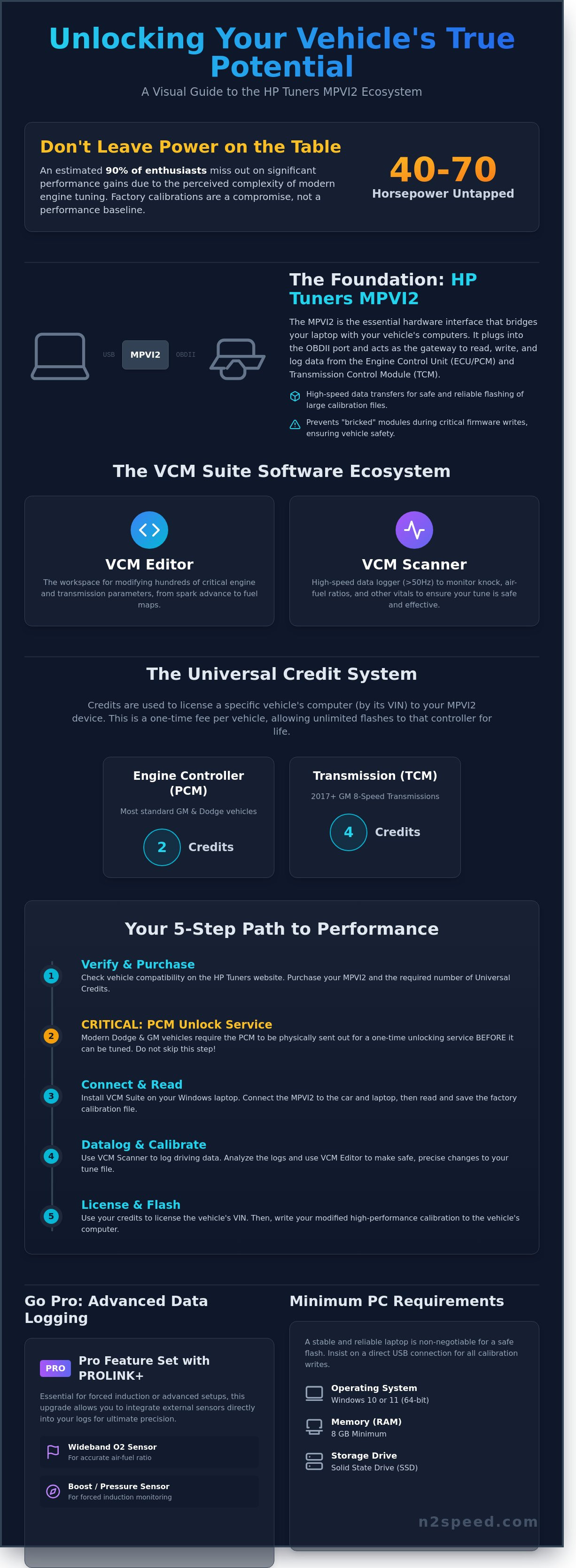
The mpvi2 is the essential hardware interface that bridges the gap between your vehicle’s internal computers and your tuning software. It's a compact OBDII device that plugs directly into the diagnostic port found under the dashboard of every vehicle built after 1996. This tool acts as the primary gateway to the Engine Control Unit (ECU), allowing you to pull factory binary files for professional modification. Without this hardware, the VCM Suite software has no way to communicate with the vehicle's proprietary networks.
Beyond just engine management, this interface handles the communication with the Transmission Control Module (TCM) and other peripheral controllers. For enthusiasts running late-model GM or Mopar platforms, having a reliable interface is the difference between a successful calibration and a bricked module. It's engineered to handle high-speed data transfers; this is vital when you're flashing a 4MB file to a modern PCM. The device supports a wide array of American performance vehicles, from the 5.7L Hemi found in RAM trucks to the high-output LT4 engines in modern Cadillacs.
To better understand how to get this hardware up and running, watch this helpful setup guide:
Understanding the universal credit system is vital for any user. HP Tuners transitioned to this model in early 2019 to simplify the licensing process across different vehicle brands. When you want to tune a specific vehicle, you purchase credits that license that specific VIN to your hardware. Most standard GM and Dodge cars require 2 credits for the PCM. If you're working on a 2017 or newer GM 8-speed transmission, you'll likely need an additional 4 credits to license the TCM. This one-time fee per vehicle allows for unlimited flashes on that specific controller for the life of the hardware.
The VCM Suite Ecosystem: Editor and Scanner
Effective tuning relies on the synergy between VCM Editor and VCM Scanner. The Editor is your workspace for manipulating hundreds of tables, including airflow models and spark advance. However, you shouldn't flash a file without first using the Scanner. The VCM Scanner provides high-speed data logging at rates exceeding 50Hz on some channels. It allows you to monitor knock sensors, injector pulse widths, and air-fuel ratios in real-time. This data is the only way to confirm your 5.7L Hemi or 6.2L LT1 is running safely under load.
Hardware Connectivity and Requirements
The mpvi2 utilizes a standard USB-to-laptop connection for the most secure data transfer during the write process. While the hardware supports Bluetooth for monitoring data logs on the VCM Scanner mobile app, we insist on using a high-quality USB cable for all calibration flashes. For 2026, your tuning laptop must run a 64-bit version of Windows 10 or 11. We recommend at least 8GB of RAM and a solid-state drive to ensure the software doesn't lag during a critical flash. Reliability is paramount when you're rewriting the firmware on an expensive encrypted controller.
Pro Feature Set: Taking Your MPVI2 to the Next Level
The Pro Feature Set transforms the mpvi2 from a standard interface into a professional grade diagnostic tool. It includes the PROLINK+ cable, which allows the device to ingest two analog signals and one CAN bus signal simultaneously. For enthusiasts running forced-induction setups, this hardware upgrade isn't optional; it's a safety requirement. High-performance calibrations require precise data to prevent catastrophic engine failure. While HP Tuners provides the tools for optimization, users must remain aware of EPA regulations on tampering when modifying street-driven vehicles.
This expansion designed for the mpvi2 interface bridges the gap between the vehicle's computer and external sensors. The PROLINK+ cable uses a 5-pin M8 connector to facilitate this connection. It enables the integration of wideband O2 sensors, boost sensors, and E85 content sensors directly into your data logs. Instead of guessing your fueling based on narrow-band factory sensors, you get real-time, high-resolution data that reflects the actual state of your combustion cycle.
The Value of PROLINK for Wideband Monitoring
Monitoring your Air-Fuel Ratio (AFR) is the only way to ensure your engine survives a wide-open throttle pull. A target AFR of 11.8:1 on a boosted Gen V LT1 is safe, but drifting to 12.8:1 under 10 pounds of boost will likely result in broken ring lands. PROLINK simplifies this by mapping 0 to 5V analog signals directly into the VCM Scanner. This eliminates the need for complex serial-to-USB adapters that often suffer from ground offsets and data lag. You get a synchronized view of engine RPM and oxygen levels in a single file, allowing for 0.1 unit precision in your fuel table adjustments.
Standalone Logging for the Track and Street
Standalone Data Logging is a game changer for drag racers and road course drivers. You can store up to 4GB of data directly on the internal memory, which is enough space for hundreds of track passes. Users can program specific triggers, such as when engine speed exceeds 3,000 RPM or throttle position hits 75 percent. This automation ensures you never miss a critical run because you forgot to hit record on a laptop. It also protects your equipment; laptops are prone to sliding or disconnecting during high-G maneuvers.
Recording data without a laptop in the passenger seat significantly reduces driver distraction. It allows you to focus on the Christmas tree or the next apex while the hardware captures every sensor parameter at rates up to 100Hz. This sampling frequency is 10 times faster than many basic OBDII readers, providing the granularity needed to see transient lean spikes. Once the session ends, you simply plug the device into your PC to refine your custom calibration. This workflow is essential for remote tuning where every millisecond of data counts toward a perfect revision. High-horsepower builds on the GM E90 or Dodge GPEC2A platforms demand this level of precision to maintain reliability and performance.
MPVI2 vs. MPVI3 vs. MPVI4: The 2026 Hardware Landscape
In 2026, the mpvi2 remains a workhorse for many performance shops, though the gap between legacy hardware and modern requirements is widening. This interface still handles 90% of pre-2020 vehicle applications with clinical precision. For a project like a 2015 Camaro or a Gen 4 LS swap, the hardware delivers the exact same calibration results as the newest units. However, the performance industry doesn't stand still. The processing speed of the MPVI3 effectively doubled the data logging frequency of its predecessor, and the MPVI4 has pushed those boundaries further by optimizing bus communication for high-speed CAN-FD networks.
Internal storage is the primary differentiator for enthusiasts who track their vehicles. The mpvi2 requires a laptop connection for all data logging sessions. This is a significant hurdle during high-speed passes or tight engine bay diagnostics. The MPVI3 introduced 8GB of internal storage for standalone logging, and the MPVI4 has expanded this capacity to support 24 hours of high-resolution telemetry. If you're tired of balancing a laptop in the passenger seat while trying to capture a clean pull, the hardware upgrade is a necessity rather than a luxury.
The "Upgrade Path" is a structured program offered by HP Tuners to prevent hardware obsolescence. Owners can trade in their legacy mpvi2 for a credit toward the MPVI4. This transition is essential for professional tuners who cannot afford to turn away 2025 or 2026 model year vehicles. The process involves transferring your existing vehicle licenses to the new device, ensuring you don't lose the investment you've already made in your current fleet of cars.
Legacy Support and Firmware Updates
Maintaining your mpvi2 requires consistent firmware updates via VCM Suite to keep vehicle definitions current. While it supports most legacy platforms, it cannot communicate with the GPEC5 controllers found in 2021 and newer RAM trucks or the E90 ECUs in modern GM HD pickups. These controllers feature advanced encryption that older hardware simply cannot bypass. Compliance is another critical factor in 2026. Since 2021, California's ECU tuning laws have changed the way enthusiasts approach modifications. Newer hardware ensures your device supports the latest checksum verification protocols required to stay within the bounds of evolving emissions regulations while still unlocking performance potential.
Choosing the Right Interface for Your Build
Selecting the right interface depends on your vehicle's build date and the complexity of your modifications. N2 Speed recommends specific hardware based on these three criteria:
- Budget: If you're working on a 2005-2017 platform, a used or existing older interface is the most cost-effective entry point.
- Vehicle Platform: 2018 and newer Mopar vehicles require a security gateway bypass cable. The MPVI4 is optimized to work with these proprietary cable sets without communication drops.
- Complexity: For forced-induction builds requiring external sensors like wideband O2 or boost controllers, the MPVI4 Pro Feature Set provides the most reliable analog and digital inputs.
N2 Speed specifically advises Dodge and GM owners to move to the latest hardware if they plan on tuning 2024+ models. The internal architecture of the latest generation is designed to handle the 500kbps and 1000kbps bus speeds found in modern powerplants. Don't let outdated hardware be the bottleneck that prevents you from reaching your horsepower goals.
Using MPVI2 with PCM Unlocking and Custom Tuning
Modern performance tuning hit a massive roadblock in 2015. That year, Dodge began encrypting their Powertrain Control Modules (PCMs), effectively locking out unauthorized changes. GM followed suit shortly after with complex controllers like the E90 and T93 found in newer trucks and Corvettes. If you try to write a file using your mpvi2 on a factory-locked 2015 or newer Mopar, the software will simply block the attempt. This encryption isn't a suggestion; it's a hard digital wall that requires professional intervention before any tuning can occur.
The mpvi2 serves as the essential bridge between your vehicle's hardware and our calibration experts. Once the PCM is unlocked, the device functions as the primary delivery vehicle for remote email tuning. This process transforms your laptop into a mobile dyno lab. You aren't just changing numbers; you're gaining the ability to disable restrictive factory settings like the Multi-Displacement System (MDS) or those frustrating 118 MPH speed limiters that hold back your vehicle's true capabilities.
Following a proven workflow ensures success every time. First, you perform the hardware unlock. Next, you connect the interface to read the factory calibration file. You then email that specific file to N2 Speed. Our team modifies the parameters and sends back a custom calibration. You use the VCM Suite to write that new file back to the vehicle, instantly changing its performance DNA.
N2 Speed’s Specialized Unlocking Services
We provide two distinct paths to get your controller ready for tuning. A mail-in PCM unlock involves shipping your physical module to our facility where we modify the internal board to accept new flashes. For those seeking immediate results, our Dodge PCM bench tunes are the gold standard for Hellcat and Scat Pack owners. This service ensures your hardware is fully compatible with the VCM Editor so your mpvi2 recognizes the controller immediately. We handle the technical heavy lifting so you don't face "Controller Not Found" errors during your first flash attempt.
Maximizing Horsepower with Custom Calibrations
Generic "canned" tunes often leave 25 to 40 horsepower on the table because they have to account for the worst possible fuel and weather conditions. Custom calibrations are different. We use the data logs recorded by your device to analyze real-world fueling, spark advance, and knock sensor activity. On Corvette and Hellcat platforms, this precision allows us to find "monster" power gains while maintaining daily reliability. By refining the timing curves based on your specific modifications, we deliver a driving experience that feels factory-smooth but reacts with explosive force when you hit the throttle.
Getting Started: Your Checklist for Performance Success
Achieving peak performance isn't a matter of luck; it's the result of a disciplined workflow and the right hardware. Before you attempt to modify your vehicle's software, you must ensure the foundation is secure. This checklist ensures your mpvi2 setup delivers the horsepower gains you expect without the technical headaches that sideline many enthusiasts.
- Step 1: Verify vehicle compatibility and PCM unlock status. Most 2015 and newer Mopar vehicles, along with 2017 and newer GM models, feature encrypted controllers. You can't simply plug in and write a file. You must verify if your PCM requires a physical unlock or a Security Gateway (SGW) bypass cable. For example, a 2018+ RAM requires an SGW bypass to allow the tool to communicate with the bus.
- Step 2: Procure the mpvi2 and necessary Universal Credits. Hardware is only half the equation. You need Universal Credits to license your vehicle's VIN in the VCM Suite. While a standard naturally aspirated GM E38 controller usually requires 2 credits, newer global B architectures or specialized TCMs can require 4 or more.
- Step 3: Partner with a trusted tuner like N2 Speed for custom files. Avoid generic "canned" tunes that ignore your specific modifications. Professional remote tuning provides calibrations tailored to your fuel grade, intake setup, and exhaust flow.
- Step 4: Execute the flash and verify results with data logging. Once the file is loaded, use the VCM Scanner to monitor critical engine parameters. Watch your Short Term Fuel Trims (STFT) and Knock Retard (KR) to ensure the engine is operating within safe mechanical limits.
Common Pitfalls to Avoid During Tuning
Battery voltage maintenance is the most critical factor during the write process. You must use a dedicated battery charger set to a minimum of 10 amps. If the voltage drops below 12.0V during a 3-minute write, the communication can fail, potentially bricking the PCM. Don't rely on the alternator or a jump pack; a steady power supply is mandatory. Additionally, ensure your laptop has a stable internet connection for initial license verification. If you encounter a "Write Failed" error, stay calm. Do not cycle the ignition or unplug the cable. Check your USB connection and attempt a "Write Entire" to recovery the module.
Why N2 Speed is Your Tuning Partner
We bring 20 years of hands-on experience with Mopar and GM performance to every project. Our team specializes in complex platforms, including GPEC2A and E90 controllers, ensuring your calibration is precise. We provide professional support from N2 Speed for every step, from the first data log to the final wide-open throttle pull. Our commitment is simple: we deliver data you can trust and results you can feel. We don't just guess at spark tables; we optimize every parameter for power, drivability, and long-term reliability. When you work with us, you're gaining a partner dedicated to unlocking your vehicle's true potential through expert engineering and proven technical solutions.
Take Control of Your Vehicle's Performance Today
The HP Tuners mpvi2 remains a powerful foundation for anyone serious about data logging and engine management. It provides the essential interface required to read, write, and monitor your vehicle's vitals in real time. Hardware is only as effective as the calibration behind it. For owners of modern Dodge, GM, and Corvette platforms, the path to performance often requires specialized GPEC2A and GPEC5 PCM unlocking. These encrypted controllers demand a professional touch to ensure every parameter is optimized for maximum output without compromising safety. At N2 Speed, we bridge the gap between your hardware and your horsepower goals. As a trusted HP Tuners and Diablosport partner, we bring years of hands-on experience to every calibration we write. We don't just clear codes; we build performance solutions that deliver 100 percent of what your engine is capable of. It's time to stop settling for factory limitations and start driving the car you actually built. Your next personal best is just a calibration away.
Unlock Your Vehicle’s True Potential with N2 Speed Custom Tuning
Frequently Asked Questions
Do I need a PCM unlock to use the MPVI2 on my Dodge?
You definitely need a PCM unlock for all 2015 and newer Dodge, Jeep, RAM, and Chrysler vehicles before the mpvi2 can write any calibrations. You can send your original PCM to HP Tuners for a 2 day turnaround service or purchase a pre-modified unit directly from N2 Speed. Without this physical unlock, the VCM Editor software won't be able to bypass the security encryption on GPEC2 or GPEC2A controllers.
How many credits does it take to license a Hellcat or Corvette?
A 2015 through 2023 Dodge Hellcat requires 2 Universal Credits to license the PCM, while a 2014 to 2019 Corvette C7 also requires 2 credits. If you're working on a 2020 or newer Corvette C8, the E99 ECM requires 4 credits for the controller and potentially more for the TCM. You should always check the HP Tuners supported vehicles list updated in October 2023 to verify current credit requirements for your VIN.
Can I use the MPVI2 on multiple vehicles?
Yes, the mpvi2 hardware is not locked to a single vehicle or VIN. You can use one device to scan, log, and tune an unlimited number of vehicles across Ford, GM, and Mopar platforms. You only pay for each individual vehicle by purchasing Universal Credits to license the specific PCM or TCM. This makes the interface a versatile tool for professional shops managing 50 or more customer cars or enthusiasts with multiple projects.
What is the difference between MPVI2 and MPVI2+?
The MPVI2+ model features a durable USB-C port and a faster Bluetooth 5.0 module for improved mobile connectivity. Released in 2021, the Plus version replaced the older Micro-USB connection which was prone to wear during frequent use. Both devices use the same Universal Credit system and VCM Suite software. The MPVI2+ offers 4x faster data logging speeds than the original hardware, which is critical for capturing high-resolution data during 1/4 mile passes.
Is the MPVI2 still supported by HP Tuners in 2026?
HP Tuners provides legacy support for their hardware interfaces for several years after a new version launches. Even with the MPVI3 currently available, the mpvi2 remains a viable tool for professional calibrations through the 2026 season. You'll continue to receive software updates via VCM Suite; this allows you to license and tune supported vehicles without the immediate expense of hardware replacement. It's a reliable choice for any performance enthusiast.
How do I send my data logs to N2 Speed for a custom tune?
Export the .hpl file from VCM Scanner and email it to our tuning department at N2 Speed. After recording your run, save the log file with a descriptive name like Date_Vehicle_Log1.hpl and attach it to your email. Ensure you include your order number and a brief description of any mechanical changes. Our tuners analyze these logs to refine your calibration, ensuring your forced-induction setup delivers maximum horsepower and reliable drivability.
Can the MPVI2 clear permanent check engine lights?
No, it cannot clear "Permanent" Diagnostic Trouble Codes (DTCs) because these are designed to stay in the PCM memory until a drive cycle completes. While the VCM Scanner can clear Active and Pending codes, Permanent DTCs require you to fix the underlying mechanical issue. You must then drive the vehicle for approximately 50 to 100 miles under varied conditions. Once the PCM confirms the fault is gone, it'll automatically clear the permanent code.
What happens if my laptop dies while I am writing a tune?
If the connection breaks during a write, the PCM stays in a bootloader state and won't start the engine. You should immediately connect a charger to your laptop, ensure your vehicle battery has at least 12.5 volts, and attempt a "Write Entire" recovery through VCM Editor. If the controller remains unresponsive after 3 attempts, you'll need to send the unit to a specialist for a bench flash recovery. Always use a high-quality USB cable.