
Posted by N2 Speed on Mar 18th 2026
How Much HP Does a Custom Tune Add? Dyno Data
Most advertised power gains are inflated marketing fluff that ignore how a car actually drives on the street. You've likely seen forum threads claiming 50 horsepower from a simple flash, yet you're rightfully skeptical about how much hp does a custom tune add without risking a bricked GPEC5 or E90 controller. It's a common concern for Dodge, GM, and Ford owners who want real results but fear the complexities of PCM unlocking and hardware swaps. You want the performance you paid for without sacrificing the reliability of your daily driver or ending up with a paperweight in your engine bay.
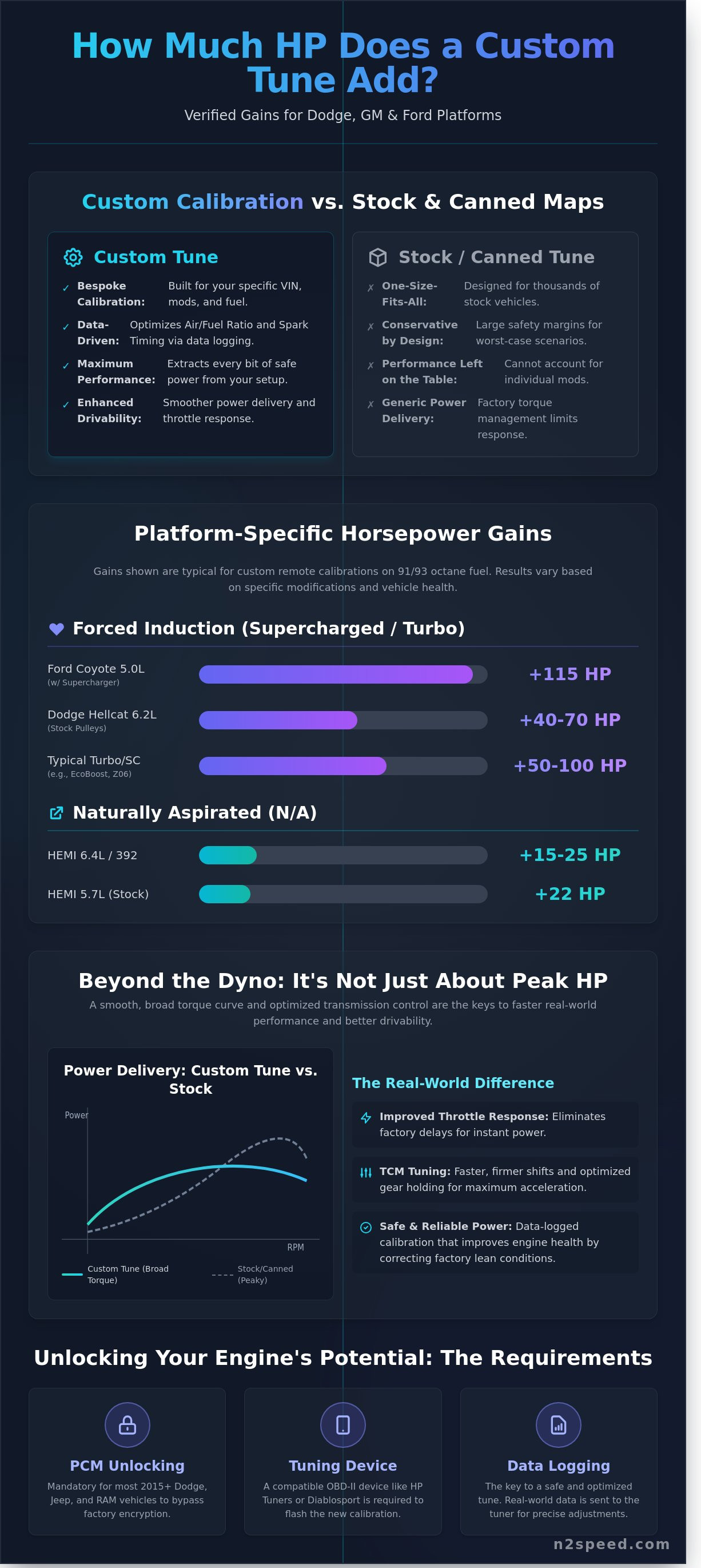
We're cutting through the noise to provide verified dyno data and real-world performance metrics for Hemi, LS/LT, and Coyote platforms. You will discover exactly what a professional remote calibration delivers, from a 22 HP bump on a stock 5.7L Hemi to the 115 HP gains seen on forced-induction Ford Coyotes. This guide breaks down the specific technical requirements for your platform, the reality of hardware unlocking, and why a smooth torque curve beats a peak horsepower number every single time.
Key Takeaways
- Understand why bespoke calibrations outperform generic "canned" maps by eliminating factory safety margins and optimizing for your specific modifications and fuel grade.
- Get the data on how much hp does a custom tune add across Dodge, GM, and Ford platforms, including gains of 70+ HP for stock-pulley Hellcat builds.
- Learn why focusing on the total torque curve and Transmission Control Module (TCM) tuning is the real secret to faster street performance and better drivability.
- Identify the essential hardware requirements, such as PCM unlocking for 2015+ Mopar vehicles, needed to bypass encrypted controllers and access your engine’s potential.
- Discover how N2 Speed leverages HP Tuners and Diablosport hardware to deliver professional remote calibrations that prioritize data-driven results and reliability.
The Physics of Power: Why Custom Tunes Add More HP Than 'Canned' Maps
A custom tune is a bespoke calibration file built specifically for your vehicle's unique VIN, hardware modifications, and local fuel grade. While factory engineers design engine controllers like the GPEC2A or E90 to run safely on low-grade 87 octane in 120-degree heat, they leave substantial performance on the table. This safety margin acts as a buffer against worst-case scenarios, but it limits the engine's true capability. Professional Chip tuning eliminates these generic compromises to prioritize efficiency and output based on your specific setup.
The primary difference between a "canned" tune and a custom calibration lies in the data. Canned maps are one-size-fits-all files designed to work on thousands of vehicles simultaneously. They're conservative by necessity. In contrast, a custom tune utilizes high-resolution data logging to optimize the Air-Fuel Ratio (AFR) and Spark Timing for maximum cylinder pressure. By narrowing the window of operation to your specific environment and 91 or 93 octane fuel, we can extract every bit of torque without crossing into mechanical danger. Determining how much hp does a custom tune add involves looking at how much room the factory left for improvement.
We focus on Volumetric Efficiency (VE), which is the engine's ability to move air in and out. A custom tune adjusts the PCM to account for high-flow intakes, headers, or cam profiles that a generic map simply can't see. This precision allows for a sharper throttle curve and smoother power delivery across the entire RPM range, rather than just a peak number at the top of the dyno graph.
Forced Induction vs. Naturally Aspirated Gains
Forced induction engines, such as the 6.2L Hellcat or 3.5L EcoBoost, offer the most dramatic results. By manipulating wastegate duty cycles and boost targets, a professional calibration often yields 15-25% increases in total output. When calculating how much hp does a custom tune add to a turbocharged platform, the answer is often found in the 50-100 horsepower range with fuel and boost adjustments alone. Naturally aspirated engines, like the 5.7L or 6.4L HEMI, typically see more modest peak gains of 15-25 HP. However, the real value for N/A builds is found in refined timing and the removal of factory torque management, which transforms how the car feels on the street.
The 'Safe Power' Philosophy
Safe power is the intersection of aggressive timing and knock sensor reliability.
Reliability isn't a happy accident; it's a result of rigorous data logging. We monitor short-term and long-term fuel trims alongside knock retard to ensure the engine stays within safe thermal and mechanical limits. There is a persistent myth that tuning wears out an engine prematurely. In reality, a professional calibration often improves engine health by correcting lean conditions or excessive heat caused by poor factory fueling. We don't just chase a number; we build a map that survives 1,000 wide-open throttle pulls as easily as the first one. Our process ensures your vehicle delivers results you can feel and data you can trust.
Platform-Specific Gains: What Can You Expect for Your Build?
The performance potential of your vehicle depends heavily on its factory architecture and how much "headroom" the manufacturer left on the table. When drivers ask how much hp does a custom tune add, the answer starts with the engine type. Forced-induction engines, like those in the Hellcat or Z06, offer the most dramatic jumps because we can safely manipulate boost delivery and timing. Naturally aspirated engines, such as the 5.7L HEMI, see more modest peak numbers but massive improvements in how the power is delivered across the RPM band.
The Hellcat and Trackhawk Advantage
Unlocking the 6.2L supercharged platform starts with PCM unlocking. For owners of 2015 and newer models, accessing the hidden tables in GPEC5 and earlier controllers is mandatory. A professional $550 Hellcat custom tune typically delivers 40 to 70 rear-wheel horsepower gains on stock pulleys. Beyond the peak numbers, the real value lies in street drivability. We refine the transition into boost to eliminate the "on-off" switch feeling common in factory calibrations. You can explore these specific calibrations on our Dodge Hellcat custom tuning page to see how we maximize the IHI supercharger's efficiency.
Corvette and GM Performance
The GM LT platform requires a nuanced approach to heat management. On the C7 Z06, a custom tune is essential for managing heat soak. By optimizing the cooling fans and adjusting spark timing based on manifold air temperatures, we provide sustainable power that doesn't drop off after two pulls. The C8 Corvette presents a higher level of complexity due to its encrypted E90A controller. Expert calibration is non-negotiable here to avoid triggering torque-management interventions. For a deeper look at these platforms, visit our Chevrolet Corvette page. Most C7 Stingray owners see 20 to 30 HP gains, while Z06 models can pick up 45 to 60 HP by simply optimizing the air-fuel ratio.
RAM 1500 and Jeep HEMI owners often prioritize utility over drag strip times. On these 5.7L and 6.4L engines, we focus on low-end grunt. We typically see gains of 20 to 25 lb-ft of torque at 2,500 RPM, which is exactly where you need it for towing. More importantly, we eliminate the "dead" spots in the electronic throttle. The factory delay is often as long as 1.5 seconds. Our calibrations make the truck feel 500 pounds lighter by providing immediate throttle response.
The Impact of Fuel Choice
Your fuel choice acts as the hard ceiling for your performance. When calculating how much hp does a custom tune add, you must factor in the octane rating. 93 octane allows us to run 3 to 4 more degrees of spark timing than 91 octane without encountering engine knock. If you have access to E85, the gains scale significantly higher. On a boosted platform, switching from 91 pump gas to E85 can add an additional 40 to 80 HP. This is because ethanol's cooling properties and high knock resistance allow for much higher cylinder pressures.
Most enthusiasts find that a "flex fuel" tune provides the best of both worlds. This setup uses a sensor to detect the ethanol content in real-time. The PCM then automatically adjusts the calibration. If you want to find out which fuel strategy fits your goals, you can view our tuning packages to get started. Whether you are running 87 octane for daily commuting or E85 for the track, the right calibration ensures you aren't leaving power on the table.
Beyond the Dyno: Why TCM Tuning and Torque Curves Matter More
Focusing solely on peak numbers is a common mistake for those new to performance calibrations. While the most frequent question we hear is exactly how much hp does a custom tune add, the peak figure on a dyno sheet only tells 10 percent of the story. A vehicle that gains 35 horsepower at 6,200 RPM but gains nothing in the mid-range will often lose a drag race to a car with a smaller peak gain but a much fatter torque curve. We prioritize the area under the curve. This refers to the total amount of power available across the entire RPM range, not just the highest point before the rev limiter kicks in.
True street performance depends on how the engine and transmission work as a synchronized unit. If your engine makes 500 horsepower but your transmission takes 500 milliseconds to complete a shift, you're losing momentum and acceleration time. Custom tuning addresses these bottlenecks by optimizing torque management. Factory settings often pull timing and reduce throttle opening during shifts to protect components. We refine these parameters to ensure power delivery remains consistent, resulting in a car that feels significantly more aggressive during real-world driving scenarios.
Transmission Calibration (TCM)
The Transmission Control Module (TCM) is the gatekeeper of your engine's power. For Dodge, Jeep, and RAM owners utilizing the NAG1 or 8HP series transmissions, TCM tuning is a requirement for serious performance. We reduce shift lag and adjust shift points to keep the engine in its optimal power band. This is critical for vehicles with 35-inch or 37-inch tires, as the factory shift logic won't account for the increased rolling mass and changed effective gear ratios. Our MDS delete and speed limiter removal services further enhance this by stopping the annoying 4-cylinder drop-out and unlocking top-end potential beyond the 118 mph or 135 mph factory caps.
Throttle Mapping and Drivability
Modern Dodge and GM vehicles use "fly-by-wire" throttle bodies that suffer from a built-in electronic delay. You press the pedal, and the PCM waits a fraction of a second before reacting. We eliminate this dead space. By remapping the throttle voltage tables, we create a 1:1 relationship between your foot and the engine. This doesn't change how much hp does a custom tune add at wide-open throttle, but it drastically changes the "seat-of-the-pants" feel during part-throttle acceleration.
We offer different mapping styles to suit your needs:
- Linear Mapping: Predictable and smooth, ideal for road course racing or daily commuting where precision is key.
- Aggressive Mapping: Provides an immediate surge of torque with minimal pedal input, perfect for that "muscle car" feel.
- Custom Torque Shaping: We can limit torque in lower gears to help with traction on street tires, then ramp it up once you've gained grip.
This level of customization is what separates a professional N2 Speed calibration from a generic handheld tuner. We don't just chase a number on a roller; we build a cohesive driving experience. By optimizing the TCM and throttle response, we turn a sluggish factory cruiser into a responsive performance machine that reacts instantly to every driver input.
The Hardware Hurdle: PCM Unlocking and Tuning Devices
Since 2015, Dodge, Chrysler, Jeep, and RAM vehicles have shipped with encrypted Powertrain Control Modules (PCMs). This digital lock prevents unauthorized changes to the factory calibration. You can't just plug in a laptop and start tweaking fuel maps; the computer will reject any external data. To see real results, you must first bypass this encryption. This is the primary reason hardware like the HP Tuners MPVI3 or Diablosport devices are essential. They act as the bridge between your vehicle's brain and our professional tuning software.
For 2018 and newer models, the challenge increases with the Security Gateway Module (SGM). This module blocks commands sent through the OBDII port to prevent hacking. To tune these vehicles, you'll need an SGM bypass cable. This simple harness allows the tuning hardware to communicate directly with the bus. While enthusiasts often focus on how much hp does a custom tune add, this hardware preparation is the actual foundation for those gains. Without a successfully unlocked PCM and an SGM bypass, the engine remains stuck in its factory-restricted state.
The Unlocking Process Explained
The first step to performance is the physical unlock. You'll need to locate your PCM, typically found in the engine bay, and remove it from the vehicle. From there, you send the unit to a specialized facility. Our 2015+ Dodge/Jeep PCM Unlock Service handles the technical heavy lifting. We use professional-grade bench tools from HP Tuners to reset the internal security flags without damaging the hardware. Once we've modified the controller to accept new calibrations, we ship it back to you. You plug it back in, and the vehicle is ready to receive a custom file. It's a precise, one-time requirement that opens the door to significant power increases.
Remote E-mail Tuning Logistics
Once the hardware is ready, the remote tuning process begins. This isn't a "set it and forget it" chip. It's a dynamic conversation between your car and our tuners. You'll keep an MPVI3 device plugged into your OBDII port to record data logs while you drive. These logs capture hundreds of parameters like knock sensor activity, injector pulse width, and throttle position. You email these files to us; we analyze the data and send back a revised tune. This cycle repeats until the calibration is perfect.
The biggest benefit of remote tuning is environmental precision. A generic "canned" tune doesn't know if you're at sea level in Florida or at 5,000 feet in Colorado. By analyzing your specific data, we calibrate for your local air quality and elevation. This ensures your engine remains safe and powerful in your specific driving conditions. When considering how much hp does a custom tune add, remember that a tune refined via data logging will always outperform a generic file by 10 to 15 percent because it's optimized for your exact setup.
Ready to get started on your performance journey? Schedule your PCM unlock and custom tune today to see what your vehicle is truly capable of.
Maximizing Your ROI: The N2 Speed Custom Calibration
Realizing the full potential of your vehicle isn't just about flashing a file; it's about the synergy between hardware and software. At N2 Speed, we deliver results you can feel and data you can trust. When enthusiasts ask how much hp does a custom tune add, they're often focused on peak numbers. We look at the entire power curve. A 35 HP gain at 5,800 RPM is impressive, but a 50 lb-ft torque increase at 3,000 RPM is what actually transforms your driving experience. We bridge the gap between PCM unlocking, performance hardware, and precision custom files to ensure your investment pays off in raw performance.
Preparation is the foundation of a successful build. You can't build a high-performance monster on a shaky foundation. Before we begin the calibration process, your vehicle must be mechanically sound. We've seen 15% power losses simply due to old spark plugs or clogged air filters. For forced induction applications, we recommend fresh plugs gapped specifically to 0.028 or 0.030 inches to prevent spark blow-out. Fuel quality is equally critical. Using 93 octane or E85 is a requirement for maximizing gains. A single tank of sub-par fuel can cause the knock sensors to pull 10 degrees of timing, effectively killing your power gains before you even leave the driveway.
Why Choose Professional Calibration?
Generic "copy-paste" tuners often rely on aggressive timing maps that don't account for your specific engine's health or environmental variables. This creates a high risk of detonation and engine failure. N2 Speed brings years of hands-on industry experience to every file. We support advanced modifications like larger fuel injectors, upgraded fuel pumps, and custom forced induction setups. Whether you're running a GPEC2A, E90, or the latest GPEC5 controller, we have the technical expertise to handle it. Visit our homepage to see the full list of supported controllers and modules we service daily.
Next Steps for Your Build
Ready to see how much hp does a custom tune add to your specific setup? The process is straightforward. When you order your custom e-mail tune, have your VIN and a comprehensive list of modifications ready. This includes everything from your intake brand to your specific pulley size. Once we send your initial file, the "final log" is the most important step. We analyze your real-world data to ensure the air-fuel ratios and timing curves are 100% optimized for your local climate and fuel quality. This iterative process is what separates a fast car from a reliable high-performance machine.
Your vehicle is a complex machine that deserves more than a one-size-fits-all solution. By focusing on data-driven calibrations and professional-grade support, we turn your daily driver into a track-ready beast without sacrificing reliability. We've spent thousands of hours refining our processes using HP Tuners and Diablosport CMR software to ensure every calibration meets our rigorous standards. Don't leave your engine's safety to chance or settle for mediocre performance gains from a generic handheld device.
The path to more power is clear. Stop guessing and start logging. Unlock your vehicle's true potential with N2 Speed and experience the difference that professional calibration makes.
Unlock Your Vehicle's True Performance Potential
Determining exactly how much hp does a custom tune add depends on your specific modifications, but the results for 2015 and newer Dodge and GM platforms are undeniable. A generic map can't account for your unique airflow or fuel quality. We specialize in 700+ HP Hellcat and Corvette builds where calibration precision is the difference between a record pass and a mechanical failure. Our remote e-mail tuning delivers professional, track-tested files directly to your inbox. We handle the technical heavy lifting of PCM and TCM unlocking so you don't have to worry about encrypted controllers. It's about more than just a peak number on a graph. It's about refining the torque curve and sharpening shift points to make your car feel like a completely different animal. You've invested in the hardware; now it's time to maximize the software.
Ready to see what your car is truly capable of? Order your Custom N2 Speed Tune today!
Your journey to a faster, more responsive machine starts with a single log. Let's get to work.
Frequently Asked Questions
How much horsepower does a stage 1 tune add?
A Stage 1 custom tune adds 15 to 45 horsepower on naturally aspirated engines and 40 to 80 horsepower on forced-induction vehicles. These results depend on your specific engine platform and the octane rating of your fuel. For example, a Gen 3 Coyote engine typically sees a 10% increase in peak power with optimized timing. We focus on refining the entire power band to ensure your vehicle's performance potential is fully realized.
Will a custom tune void my vehicle's manufacturer warranty?
A custom tune will void the powertrain portion of your manufacturer warranty if the dealership detects the modification. While the Magnuson-Moss Warranty Act offers some protection, manufacturers typically deny claims for engine or transmission failures once they identify a flashed PCM. Modern controllers like the GPEC5 leave clear digital footprints. You should assume any calibration change puts your factory coverage at risk before you pursue higher performance levels.
Do I need to unlock my PCM if I only want a transmission tune?
You don't always need to unlock the PCM to perform a TCM tune, but it depends on your specific vehicle year and model. For 2015 and newer Dodge or Jeep vehicles, the PCM and TCM require separate unlocking steps via tools like HP Tuners. If you're running a GM 8-speed or 10-speed transmission, the T87A or T93 controller needs an individual unlock. This allows us to adjust shift points and torque management.
What is the difference between an e-mail tune and a dyno tune?
An e-mail tune uses data logs recorded on the street while a dyno tune happens in a controlled shop environment. Both methods use professional software to adjust your vehicle's calibrations for better results. A dyno tune provides 100% precision for peak power numbers; however, a remote e-mail tune is often more realistic for daily drivability. We've found that 95% of street-driven builds achieve their goals through our remote tuning services without the dyno expense.
Can a custom tune improve my gas mileage (MPG)?
A custom tune can improve your gas mileage by 1 to 3 miles per gallon during steady-state cruising. We achieve this by optimizing air-fuel ratios and advancing ignition timing for better combustion efficiency. While enthusiasts often ask how much hp does a custom tune add, the increased efficiency often leads to better fuel economy. Your driving habits remain the biggest factor; staying out of the throttle is key to seeing these 8% efficiency gains.
How long does the PCM unlocking and tuning process take?
The PCM unlocking process takes 1 to 3 business days once the controller reaches our facility for service. If you're using a remote exchange program, we ship a pre-unlocked unit within 24 hours of your order. The actual tuning process involves flashing the new calibration, which takes less than 10 minutes. Total turnaround time for a complete remote tuning package usually spans 5 to 7 days including shipping and data log revisions.
Do I need special fuel like E85 to see a significant HP increase?
You don't need E85 to see a gain, but switching to ethanol-blended fuel can increase horsepower by 15% to 20% over 91 octane pump gas. E85 has a higher cooling effect and knock resistance, which allows for more aggressive timing in forced-induction setups. For a standard 93 octane tune, you'll still see a 30 to 50 HP increase on most turbocharged vehicles. We recommend high-quality fuel to maximize these performance results.
What happens if I add more parts after I've already received my custom tune?
You'll need a calibration update if you add parts that change the engine's airflow, such as a different intake, headers, or a larger throttle body. Minor cosmetic mods don't require changes, but 100% of forced-induction upgrades or camshaft swaps need immediate tuning adjustments. This ensures your air-fuel ratios stay within safe limits. Knowing how much hp does a custom tune add helps you understand why recalibrating for new hardware is vital for engine longevity.
Related N2 Speed Tuning Services
- Dodge Charger 5.7L HEMI tuning
- Dodge Challenger 5.7L HEMI tuning
- Dodge Durango 5.7L HEMI tuning
- Jeep Grand Cherokee 5.7L HEMI tuning
- HEMI MDS delete & speed limiter removal
- remote custom tuning
Questions about your build? Call (954) 406-8550 or email sales@n2speed.com.