

Posted by N2 Speed on Apr 17th 2026
Can a Tune Void Your Warranty? 2026 Facts
Your local dealership cannot legally cancel your entire factory service contract simply because you uploaded a performance calibration. While service advisors often use "blacklisting" as a scare tactic, the legal reality behind the question, can a tune void my car warranty, is far more nuanced than a simple yes or no. Most enthusiasts hesitate to unlock their vehicle's potential because they've read conflicting forum posts about denied claims and $15,000 out-of-pocket engine repairs. It's a valid concern when you're looking for better drivability but don't want to gamble with your financial security.
We're here to provide the technical and legal facts you need to modify your vehicle with confidence in 2026. This guide breaks down the protections provided by the Magnuson-Moss Warranty Act of 1975 and explains how modern diagnostic tools actually detect PCM and TCM modifications. You'll gain the knowledge needed to use industry leading tools like HP Tuners or Diablosport responsibly while maintaining your coverage. We'll cover the burden of proof required by manufacturers and the specific steps you can take to protect your investment while chasing peak performance.
Key Takeaways
- Clarify the critical distinction between a total warranty void and a specific denied claim to navigate dealer interactions with confidence.
- Leverage the Magnuson-Moss Warranty Act to ensure your legal rights are protected when using aftermarket performance upgrades.
- Learn how digital fingerprints like flash counters and CVNs function, addressing the common concern: can a tune void my car warranty?
- Master the "pay to play" mindset by prioritizing engineering-backed calibrations over peak numbers to ensure long-term mechanical reliability.
- Discover how specialized PCM and TCM unlocking services for American muscle allow you to maximize performance potential without compromising drivability.
The Warranty Myth: 'Voiding' vs. 'Denied Claims'
The question "can a tune void my car warranty" is the first thing enthusiasts ask before they touch a single bit of data. In 2026, the answer remains nuanced but clear. A manufacturer cannot legally cancel your entire warranty simply because you installed a performance calibration. Federal laws protect consumers from blanket cancellations. Engine tuning involves modifying factory software to optimize air-fuel ratios and ignition timing. While this unlocks horsepower, it doesn't give a dealership a free pass to ignore a leaking sunroof or a failed infotainment screen. To better understand how these modifications interact with dealership service departments, watch this helpful video:
What Does 'Voiding a Warranty' Actually Mean?
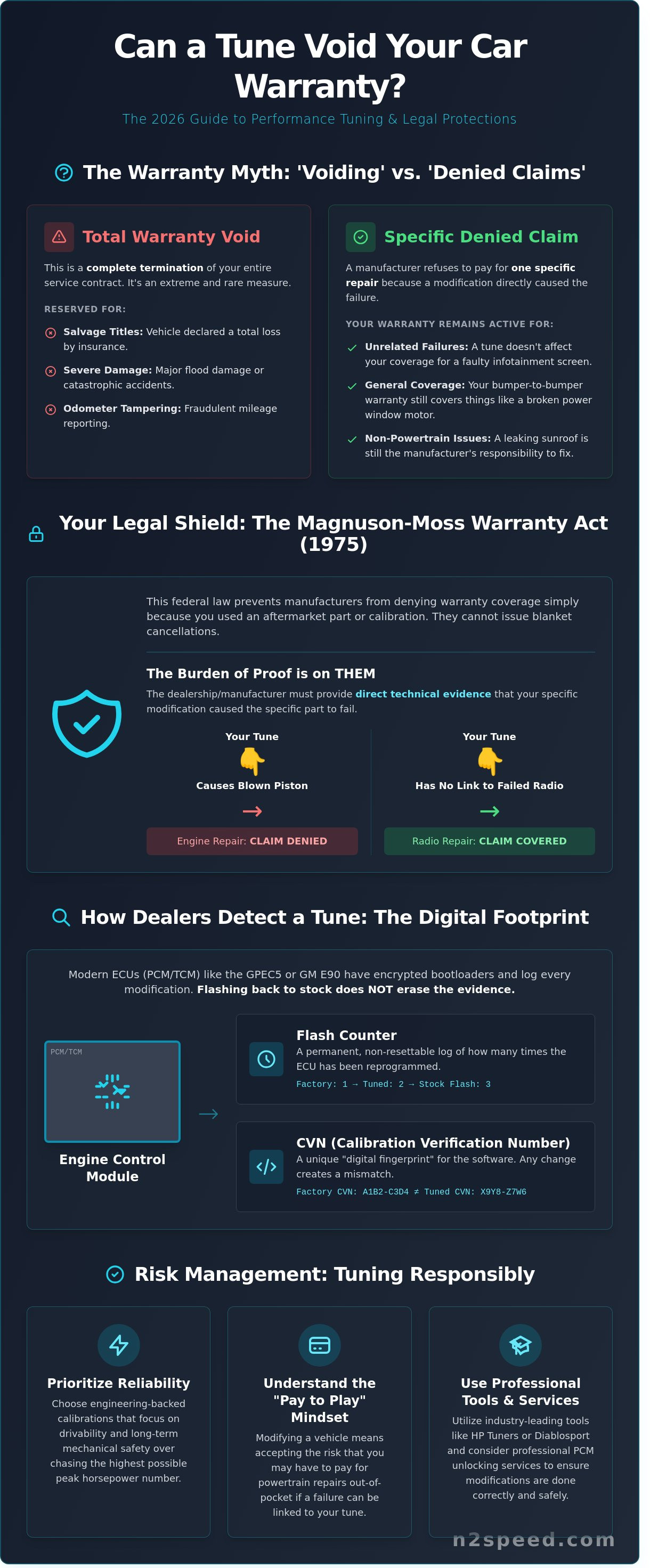
Voiding a warranty is a total termination of the legal contract between you and the manufacturer. This is an extreme measure reserved for specific legal violations. Total warranty cancellation only occurs in cases of salvage titles, severe flood damage, or odometer tampering. Under 2026 industry standards, a voided warranty means the entire contract is dead, while a denied claim only means the manufacturer won't pay for one specific repair. If your power window motor fails, the dealer still has to fix it under your bumper-to-bumper coverage, regardless of what's in your PCM.
The Burden of Proof: Who Has to Prove What?
The burden of proof falls on the dealership service department. They must provide technical evidence that your aftermarket software directly led to the hardware failure. Common scenarios where a tune is blamed involve melted pistons, cracked ring lands, or burnt clutch packs in high-torque applications. In 2026, manufacturers use advanced diagnostics to detect PCM modifications even if you attempt to hide them. Modern controllers like the GPEC5 or GM E90 feature encrypted bootloaders and permanent flash counters.
Simply flashing back to stock won't erase the digital footprint. If the dealer finds a mismatch in the CVN (Calibration Verification Number) or an unexpected flash count, they'll flag your VIN in their national database. This doesn't kill your warranty for a broken sunroof, but it does mean you'll pay out of pocket for a blown engine. You need to understand that while your powertrain coverage is at risk, your general vehicle warranty remains intact for unrelated issues. To unlock your vehicle's true potential safely, you must account for this shift in how dealers process claims.
The Magnuson-Moss Warranty Act: Your Legal Shield
The 1975 Magnuson-Moss Warranty Act serves as the primary federal protection for enthusiasts who modify their vehicles. This law was designed to prevent manufacturers from using vague or unfair warranty terms to force consumers into using only original equipment manufacturer (OEM) parts for maintenance and repairs. Under this act, a dealer cannot legally "void" your entire vehicle warranty simply because you installed an aftermarket intake, exhaust, or PCM calibration. The burden of proof lies with the manufacturer, not the vehicle owner.
A critical component of this legislation is the requirement for causality. If a component fails, the dealership must prove that your specific modification directly caused the failure before they can deny a warranty claim. For example, if your power window motor stops working, the dealer cannot refuse to fix it because you have an engine tune. There is no logical link between a PCM calibration and a window regulator. However, when people ask can a tune void my car warranty, they are usually thinking about engine or drivetrain failures. If a custom tune increases boost pressure beyond factory limits and causes a head gasket failure, the manufacturer has a legal right to deny that specific claim.
This protection is not a "get out of jail free" card for reckless calibrations. While the Act protects you against broad warranty cancellations, it does not cover damage resulting from poor tuning or hardware that exceeds the mechanical limits of the engine. Using high-quality equipment and following a professional HP Tuners MPVI2 guide ensures that your modifications remain within safe parameters, which is your best defense against legitimate claim denials.
How the FTC Enforces Warranty Rights
The Federal Trade Commission (FTC) takes a hard line against "tie-in sales" provisions. These are illegal tactics where a dealer implies that your warranty is "gone" the moment you walk in with aftermarket parts. If a service advisor makes a blanket statement that your modifications have voided your protection, they are likely violating federal law. The FTC has issued multiple alerts over the last 50 years reminding dealers that they must provide a valid, technical reason for a denial. For owners of modern platforms, our remote tuning services focus on maintaining drivability and reliability to minimize the risk of mechanical issues that could trigger a dispute.
Practical Steps if Your Claim is Denied
If a dealership denies a repair based on your PCM modifications, don't walk away immediately. First, request a written explanation from the service manager detailing exactly how the tune caused the specific failure. If the explanation is vague, escalate the issue to the manufacturer's regional representative. In many cases, providing data logs or commissioning an independent mechanical inspection can prove that the failure was due to a factory defect rather than your performance settings. This paper trail is essential if you need to pursue a formal dispute. When considering can a tune void my car warranty, remember that documentation and technical evidence are your most powerful tools in 2026.
How Dealers Detect a Tune: Flash Counters and CVNs
Every time you write a new calibration to your vehicle's Powertrain Control Module (PCM), you leave a digital trail. Modern Engine Control Units (ECUs) use a Flash Counter to record the total number of times the internal memory has been rewritten. If your factory service record shows two updates for official recalls but the internal counter reads five, the dealer knows the software was tampered with. This digital fingerprint is a primary way technicians determine if can a tune void my car warranty during a major repair claim.
The Calibration Verification Number (CVN) serves as a second layer of detection. This is a unique checksum generated by the specific software version currently running on the PCM. When a service technician connects a factory scan tool like WiTECH or GDS2, the system automatically compares your CVN against the manufacturer's global database. If the numbers don't match, the vehicle is flagged. This mismatch is often the first step in a process where a service manager denies a powertrain claim based on unauthorized software modifications.
- Flash Counters: Incremental logs that track every write event to the PCM memory.
- CVN Mismatch: A checksum error that occurs when custom software replaces factory code.
- Data Logging: Permanent records of peak values like boost pressure, RPM, and timing.
The Reality of 'Stealth' Tunes
Handheld tuners often claim to be invisible once you restore the stock file; however, this is a dangerous myth. While the software might look stock, deep-level scans reveal "out of range" data logs. If a turbocharger hit 22 PSI on a car factory-rated for 15 PSI, that peak value remains in the history. To mitigate these risks, enthusiasts rely on high-quality custom e-mail tunes. These calibrations are engineered to stay within safe mechanical limits, which reduces the likelihood of a catastrophic failure that would trigger a deep forensic investigation by the manufacturer.
Modern Encryption and PCM Unlocking
Since 2015, Dodge, Jeep, and RAM vehicles have utilized encrypted GPEC2A and GPEC5 controllers. These require a physical PCM unlock service before any tuning can occur. A dealer technician will immediately notice if the PCM case shows signs of tampering or if the security seals are broken. While "OBD Unlocking" is available for some platforms, "Bench Unlocking" remains the standard for high-performance GM and Mopar builds. Both methods leave traces that a trained eye can spot. If your hardware shows physical signs of being opened, the question of whether can a tune void my car warranty becomes much easier for the dealer to answer with a denial.
Risk Management: Tuning Responsibly in 2026
Adopting a "pay to play" philosophy is the first step for any serious performance enthusiast. High-performance modifications carry inherent risks that no amount of legal maneuvering can fully erase. If you push a 5.7L Hemi or a 3.5L EcoBoost beyond factory specifications, you must accept responsibility for the hardware. While the question of can a tune void my car warranty often leads to anxiety, seasoned racers know that a reliable calibration is better than any factory safety net. Choosing a tuner with a proven track record is your best insurance policy against mechanical failure.
Maintaining meticulous service records is non-negotiable. If a power steering pump fails, a dealership cannot legally deny the claim due to a PCM flash, but they will look for any reason to push back. Keeping a digital folder of every oil change at 5,000-mile intervals and every spark plug swap proves you aren't neglecting the vehicle. Building a relationship with mod-friendly dealerships can also save you thousands. Some service advisors are enthusiasts themselves. They understand that a clean, well-maintained car with a professional calibration isn't an automatic liability.
Choosing the Right Calibration
Generic "canned" tunes often use aggressive timing curves that don't account for your specific fuel quality or local elevation. This is a major risk for newer GPEC5 or E90 controllers. We prioritize professional remote email tuning over off-the-shelf programmers because it allows for precision. A custom calibration involves data logging, where we monitor short-term fuel trims and knock sensors in real-time. This ensures your engine stays within safe operating parameters. A precise tune often improves engine longevity by optimizing air-fuel ratios, preventing the "pig-rich" conditions factory setups use to mask cooling inefficiencies.
When to Wait: The Break-In Period
We recommend waiting until your odometer hits at least 1,000 miles before modifying the PCM. This window allows you to identify "infant mortality" factory defects, such as a faulty oil pump or a casting flaw in the block, before you change the software. If a component fails at 300 miles, it's a factory issue. If it fails at 300 miles with a custom flash, the can a tune void my car warranty debate becomes much harder to win. Use this initial period to plan a long-term performance strategy that aligns your hardware upgrades with your software goals. This patience ensures you aren't masking a lemon with aftermarket parts.
The N2 Speed Approach: Performance Without Compromise
Performance tuning isn't just about chasing peak horsepower numbers on a dyno sheet. It's about how the car behaves in the real world. At N2 Speed, we develop calibrations specifically for drivability and long term reliability. A common concern for enthusiasts is "can a tune void my car warranty" when they're looking for more throttle response or better shift points. While any modification can lead to a dealer claim denial, our professional approach ensures your vehicle stays within safe mechanical operating parameters. We specialize in PCM & TCM unlocking services for high performance American muscle. This includes late-model Dodge and GM platforms that utilize highly encrypted engine controllers. Thousands of Corvette and Hellcat owners trust our team because we prioritize engine longevity as much as we prioritize power. Our expertise helps you navigate the technical side of modifications with confidence.
Specialized Services for Dodge and GM
Modern Dodge and GM vehicles require specialized tools to access the engine management system. Our Dodge PCM bench tune provides essential features for enthusiasts, including MDS delete and speed limiter removal. These adjustments prevent the annoying transition between four and eight cylinders while improving overall engine smoothness. For the Chevrolet Corvette community, we offer expert TCM tuning for the C8 platform. This optimization is critical for handling the increased torque of forced induction builds. We deliver calibrations built on data you can trust for 2026 performance standards. Every file we write is tested to ensure it meets the rigorous demands of both the street and the track. By focusing on the specific architecture of GPEC and E90 controllers, we provide solutions that generic tuners simply can't match.
Unlock Your Vehicle's True Potential Today
Balancing a factory warranty with the desire for increased performance requires a clear strategy. You don't have to settle for stock performance to maintain peace of mind. Our team of experts is here to help you understand exactly how modifications affect your vehicle's status. We've spent years refining our processes to provide the most reliable tuning solutions on the market. Before you commit to your first modification, consult with our professionals to build a roadmap for your build. We'll help you choose the right components and calibrations to reach your goals safely. When you're ready to take the next step, our support team is available to guide you through the unlocking and installation process. Visit N2 Speed today to browse our selection of tuning devices and professional services. Unlock your vehicle's true potential today.
Master Your Performance Strategy
Navigating the intersection of high-performance mods and factory protection requires a data-driven approach. The Magnuson-Moss Warranty Act of 1975 remains your primary shield; it mandates that a dealer must prove an aftermarket modification directly caused a failure before denying coverage. While modern diagnostic tools can identify altered CVNs or flash counters, the real-world risk depends on the quality of the calibration. The question of can a tune void my car warranty often boils down to whether your modifications exceed the mechanical tolerances of your engine and drivetrain components.
N2 Speed provides the technical expertise needed to balance these risks. We specialize in expert PCM and TCM unlocking for 2015 and newer American vehicles, including high-output Hellcat, Corvette, and RAM platforms. By focusing on precision calibrations engineered for both peak power and long-term reliability, we ensure your vehicle performs at its peak without unnecessary strain. It's time to stop worrying about factory limitations and start experiencing the full capability of your build.
Frequently Asked Questions
Can a dealer tell if I've flashed my PCM back to stock?
Yes, dealership technicians can identify if a PCM has been modified even if you return it to the factory settings. Modern engine controllers like the GPEC5 found in 2024 and newer models utilize flash counters and Calibration Verification Numbers (CVN). When you flash a custom calibration, the counter increments; returning to stock doesn't reset this number to its original state.
Diagnostic tools like WiTECH or Ford's IDS compare your current CVN against a centralized database. If the numbers don't match the factory records for your VIN, the system flags the controller. This digital footprint remains visible to any technician performing a deep system scan during a warranty claim investigation.
What is the Magnuson-Moss Warranty Act and how does it protect me?
The Magnuson-Moss Warranty Act of 1975 is a federal law that protects consumers from having their entire warranty voided due to aftermarket parts. Under this act, a manufacturer cannot legally deny a warranty claim unless they prove the aftermarket modification caused the specific failure. If your power seat motor fails, the dealer cannot deny the claim because you have a performance tune.
Protection is specific to the failed component and its relationship to the mod. If you experience a turbocharger failure on a vehicle with increased boost levels, the manufacturer has a strong legal basis to deny the claim. The burden of proof lies with the dealer, but technical data from the PCM often provides the evidence they need.
Does a tune void the warranty on my entire car?
A tune does not void the warranty on your entire vehicle. When people ask can a tune void my car warranty, they're usually referring to the powertrain coverage. Your bumper-to-bumper warranty remains valid for unrelated systems like the air conditioning, suspension bushings, or infotainment screen. These components aren't affected by engine calibration changes.
The manufacturer only restricts coverage on parts directly impacted by the software. This typically includes the engine, transmission, and differential. If you have a custom calibration, you should expect the dealership to scrutinize any powertrain-related issues more closely than they would on a stock vehicle.
Will a speed limiter removal or MDS delete void my warranty?
Removing a speed limiter or performing an MDS delete requires modifying the factory software, which puts your powertrain warranty at risk. These changes are permanent markers in the PCM's history. If a lifter fails on a HEMI engine after an MDS delete, the manufacturer will likely cite the software modification as the reason for denying the repair.
Manufacturers design internal components to operate within specific parameters. Altering these settings, even for reliability reasons like an MDS delete, provides the dealer with the justification needed to flag the vehicle. Any change to the factory calibration is viewed as operating the vehicle outside of its engineered specifications.
Can I still get my oil changed at the dealer if my car is tuned?
You can absolutely continue to get routine maintenance like oil changes or tire rotations at the dealership. Service technicians performing a standard 27 point inspection rarely plug into the OBD-II port to check for calibration changes. They're focused on high-volume tasks and general vehicle health rather than hunting for software mods.
The risk arises if there is an outstanding recall that requires a PCM update. The technician might overwrite your custom tune with a factory update without warning. If you're running an unlocked PCM or a specific calibration, it's wise to inform the service advisor or use a port cover to prevent unauthorized flashes.
What happens if my engine fails and I have a custom tune?
If your engine suffers a major mechanical failure, the manufacturer will require the dealer to submit a PCM data dump before authorizing a replacement. This process involves sending the internal logs to corporate engineers who look for peak boost levels, maximum RPM, and timing curves. If these values exceed factory limits, the warranty claim is denied immediately.
Engine failures are expensive, and manufacturers use every tool available to verify the cause. SEMA reports indicate that powertrain claims are the most frequent area of dispute for modified vehicles. Once the data confirms a non-factory calibration was present, you'll be responsible for the full cost of the engine replacement.
Are some dealerships more 'mod-friendly' than others?
Dealerships are independent franchises, so their "mod-friendly" status varies based on the owner's philosophy and the service manager's experience. Some shops specialize in performance parts and might be more lenient with minor modifications. You can often find these locations by checking regional racing forums or local enthusiast groups for recommendations.
Even a friendly dealer must follow corporate protocols for major warranty work. While they might ignore a cold air intake during a minor repair, they can't bypass the automated PCM scans required for engine or transmission replacements. A dealer's friendliness has limits when the manufacturer is the one paying for the multi-thousand dollar repair.
Does a TCM (Transmission) tune carry more risk than a PCM tune?
A TCM tune often carries a higher risk for drivetrain claims because it directly alters line pressures and shift timing. Modern transmissions like the ZF 8HP are complex and rely on precise torque management to survive. When you ask can a tune void my car warranty, you must consider that TCM changes are very obvious during a diagnostic teardown.
If the transmission experiences a clutch pack failure or a broken input shaft, the first thing an inspector checks is the shift logic. Increased line pressure leaves physical evidence inside the transmission housing. Because TCM tuning is less common than PCM tuning, it often stands out more during a corporate technical inspection.
Related N2 Speed Tuning Services
- Dodge, RAM & Jeep PCM / TCM unlocking
- Dodge Charger 5.7L HEMI tuning
- Dodge Challenger 5.7L HEMI tuning
- remote custom tuning
Questions about your build? Call (954) 406-8550 or email sales@n2speed.com.