
Posted by N2 Speed on Mar 19th 2026
Is a Custom Tune Worth It for a Stock Car? The Truth About Factory Calibrations
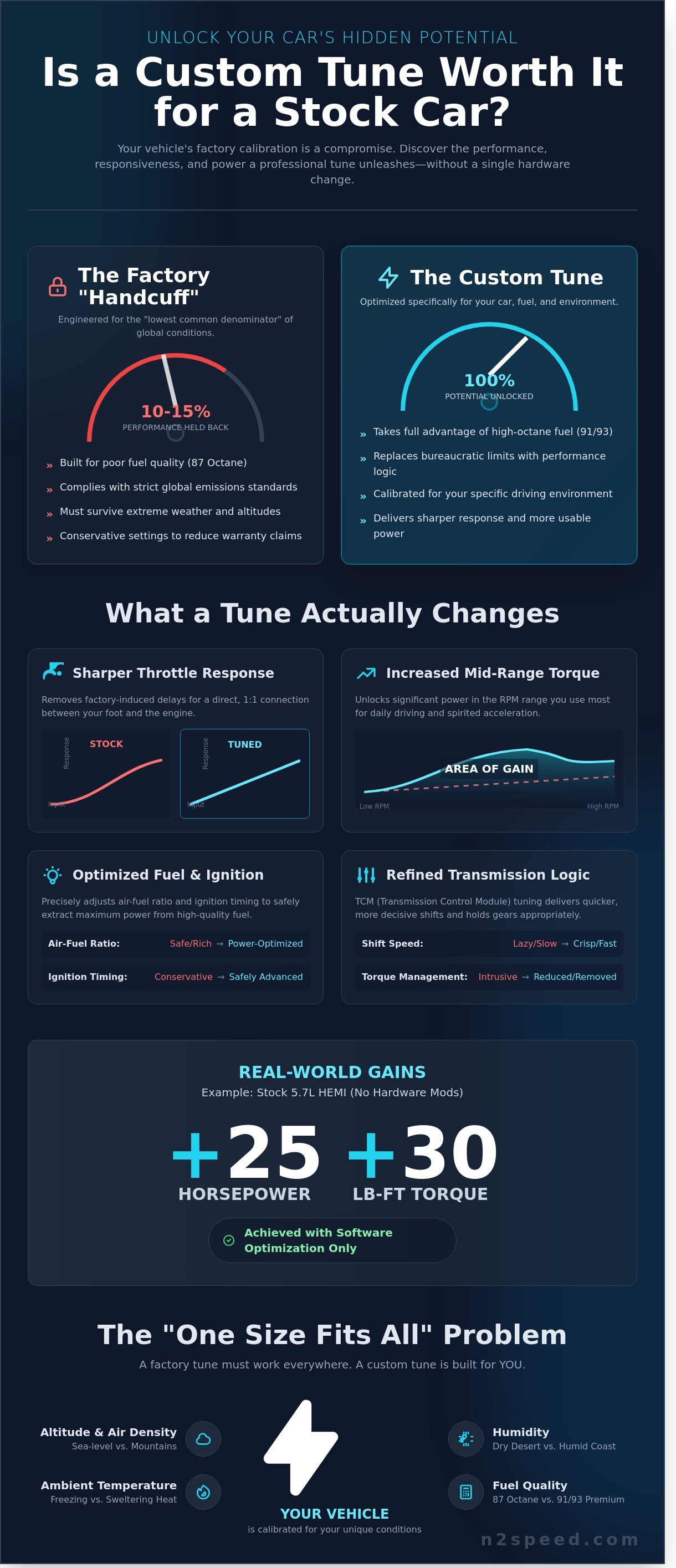
Your car left the assembly line with a digital "handcuff" that limits its output to satisfy the lowest common denominator of global emissions and fuel standards. Most owners believe they must bolt on expensive hardware to see real gains, but the truth is that your factory calibration is likely holding back 10% to 15% of your engine's available performance. You have probably felt that sluggish throttle response or the lazy transmission shifting that makes even a high-displacement engine feel disconnected. It leads many enthusiasts to wonder; is a custom tune worth it for a stock car?
We know that "good enough" for the manufacturer isn't good enough for you. A professional custom tune can unlock up to 25 hidden horsepower and 30 lb-ft of torque on a standard 5.7L HEMI without a single hardware change. By optimizing PCM and TCM parameters, we deliver the sharper throttle response and usable mid-range power that factory engineers left on the table. This article explains how we use HP Tuners and advanced data logging to transform your stock vehicle into a more engaging, responsive machine that finally reflects its true performance potential.
Key Takeaways
- Understand why factory calibrations are engineered for the lowest common denominator and how a custom tune unlocks the performance potential restricted by OEM compromises.
- Determine whether a custom tune is worth it for a stock car by analyzing the massive gains in mid-range torque and throttle response that peak numbers often hide.
- Learn how precise adjustments to Air-Fuel Ratios and ignition timing allow your stock engine to finally take full advantage of high-octane fuels.
- Discover how platform-specific PCM and TCM refinements can transform the drivability of Dodge HEMI and GM LT-based vehicles through advanced software optimization.
- Explore the professional remote tuning process and how real-world datalogging delivers a precision calibration tailored to your specific driving environment.
Table of Contents
- The Factory Compromise: Why Your Stock Car Isn't Optimized
- What Does a Custom Tune Actually Change on a Stock Car?
- Real-World Results: Peak Numbers vs. Drivability
- Is Your Specific Platform Worth Tuning Stock?
- Getting Started: Remote Email Tuning with N2 Speed
The Factory Compromise: Why Your Stock Car Isn't Optimized
Every vehicle rolling off the assembly line is a product of compromise. Original Equipment Manufacturers (OEMs) like Ford, GM, and Stellantis do not calibrate their vehicles for peak performance. Instead, they design engine software for the "lowest common denominator" of global drivers. This means your car is tuned to survive the worst possible conditions, such as a driver in a high-altitude region using sub-standard 87-octane fuel while towing a heavy load in 110-degree heat. To ensure the engine survives these extremes without a catastrophic failure, engineers leave a massive amount of power on the table. Most factory Engine tuning profiles are intentionally conservative to protect the manufacturer's bottom line.
Data from industry teardowns suggests that manufacturers typically leave a safety margin of 12% to 15% in their stock calibrations. This buffer exists almost exclusively to reduce warranty claims. By pulling ignition timing and maintaining overly rich air-fuel ratios, the factory PCM prevents engine knock and heat soak at the cost of your driving experience. If you are a responsible owner who uses high-quality fuel and stays on top of maintenance, you are essentially paying for performance that the factory has locked away. This leads many enthusiasts to ask: is a custom tune worth it for a stock car? When you realize the factory map is a "safe" average rather than an optimized solution, the answer becomes clear.
To better understand the limitations of factory software and how professional calibration can improve your vehicle, watch this helpful video from High Performance Academy:
The 'One Size Fits All' Problem
A car sold in the humid, sea-level climate of Florida runs the exact same software as one sold in the freezing, thin air of the Alaskan interior. Standardized factory maps cannot account for local atmospheric variables like density altitude or humidity. Because the OEM must ensure the car starts and runs reliably in every corner of the country, the calibration is never truly efficient for your specific location. Furthermore, high-performance engines are often hamstrung by 87-octane compatibility requirements. While the engine might be capable of much more, the factory timing tables are restricted to prevent damage from low-grade fuel. A custom tune allows you to optimize the engine for the 91 or 93-octane fuel you actually put in the tank.
Emissions vs. Performance
Strict EPA and CARB standards dictate how your engine behaves more than your right foot does. To meet these targets, manufacturers implement "rev hang," which keeps the throttle plate slightly open after you lift off the gas. This burns off residual hydrocarbons but makes manual shifts feel sluggish and disconnected. Additionally, the ECU often limits Wide Open Throttle (WOT) power to protect catalytic converters from overheating during spirited driving. The computer intentionally slows down throttle plate opening speeds to smoothen out torque delivery, which kills the "snap" you expect from a performance vehicle. Custom tuning targets these specific logic tables to restore throttle linearity and remove artificial power ceilings. This is why a custom tune is worth it for a stock car; it replaces bureaucratic restrictions with performance-first logic.
What Does a Custom Tune Actually Change on a Stock Car?
Factory engine control modules (ECMs) are programmed with a wide margin of safety to account for the lowest common denominator. Manufacturers design their software for drivers who might use low-grade 87 octane fuel or ignore 10,000-mile oil change intervals. They also must adhere to strict EPA regulations on vehicle emissions, which often results in a lean-biased calibration that prioritizes tailpipe cleanliness over peak torque. When enthusiasts ask is a custom tune worth it for a stock car, the answer lies in the removal of these factory compromises.
A professional calibration optimizes the Air-Fuel Ratio (AFR) across the entire RPM band. While the factory tune aims for efficiency, a custom tune focuses on the "Power Enrichment" phase. By adjusting the fuel delivery to match the specific airflow characteristics of your engine, we can extract 15 to 25 additional horsepower from a completely stock naturally aspirated engine. We also recalibrate the "Torque Management" tables. These factory settings intentionally lag the throttle response and pull timing during shifts to protect drivetrain components. Reducing this intervention by 25% or 30% makes the vehicle feel significantly more aggressive and responsive to driver input.
Engine Calibration Deep Dive
Stock calibrations often hold the engine in a 'Stoichiometric' fueling state (14.7:1 air-to-fuel ratio) even under moderate load to save fuel. We reprogram the ECM to enter 'Power Enrichment' earlier in the throttle sweep, providing the extra fuel needed to safely generate more heat and energy. We also advance the spark timing to take advantage of 91 or 93 octane fuel. Ignition Timing is the precise moment the spark plug fires to maximize piston force. By advancing this timing by 3 to 5 degrees in high-load cells, we increase cylinder pressure, which directly translates to more torque at the wheels. This is a primary reason is a custom tune worth it for a stock car for those who want a more capable daily driver.
Transmission (TCM) Tuning: The Hidden Hero
The Transmission Control Module (TCM) dictates how the power actually reaches the pavement. In many modern vehicles, the TCM is the real bottleneck. We reduce shift times by up to 150 milliseconds, replacing the "slushy" factory feel with a crisp, mechanical engagement. This isn't just about speed; it's about efficiency. We optimize shift points to keep the engine within its peak power band rather than short-shifting for fuel economy. We also refine the downshift logic to eliminate the "hunting" for gears that occurs when you attempt to pass on the highway. This ensures the transmission selects the optimal gear instantly. If you want to transform your driving experience, our professional calibration services provide the technical precision needed to unlock these hidden gains.
- Speed and RPM Limiters: We raise or remove electronic governors that often cap stock vehicles at 110 or 120 mph.
- Fan Settings: We lower the temperature at which electric cooling fans engage, keeping the engine in a cooler, more consistent operating range.
- Throttle Mapping: We remove the "dead zone" in the first 20% of pedal travel for instantaneous acceleration.
Real-World Results: Peak Numbers vs. Drivability
Peak horsepower figures grab headlines, but torque delivery defines the actual driving experience. On a typical 5.7L Hemi or a 3.5L EcoBoost, a custom calibration might only show peak gains of 15 to 30 horsepower on a dyno. While these numbers seem modest, they don't tell the full story. The real transformation occurs in the mid-range where you spend 90% of your time. A stock vehicle often feels restricted due to conservative factory mapping. When you ask, is a custom tune worth it for a stock car, the answer is found in the 25 to 40 lb-ft of torque added between 2,500 and 4,500 RPM. This is the "meat" of the powerband that makes a vehicle feel lighter and more responsive during a standard highway merge.
The "Butt Dyno" test is where most owners notice the biggest change. Manufacturers intentionally program a "dead spot" or lag in the first 15% of pedal travel to improve fleet fuel economy and prevent jerky movements for average drivers. We recalibrate the electronic throttle control (ETC) tables to provide a linear, 1-to-1 relationship between your foot and the butterfly valve. This eliminates the hesitation that plagues modern drive-by-wire systems. Beyond the fun factor, there's a practical side to this efficiency. By optimizing ignition timing and air-fuel ratios for 91 or 93 octane, many drivers report a 1.5 to 2.2 MPG increase during steady-state cruising at 70 mph.
The Power Under the Curve
A dyno sheet showing a 30 HP gain at redline looks impressive on a shop wall, but you rarely live at 6,500 RPM. A professional tune focuses on the area "under the curve." Gaining 22 HP at 3,200 RPM is significantly more valuable than 35 HP at the rev limiter. Our experts use advanced ECU remapping and tuning techniques to smooth out the dips and flat spots found in factory torque curves. These inconsistencies are often the result of the OEM trying to meet strict emissions targets at specific engine loads. Removing these hurdles creates a seamless wave of acceleration. The psychological impact is immediate; the car stops feeling like a commuter appliance and starts feeling like a performance machine.
Drivability and Reliability
A common concern is that a tune will stress a stock engine to its breaking point. This is a misconception when using professional-grade software like HP Tuners or Diablosport CMR. We don't just "crank up the boost" or "dump more fuel." We monitor specific data pids like "knock retard" and "long-term fuel trims" to ensure the engine operates within safe mechanical margins. In many cases, a custom tune improves engine longevity. Factory calibrations often run excessively rich under load to protect catalytic converters, which can lead to carbon buildup on intake valves. By refining the combustion cycle, we reduce these deposits, especially in direct-injection engines like the GM L84 or Ford 2.7L EcoBoost. When you consider the total package of throttle response, mid-range torque, and engine health, it's clear that is a custom tune worth it for a stock car for any serious enthusiast.
Is Your Specific Platform Worth Tuning Stock?
When enthusiasts ask is a custom tune worth it for a stock car, they're usually looking for a "yes" or "no" answer. The reality depends on your specific platform and how much factory restriction the manufacturer applied. For most modern American muscle and heavy-duty trucks, the answer is a resounding yes because manufacturers prioritize emissions and fuel economy over raw drivability and throttle response. A stock HEMI or Coyote engine is often capable of 25 to 40 more horsepower just by optimizing the air-fuel ratio and ignition timing that the factory left conservative.
Dodge and RAM owners with the 5.7L or 6.4L HEMI see some of the most dramatic changes. Factory throttle mapping is notoriously "lazy," often requiring 40% pedal input just to get a 15% response from the throttle body. Custom calibrations fix this mapping, making the vehicle feel 500 pounds lighter. Ford Mustang owners with the 5.0L Coyote engine benefit from optimizing high-RPM breathing. While the factory tune begins to taper off power near the redline, a custom tune keeps the intake valves and timing aggressive all the way to 7,500 RPM, turning a standard GT into a high-revving monster.
GM platforms like the Corvette C7 and C8 also have massive potential locked behind the Transmission Control Module (TCM). The LT1 and LT4 engines are powerhouses, but factory shift points are often sluggish to keep the ride "smooth" for the average consumer. Refining these shift points and reducing torque management allows the car to put power to the ground instantly. However, modern platforms come with a significant hurdle: encryption. Since 2015, manufacturers have locked their controllers, meaning you can't just plug in a handheld and go. You need professional intervention to even begin the process.
The Mopar & GM Roadmap
To access the performance potential of modern Mopar vehicles, you must first address the encrypted hardware. We provide a specialized 2015+ Dodge PCM Unlock Service that bypasses factory security, allowing tools like HP Tuners to write new data. This is not optional; it's the gateway to performance. Modern GPEC5 and E90 controllers found in the newest RAMs and Silverados require specialized bench services where the unit is physically unlocked. Once the gate is open, Corvette performance tuning can finally address the nuances of the LT platform, providing a sharper, more aggressive driving experience that the factory simply isn't allowed to offer.
The 'MDS Delete' Advantage
One of the most requested features for daily drivers is using a bench tune to disable MDS (Multi-Displacement System). While 4-cylinder mode saves a negligible amount of fuel, it creates a frustrating lag when you need to accelerate and ruins the exhaust note of a V8. Disabling this system provides a consistent, predictable power delivery. For truck owners, the benefits extend even further:
- Speed Limiter Removal: Most trucks are capped at 105 or 115 mph. A custom tune removes these artificial ceilings.
- Transmission Refinement: Adjusting shift points prevents the "gear hunting" common in 8-speed and 10-speed automatics.
- Torque Management: Reducing factory-set torque limits allows for harder launches and better towing performance.
Ultimately, is a custom tune worth it for a stock car? If you value a vehicle that responds exactly when you tell it to and pulls hard through the entire powerband, the answer is clear. You aren't just buying horsepower; you're buying the driving experience the engineers originally intended before the legal department stepped in.
Getting Started: Remote Email Tuning with N2 Speed
You don't need to live near a high-end performance shop to access elite level calibrations. Remote email tuning has revolutionized the industry by bringing professional expertise directly to your driveway. This process eliminates the logistical headache of transporting your vehicle to a physical location. At N2 Speed, we bridge the gap between your car's factory limitations and its true performance potential using precision data and years of platform specific experience.
The backbone of a successful remote session is the datalog. This file acts as a digital fingerprint of your engine's health and behavior. It records critical parameters like spark advance, short term fuel trims, and manifold absolute pressure at high frequencies. Unlike a generic "canned" tune, a datalog allows our tuners to see exactly how your specific engine responds to local fuel quality and ambient conditions. We don't guess; we calibrate based on the 30 or more data channels your PCM provides during a real world driving cycle.
Our calibrations prioritize a balance of power, drivability, and long term reliability. We focus on smoothing out the power band and sharpening throttle response, which makes the car feel lighter and more athletic. By optimizing the air-fuel ratio and timing maps, we often see gains of 25 to 40 horsepower on naturally aspirated platforms like the 5.7L Hemi without compromising daily usability. It's a professional grade solution for drivers who demand more from their machines.
The N2 Speed Process
Starting your journey is straightforward. First, visit our Dodge, RAM, and Jeep remote tuning portal to select your specific year and model. You'll need the right hardware to interface with your vehicle's diagnostic port. We utilize industry leading HP Tuners RTD or MPVI3 devices to facilitate the data exchange. These tools are the gold standard for modern PCM and TCM communication.
The flow is efficient and technical. You'll use your device to read the stock file from your vehicle and email it to our team. We then build a custom base calibration tailored to your VIN and hardware setup. Once you load this file, you'll perform a series of datalogs. We review that data, make necessary adjustments, and send back a revised file. This iterative process ensures your calibration is perfect for your specific environment and driving style.
The Verdict on Stock Tuning
When enthusiasts ask is a custom tune worth it for a stock car, the answer is found in the immediate change in vehicle dynamics. A custom tune is the most cost-effective modification available because it optimizes the hardware you already own. Manufacturers leave a 10% to 15% performance margin on the table to account for poor maintenance or low grade fuel. We reclaim that margin with surgical precision.
Establishing a "Stage 1" foundation is a strategic move for any owner. This initial tune makes every future modification perform better. An aftermarket intake or cat-back exhaust won't reach its full potential if the stock computer is still trying to hit factory targets. By starting with a custom calibration, you ensure your engine is prepared to breathe deeper and run harder as you add more parts. It's the essential first step for any performance build.
Ready to unlock your vehicle's true potential? Get your custom N2 Speed tune today!
Take Control of Your Driving Experience
Factory calibrations are designed for the lowest common denominator, often sacrificing 10% to 15% of potential power to accommodate low-grade fuel and generic emissions targets. When you ask is a custom tune worth it for a stock car, you're really asking if you should reclaim that lost performance. Our expert calibrations for Dodge, GM, and Ford platforms focus on more than just peak numbers; they refine the entire power band. By optimizing timing and fueling, we've seen stock vehicles gain significant mid-range torque and much sharper throttle response.
N2 Speed provides specialized PCM and TCM unlocking services for encrypted controllers like the GPEC2A and E90. Our remote e-mail tuning offers nationwide support, allowing you to flash professional-grade files via HP Tuners hardware from your own driveway. You don't need a garage full of bolt-ons to feel a massive difference in how your car handles daily traffic or highway pulls. Stop settling for a compromised factory setup and start driving the vehicle you actually paid for.
Unlock Your Vehicle's True Potential with an N2 Speed Custom Tune
Your car has more to give, and we're ready to help you find it.
Enhancing your driving experience is about appreciating a higher level of performance and sound. For enthusiasts who apply that same passion for quality to other parts of life, the right entertainment can make all the difference. While the roar of a V8 is one kind of music, a professional singing pianist Corpus Christi offers a different kind of powerful performance for special events.
Frequently Asked Questions
Will a custom tune void my factory warranty?
Modifying your PCM software typically allows a manufacturer to deny warranty claims related to the powertrain. Dealership technicians use diagnostic tools to check the Calibration Verification Number (CVN) or flash counters to see if the software was altered. If these numbers don't match factory records, your 5 year or 60,000 mile powertrain warranty is at risk. The Magnuson-Moss Warranty Act of 1975 offers some protection, but the burden of proof often shifts once the factory calibration is changed.
Do I need to run 93 octane fuel if I get a custom tune?
You must use the specific octane rating your calibration is designed for to prevent engine knock. Most high-performance tunes require 93 octane to advance ignition timing safely and maximize power. If we calibrate your vehicle for 93 octane, running 87 octane will trigger the knock sensors and pull 4 to 8 degrees of timing. This reduces performance and risks internal engine damage under high load. Always follow the tuner's fuel requirements to protect your engine.
Can I return my car to the stock tune if I want to sell it?
You can revert to factory settings at any time by flashing the original read file back to the PCM. Using an HP Tuners MPVI3 or a Diablosport handheld device makes this a 5 minute process. This restores the factory fuel maps, speed limiters, and transmission shift points. However, keep in mind that a permanent flash counter increment may still be visible to advanced dealership scanners even after the stock file is reinstalled.
How much horsepower will I gain on a completely stock car?
Owners often ask is a custom tune worth it for a stock car when looking at dyno results. On a naturally aspirated 5.7L Hemi, you can expect 15 to 22 rear wheel horsepower gains through software alone. Turbocharged vehicles like the Ford EcoBoost platform see much larger increases, often jumping 50 horsepower and 70 lb-ft of torque. These results come from optimizing the air-to-fuel ratio and increasing boost pressure beyond conservative factory limits.
What is the difference between an 'off-the-shelf' (OTS) tune and a custom tune?
An OTS tune is a "one size fits all" file designed to work safely on thousands of different vehicles. In contrast, a custom tune uses data logs from your specific PCM to adjust for local fuel quality and engine health. We analyze 20 to 30 different data parameters to refine the calibration for your exact environment. This precision results in better drivability and more consistent power than a generic 91 octane canned map found on basic handhelds.
Is a custom tune safe for my daily driver's reliability?
A professional calibration is safe because it maintains factory engine protection symbols and knock sensor sensitivity. Manufacturers leave a 20% to 30% margin of safety in their stock programming for extreme conditions. We utilize a portion of that margin to improve efficiency and throttle response without exceeding mechanical limits. Your daily driver will maintain its 100,000 mile longevity while delivering a more responsive and powerful driving experience.
Do I need to change my spark plugs before getting a tune?
You should install a fresh set of spark plugs to ensure a strong spark under increased cylinder pressure. For many Hemi or GM LS applications, we suggest gapping them to 0.030" or 0.032" to prevent spark blowout. If your car has over 30,000 miles, old plugs may cause misfires once the new calibration increases the load. This simple maintenance step ensures your custom tune performs at its peak without ignition issues.
What happens if I add an intake or exhaust later after being tuned?
Adding a cold air intake or a high-flow exhaust changes the volume of air entering and exiting the engine. This requires a calibration update to scale the Mass Air Flow (MAF) sensor or adjust Speed Density tables. If you don't update the software, your fuel trims may drift by 10% or more, which triggers check engine lights. Many enthusiasts wonder is a custom tune worth it for a stock car if they plan to add parts later; it provides a solid foundation for future revisions.